


What if your engineering website could explain the value of complex work before a prospective client speaks to your team? If you’re researching website design for engineering firms Durham, the challenge is often turning specialist capabilities into clear, useful information without losing the technical detail that matters.
Your website needs more than polished visuals. It should reflect the quality and scope of your services, help visitors understand whether you’re a good fit, and make the next step straightforward. Deciding which capabilities, sectors, project details and images deserve the most attention can be difficult.
This guide explains how to shape an engineering website around clear communication and credible evidence. You’ll learn how to organise service information, choose project content that gives prospects a meaningful picture of your work, and build a simple path to an enquiry. The aim is a practical website direction that supports your business goals and helps the right visitors find the information they need.
Key Takeaways
- Shape website design for engineering firms Durham around the questions prospective clients need answered, not just a list of services.
- Use service and sector pages, project evidence and company information to help visitors find relevant details and understand your capabilities.
- Assess whether your site presents specialist work clearly or needs a more capability-led structure.
- Build a practical project brief by defining business goals, prioritising audiences, gathering content and mapping the enquiry journey.
- Explore how Cornerstone Marketing Solutions creates high-quality, mobile-friendly websites for businesses across the North East.
Why website design for engineering firms in Durham needs to explain more than services
Engineering expertise can be highly specialised, but a website visitor may not know the terminology, processes or applications behind it. A list of service names rarely answers the practical questions a prospective client is weighing: can this firm address our requirement, has it worked in a relevant sector, and how do we start a conversation?
That gap matters for firms in Durham and across County Durham, where a website may be the first place a prospective client assesses whether your capabilities match a project. Your site should make specialist work understandable without simplifying away the engineering detail that supports a sound decision. An effective engineering website creates a clear path from capability to enquiry.
What engineering buyers need to understand quickly
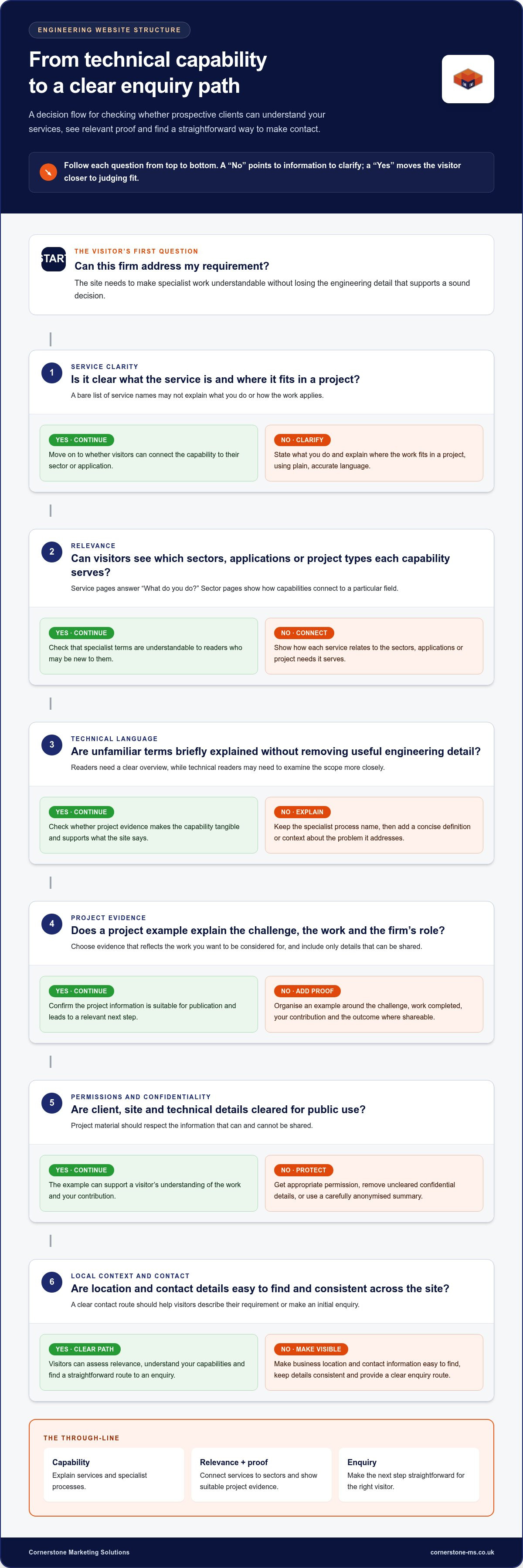
Visitors should be able to distinguish your core services from the specialist processes that support them. Describe each service in plain, accurate language, then show how it applies to a sector, application or type of project. This helps readers connect your technical offer to a real requirement instead of having to interpret a bare list of terms.
- Explain the service: State what you do and where the work fits in a project.
- Show relevance: Identify the sectors, applications or project types each capability serves.
- Clarify technical language: Define unfamiliar terms briefly while retaining the detail a technical reader needs.
- Support the claim: Use suitable project evidence to show the nature of the work and your role in it.
For example, keep a specialist process name prominent, then add a concise explanation of what it involves and the problem it addresses. This layered approach serves readers who need a quick overview and those who want to examine the technical scope. The wider principles of web design also cover how information is presented and how users interact with it, both of which matter when making complex services easier to explore.
How a local website supports trust
For Durham-area prospects, clear business information helps establish whether your firm is relevant to their needs and where it operates. Make your location and contact details easy to find, and keep them consistent across the site. Pair this information with focused service pages and project evidence so visitors can assess your offer without searching through unrelated material.
Project examples can explain the context, engineering challenge, your contribution and the outcome, where those details can be shared. Choose evidence that reflects the work you want to be considered for, and explain specialist terms where needed. A short, clear contact route should help visitors describe their requirement or make an initial enquiry.
A Durham location provides useful context, but it doesn’t guarantee visibility or enquiries on its own. A considered website design for engineering firms Durham connects location, capability and proof so the right visitor can judge relevance and take a sensible next step.
How to structure engineering website design around technical capabilities
Website structure is how information is organised so visitors can understand what you do and choose a relevant next step. For an engineering firm, connect each capability to the sectors and project needs it serves rather than putting every service on one long page. A clear hierarchy gives each subject room for explanation while keeping the site easy to navigate.
Clear page structure reduces the effort visitors need to spend finding, interpreting and acting on relevant information. That principle is useful when planning website design for engineering firms Durham, whether your audience includes technical decision-makers, procurement teams or people assessing your business for the first time.
Present services and technical capabilities clearly
Group related services into logical categories, then give each important capability its own page or a distinct section where the detail warrants it. Use headings that describe the service or application in terms a client might recognise. Explain specialist processes accurately, and introduce unfamiliar terminology with a short definition or context. This makes the information easier to scan without stripping away useful engineering detail.
A service page can explain what a capability involves, where it fits within a project and what information a prospective client might need to discuss their requirement. Sector pages add another layer by showing how relevant capabilities connect to particular industries or applications. Keep the distinction clear: service pages answer “What do you do?” Sector pages answer “How might this apply to my field?”
Use project content to make expertise tangible
Project examples give visitors a practical way to understand the work behind your service descriptions. Organise each example around the challenge, the work completed and the relevant outcome. Explain your firm’s role clearly, and include only details that can be shared. Approved photographs, diagrams or video can clarify a process or finished application when they add information rather than serving as decoration.
Protect client, site and technical information. Get appropriate permission before publishing project material, and remove confidential details that aren’t cleared for public use. If a project cannot be named, a carefully anonymised summary may still explain the type of challenge and your contribution, provided it doesn’t reveal protected information.
Connect every page to a useful next step
Company information should give context to the services: who the firm is, its approach and the people or expertise relevant to the work. Consistent navigation should help visitors move between capabilities, sectors, project examples and contact details without losing their place. Link related pages so someone reading about a project can find the service behind it and a clear route to enquire.
As you plan the site, check that labels are consistent and key pages aren’t isolated. Cornerstone Marketing Solutions designs and builds high-quality, mobile-friendly websites for businesses across the North East. Explore its website design services to see how a mobile-friendly business website can support your online presence.
How to assess an engineering website design against business needs
A general business website can provide a sound starting point, but a standard brochure-style layout may not explain specialist engineering work. The test isn’t whether the site looks polished. It’s whether the structure helps the right visitor understand your capabilities, assess their relevance and take a useful next step.
Compare the site with the questions prospective clients bring. A brochure-style site often gives equal weight to broad company statements and service names. A capability-led site organises information around what visitors need to assess: the work, its application, evidence of relevant experience and how to discuss a requirement. For website design for engineering firms Durham, this distinction connects the website to business priorities instead of treating appearance as the only measure of quality.
Does the site make specialist work easy to follow?
Choose a key service page and read it as a prospective client unfamiliar with your internal terminology. Can you identify what the firm does, the type of requirement it addresses and the sectors or applications it relates to? Then check whether supporting information is easy to find, rather than buried in generic company copy or scattered across unrelated pages.
Look for gaps that force visitors to guess. Unexplained jargon may leave non-specialists unsure what a service means; vague claims such as “complete engineering solutions” don’t show which capabilities are involved. Repeated descriptions across several pages can also obscure what makes each service or application distinct. Headings should guide scanning, while the text beneath them should add specific context rather than restating the heading.
Does the website support the next business conversation?
Review the site on a mobile device as well as a desktop. Check that paragraphs remain comfortable to read, navigation is straightforward and contact details are easy to find on pages where a visitor might decide to enquire. The contact route should make the next action clear, whether that means describing a project requirement or starting a general conversation.
Assess evidence alongside the claims it supports. Does a project example explain the firm’s role and the work involved, or does it rely on a striking image without enough context? Make sure published material is approved and doesn’t expose confidential client, site or technical details. A relevant example with clear context can be more useful than a large collection of images that gives visitors little insight into the capability.
- Clarity: Can visitors explain the firm’s key capabilities after reading the relevant pages?
- Relevance: Can they find information about sectors, applications or projects that match their needs?
- Evidence: Do examples support claims and provide enough context to assess the work?
- Action: Can visitors locate a clear enquiry route on desktop and mobile?
Use these checks to identify whether your site needs clearer content, a different page structure or a more visible contact route. For a broader regional perspective on planning a website, explore this Web Design North East guide.
Plan a Durham engineering website project with a practical content checklist
A clear project brief gives your website a purpose before pages are drafted or visuals selected. For website design for engineering firms Durham, agree what the site needs to achieve, who it must serve and what visitors should be able to do. A focused plan helps your team prioritise useful information instead of giving every service and message equal space.
Work through these steps in order:
- Define the goals. Identify the business priorities the website should support, such as explaining a key capability or making it easier for prospective clients to enquire.
- Prioritise audiences. Consider who needs to use the site, including the types of clients, sectors or decision-makers you want to reach. Note what each audience needs to understand.
- Gather the content. Collect accurate service descriptions, approved project summaries, brand assets and suitable visual material before drafting pages.
- Agree the enquiry journey. Decide what action visitors should take after reading key pages, and make sure the route to that action is clear.
Build a useful website brief
Keep the brief practical. List the services that matter most to your business, the sectors or applications you want to address, and the priorities the website should support. Then identify the essential pages and the information each needs. A priority service may need a detailed page, while supporting information can sit in a shorter section. This gives the project a clear scope and prevents the content from becoming a collection of equally weighted messages.
For each key page, write down what the intended visitor should understand and what they should be able to do next. An enquiry route might invite a visitor to describe a project need or start a conversation. Match the action to the page’s purpose instead of using a generic prompt detached from the content.
Prepare content and visual material
Collect source material before writing begins, then arrange a review process with the people responsible for technical accuracy and approvals. A useful working checklist includes:
- Current descriptions of services, processes and relevant applications
- Project summaries that explain the challenge, work completed and approved outcome
- Photographs, diagrams or video that clarify the work and are approved for website use
- Brand assets and business information needed for a consistent presentation
- Named reviewers for technical content, permissions and internal sign-off
Confirm permissions for project details and visual material before publication. Where information is sensitive, agree what can be shared and how the example should be presented. This keeps the content useful while respecting client and site confidentiality.
Planning continues after launch. Clear, relevant pages provide a sound basis for improving how prospective clients find your business online; the local SEO services guide offers broader context on regional visibility. To put your brief into action, discuss a mobile-friendly website project with Cornerstone Marketing Solutions.
How Cornerstone approaches website design for engineering firms in Durham
Turning technical expertise into clear website content takes more than an attractive layout. The pages, explanations and supporting material need to reflect what your firm wants to communicate and help prospective clients understand where your capabilities may fit. Cornerstone Marketing Solutions is a Stockton-on-Tees-based agency serving businesses across the North East, including Durham firms planning a new website or redesign.
Cornerstone’s web design service builds high-quality, mobile-friendly websites. This gives engineering firms a practical foundation for presenting services and project information to visitors using different devices. The site’s structure and content work together, so the design supports the business message rather than competing with it.
A clear, mobile-friendly website built around the business
Cornerstone builds each website around the firm’s audience, content and business goals. Start by identifying which services need priority, what visitors should learn from the relevant pages and what action they should be able to take. A firm focused on a particular capability may need that information to be easy to find, while another may want to foreground its sectors or project experience.
Technical requirements should follow the project rather than assumptions about what every engineering business needs. A useful brief guides decisions about page structure, content and the enquiry route, while allowing for the specific needs of the firm and its visitors. For website design for engineering firms Durham, this keeps the website grounded in business priorities and helps ensure the finished presentation communicates the offer clearly.
Cornerstone also brings in-house content creation talent to website projects. Clear writing can explain specialist work in accessible language while preserving the technical terms and detail that matter to informed readers. Considering content and design together gives each page a consistent purpose and helps visitors follow the information.
Bring website content into the wider online presence
Visual content can add useful context when it shows a process, environment or finished work more clearly than text alone. Cornerstone’s video content includes professional 4K video footage and high-definition images. For an engineering firm, suitable material can bring approved project information to life when it supports the message and is cleared for use.
Before selecting content, identify what each item should help a visitor understand. A photograph may establish the scale or setting of work; video may demonstrate a process; a written project summary can explain the challenge and the firm’s contribution. Choose material that serves a clear purpose and meets the project’s permissions and confidentiality requirements.
If your Durham business is ready to turn its priorities into a practical website brief, discuss a website project with Cornerstone Marketing Solutions.
Put your next website step into motion
Your website can become a practical business tool when its content reflects what you want prospective clients to understand and how you want them to get in touch. A clear brief gives that work direction: identify the audiences and priorities that matter, then build a site that supports them. That’s the foundation of effective website design for engineering firms Durham.
Cornerstone Marketing Solutions builds high-quality, mobile-friendly websites and has in-house talent for content creation. GS Hydro is displayed among the agency’s client logos, providing context without implying a particular project or engineering specialism.
Ready to explore a website shaped around your firm’s needs? Discuss your website project with Cornerstone and take the next step towards a clear, considered online presence.
Frequently Asked Questions
How much does website design for an engineering firm in Durham cost?
Website design for engineering firms in Durham has no single standard cost; the project scope, page types and content requirements affect what’s involved. Before planning, list the site’s business goals, priority audiences and capabilities that need dedicated attention. Note whether existing copy and visuals can be used or need creating. This gives Cornerstone a clear basis for tailoring website design to your business.
What should an engineering firm’s website include?
An engineering firm’s website should make its offer and relevance easy to assess. Alongside service and sector information, include details that help a prospective client decide whether to proceed, such as the types of projects you take on and the information you’ll need to discuss a requirement. Keep essential business details current. Prioritise pages based on your business goals so visitors can find what matters without working through every part of the site.
Can a website explain complex engineering services to non-specialists?
Yes. Start with a plain-language explanation of what a service does, then add the technical detail that supports informed evaluation. For example, introduce a specialist process by describing the problem it addresses before explaining the method. Define unfamiliar terms where they appear rather than assuming every reader shares the same technical background. This helps non-specialists follow the purpose while allowing engineers to find the terminology and depth they need.
Why does mobile-friendly web design matter for engineering firms?
Mobile-friendly design matters because a prospective client may look up your firm away from their desk, then return to the site later on a larger screen. Important information should remain readable and navigation straightforward on a phone. Cornerstone’s Web Design service builds high-quality, mobile-friendly websites. When reviewing a site, try common tasks on a mobile device, such as finding a particular service or locating contact details.
How can engineering firms show project work on their website?
Present project work through concise examples that explain the context, your firm’s contribution and why the work may matter to future clients. A summary might describe the requirement and the services delivered without naming a client or disclosing sensitive specifications. Use photographs or diagrams only when they add useful context and are approved for publication. Grouping examples by application can help visitors identify relevant experience without making unsupported claims about similar projects.
How often should an engineering company redesign its website?
There’s no universal timetable for redesigning an engineering website. Review it when the business changes its services or priorities, when key information becomes inaccurate, or when visitors struggle to complete basic tasks. A content update or navigation adjustment may address a specific problem; a broader redesign may make sense if the existing structure no longer reflects the business. Record the issues first so decisions respond to clear needs rather than a desire for a different look alone.
Should an engineering firm include SEO in its website project?
Yes, consider SEO alongside the site’s content and structure so relevant pages can support the searches your prospective clients use. Choose descriptive page subjects, write accurate service information and organise content around genuine audience needs. SEO doesn’t replace clear explanations or a useful enquiry route. Cornerstone offers SEO as a service, and its local SEO guide for North East businesses provides further regional context.