

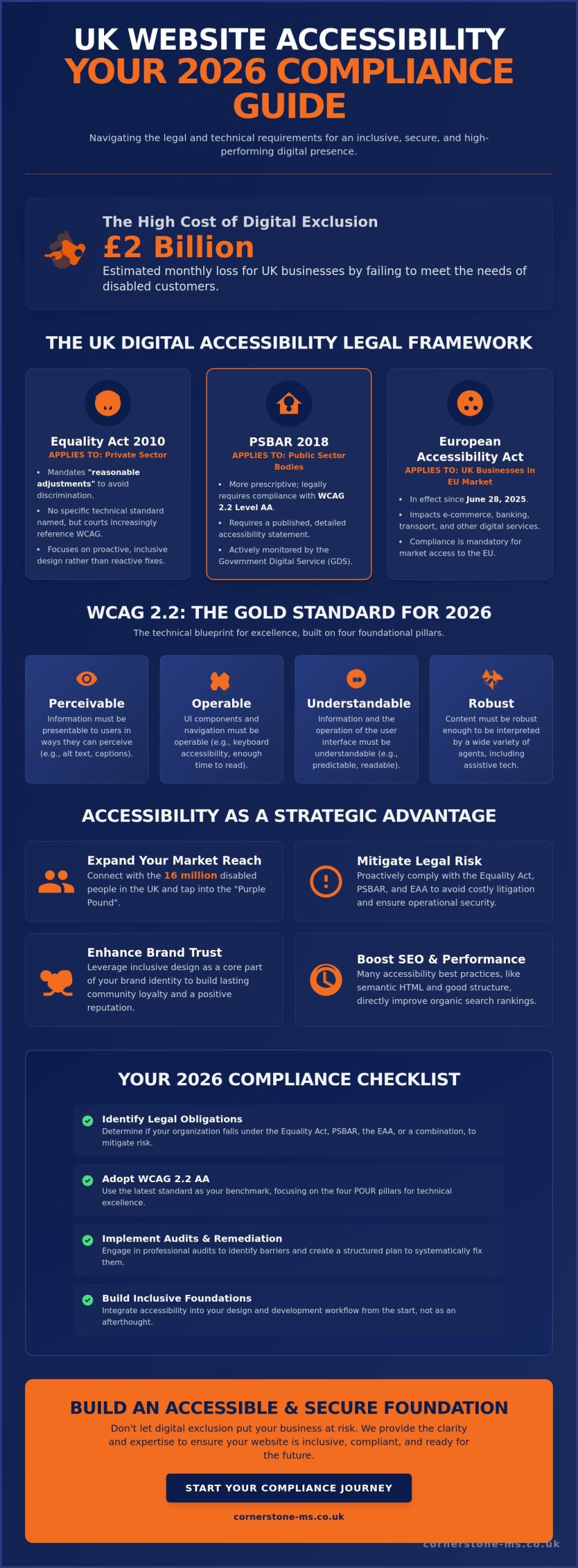
Did you know that UK businesses lose an estimated £2 billion every month simply by failing to meet the needs of disabled customers? It’s a staggering figure that highlights the high cost of digital exclusion. Understanding the website accessibility requirements uk 2026 is no longer just a matter of social responsibility; it’s a fundamental pillar of operational security and market reach. We recognize that the transition to WCAG 2.2 often feels overwhelming, especially when you’re balancing legal obligations with the desire for a high-performing, beautiful website.
You’re right to prioritize this now, as the intersection of the Equality Act and international standards like the European Accessibility Act creates a complex environment for any growing entity. We’ve designed this guide to provide the clarity you need to move forward with confidence, ensuring your digital infrastructure is both inclusive and legally robust. We’ll break down the specific legal mandates, explain the nuances of WCAG 2.2 standards, and provide a practical roadmap to achieve seamless compliance while enhancing your site’s SEO and user experience.
Key Takeaways
- Identify the specific legal obligations under the Equality Act 2010 and PSBAR 2018 to mitigate risk and ensure operational security.
- Adopt WCAG 2.2 as your benchmark for digital excellence, focusing on the four pillars of perceivable, operable, understandable, and robust design.
- Explore how aligning with website accessibility requirements uk 2026 expands your reach to 16 million disabled people while boosting organic search rankings.
- Implement a structured compliance checklist that includes professional audits and systematic remediation of content barriers.
- Leverage inclusive web design as a strategic foundation for your wider branding and marketing efforts to build lasting community trust.
The UK Digital Accessibility Legal Framework in 2026
Understanding the legal landscape is the first step toward building a resilient digital presence. In 2026, the website accessibility requirements uk 2026 are defined by two primary pieces of domestic legislation and an increasingly influential European directive. While the UK has left the European Union, the regulatory ties remain strong for any business operating across borders. We see this framework as a foundation for trust, ensuring that every user, regardless of their physical or cognitive abilities, can access essential services. This isn’t just about avoiding litigation; it’s about building a stable infrastructure for all citizens.
The Equality Act 2010 remains the cornerstone for the private sector. It mandates that service providers make “reasonable adjustments” to ensure they don’t discriminate against disabled people. While the act doesn’t explicitly name technical standards, the legal consensus has shifted. By 2026, failing to meet established benchmarks is often viewed as a failure to make those reasonable adjustments. This shift moves businesses away from reactive fixes toward a model of proactive, inclusive design. We recommend viewing these legal standards as the minimum baseline for service excellence.
Equality Act vs. PSBAR: Which applies to you?
Public sector bodies, including local authorities and most universities, fall under the Public Sector Bodies (Websites and Mobile Applications) Accessibility Regulations 2018 (PSBAR). These rules are more prescriptive than the Equality Act. They require organizations to publish an accessibility statement and meet the WCAG 2.2 AA standard. The Government Digital Service (GDS) monitors these sites actively, and non-compliance can lead to public naming or legal repercussions. It’s vital to recognize that the website accessibility requirements uk 2026 demand a higher level of technical precision for these entities than ever before.
Private businesses, conversely, are governed by the Equality Act. However, the distinction is blurring as supply chains tighten. Many private contractors serving the public sector must now meet PSBAR standards to maintain their contracts. We’ve observed that the most stable businesses apply the higher PSBAR standards across all their digital assets to ensure total coverage and future-proof their operations against shifting legal definitions.
The EAA and UK Private Sector Obligations
The European Accessibility Act (EAA) represents a significant shift for UK companies trading within the EU. Having come into full effect on June 28, 2025, the EAA mandates strict accessibility for specific products and services, including e-commerce, banking services, and transport information. It isn’t just about where your business is based; it’s about where your customers reside. If you offer digital services to the EU market, you are within the scope of this law.
UK exporters must now ensure their digital interfaces meet these harmonized EU standards to avoid market exclusion or fines. For UK businesses selling services in the EU in 2026, compliance with the EAA is a mandatory prerequisite for market access. This “ripple effect” means that even if you aren’t a public body, your global trade ambitions may dictate your technical requirements. Using a comprehensive UK Digital Accessibility Legal Framework as your guide helps you navigate these overlapping mandates with precision and care. We believe this integrated approach is the only way to ensure long-term operational security in a globalized digital economy.
WCAG 2.2: The Gold Standard for 2026 Compliance
While many organisations still reference WCAG 2.1, the technical landscape for website accessibility requirements uk 2026 is firmly rooted in the 2.2 update. Published as an official recommendation on October 5, 2023, WCAG 2.2 introduces nine additional success criteria that address specific barriers for mobile users, people with cognitive disabilities, and those with low vision. We view these standards not as a hurdle, but as a blueprint for technical excellence. By adhering to the four pillars of accessibility, perceivable, operable, understandable, and robust (POUR), we ensure that your digital infrastructure serves every citizen with equal efficiency.
Level AA remains the mandatory benchmark for UK public sector bodies and the recommended target for private enterprises. It provides a balanced level of inclusivity that is technically achievable for most commercial platforms. Aligning with these standards strengthens The Business Case for Accessibility, allowing you to tap into the “Purple Pound” which represents up to £446 billion in annual spending power. We believe that technical precision in these areas is the most reliable way to build institutional trust.
Key Updates in WCAG 2.2 for Modern Websites
The 2.2 update places a heavy emphasis on the mobile experience. One critical change is the requirement for larger touch targets. This ensures that users with motor impairments can interact with buttons and links without accidental clicks. Another vital update involves “Accessible Authentication.” This criterion removes cognitive hurdles, such as remembering complex passwords or solving puzzles, by allowing for password managers or biometric logins. We integrate these features into our web design processes to ensure your site is functional for the 16 million disabled people living in the UK today. Consistent help mechanisms and redundant entry fields for complex forms also help reduce the cognitive load, making the user journey more predictable and secure.
Achieving and Maintaining Level AA
Technical compliance requires a deep dive into your site’s underlying code. We focus on screen reader compatibility, ensuring that every image has descriptive alt-text and that the page structure follows a logical heading hierarchy. Color contrast ratios must meet a minimum of 4.5:1 for standard text to ensure readability for those with visual impairments. Additionally, users must be able to resize text up to 200% without losing any site functionality or content. While Level AAA offers the highest degree of inclusivity, it is often treated as an aspirational goal rather than a legal necessity because many of its criteria are not technically feasible for all types of content. By focusing on a robust Level AA implementation, you meet the website accessibility requirements uk 2026 while maintaining a high-performance digital environment.
The Business Case: Accessibility as a Strategic Advantage
Viewing website accessibility requirements uk 2026 as a mere legal hurdle overlooks a massive commercial opportunity. There are approximately 16 million disabled people in the UK, representing 1 in 4 of the population. This demographic, along with their households, possesses an annual spending power estimated between £274 billion and £446 billion. When your digital infrastructure excludes these users, you aren’t just failing a compliance test; you’re actively turning away a significant portion of the market. Research indicates that UK businesses lose roughly £2 billion every month by ignoring the needs of disabled customers. We believe that inclusive design is the most effective way to capture this “Purple Pound” and secure long-term growth.
The benefits of accessibility extend far beyond a single demographic. Features designed for accessibility, such as clear navigation, high-contrast text, and logical layouts, improve the user experience (UX) for every visitor. A site that’s easy to use for a person with a visual impairment is also easier to use for a customer browsing on a mobile device in bright sunlight or someone in a hurry. This universal usability reduces bounce rates and encourages deeper engagement with your brand. By prioritizing these standards, we help you build a digital foundation that projects professional reliability and a genuine commitment to community well-being.
Accessibility and Local SEO Synergy
Search engines and screen readers share a common goal: understanding the content of a webpage. When you implement clear heading structures and descriptive alt text for images, you’re providing search engines with the context they need to index your site accurately. This technical precision is a core component of our local SEO services. Clean, semantic code doesn’t just help with accessibility; it also improves site speed and mobile performance. These are critical ranking signals that help your business stand out in a crowded local market. A well-structured site is a searchable site.
Protecting Your Reputation in the North East
For businesses in Teesside, Newcastle, and the wider North East, reputation is everything. We operate in a region where word-of-mouth and community trust are vital for success. Adopting the website accessibility requirements uk 2026 proactively protects your brand from the growing “demand letter” culture and potential discrimination claims. Beyond legal safety, inclusive design signals that your firm values every client. This ethical approach builds institutional trust, positioning your business as a dependable partner that takes its social responsibilities seriously. We help you demonstrate that your digital doors are open to everyone.
2026 Compliance Checklist for UK Websites
Achieving full digital inclusivity requires a methodical transition from assessment to action. We approach the website accessibility requirements uk 2026 with a commitment to thoroughness, ensuring that no technical barrier prevents a user from completing their journey. This checklist provides a structured path for businesses seeking to solidify their digital infrastructure and meet their ethical responsibilities. By following these steps, you move beyond simple compliance toward a model of operational excellence that respects every visitor’s needs.
Step 1: The Technical and Manual Audit
Many organisations rely solely on automated scanning software, yet these tools typically identify only 30% to 40% of existing accessibility barriers. A truly robust audit requires manual intervention to catch the nuances of user experience. We use screen readers and keyboard-only navigation to replicate the actual experience of users with visual or motor impairments. This dual-layered approach uncovers “low hanging fruit” that automated systems often overlook, such as:
- Missing or descriptive form labels that confuse screen reader users.
- Inadequate alt text that fails to convey the context of essential images.
- Keyboard focus indicators that aren’t visible, making navigation impossible for some.
- Logical heading hierarchies that are broken or inconsistent.
Step 2: Remediation and Content Strategy
Once we identify the barriers, we prioritise remediation based on the user’s critical path. Barriers in the checkout process or contact forms receive immediate attention, as these directly impact your commercial outcomes and user satisfaction. It’s equally important to train your internal teams on accessible content production, such as providing video captions and using clear, descriptive language. Ensuring your web design North East foundation is inclusive from the start prevents costly retrofitting later. We believe that accessibility should be a core component of your ongoing digital maintenance, ensuring your site remains stable as you add new content.
Step 3: The Accessibility Statement
For public sector bodies, publishing an Accessibility Statement is a legal mandate under PSBAR. Private sector businesses should adopt this practice to demonstrate transparency and provide clear contact methods for users who encounter difficulties. This statement should outline what you’ve achieved, any known issues, and your plan for future improvements. In 2026, websites must include a prominent and easily accessible “Accessibility Feedback” link to allow users to report barriers directly to your team. This loop ensures your site remains dynamic and responsive to the needs of the 16 million disabled people in the UK. If you’re ready to secure your digital future, we can help you implement a professional accessibility audit and remediation strategy.
Building Accessible Foundations with Cornerstone
We position ourselves as a dependable partner in a demanding industry, providing the essential infrastructure your business needs to thrive. Meeting the website accessibility requirements uk 2026 requires a disciplined approach that we’ve refined through years of technical expertise. We don’t treat accessibility as a secondary concern or a simple tick-box exercise. Inclusive design is woven into the very fabric of your site’s architecture to ensure your digital doors remain open to all. Our team ensures that your website is built on a stable, inclusive foundation that protects your reputation and secures your market position.
Our methodology focuses on the long-term collaboration needed to maintain high standards. We understand that regulatory adherence is a continuous process rather than a one-off project. By integrating accessibility into your broader digital strategy, we help you build a presence that is both technically proficient and socially conscientious. We take responsibility for the technical precision of your site, allowing you to focus on delivering value to your customers. This grounded, human-centric approach is what sets us apart as a reliable presence in the North East business community.
Custom Web Design with Accessibility at the Core
Generic templates often promise compliance but frequently fall short when subjected to professional manual testing. We move beyond these limited solutions to provide bespoke web design that reflects your unique brand identity. Custom solutions allow us to balance sophisticated aesthetics with the rigorous demands of WCAG 2.2, ensuring that your site is as beautiful as it is functional. Every user deserves a high-end experience regardless of their physical or cognitive abilities. This commitment to quality workmanship helps Stockton and Newcastle firms build lasting trust with their end-users while meeting the website accessibility requirements uk 2026 with total confidence.
Ready to Audit Your Website?
A professional accessibility audit is the first step toward a more inclusive and legally robust digital future. We provide a clear, logical roadmap to compliance, identifying specific barriers and offering verified solutions that enhance your site’s performance. Our audits go beyond automated scans to include the rigorous manual testing necessary for true inclusivity. We’re ready to help you navigate these operational requirements with the care and expertise your business deserves. Ensure your business is compliant—get an accessibility audit from Cornerstone today.
Securing Your Digital Future with Inclusive Design
The transition toward digital inclusion represents a shift from reactive compliance to a model of continuous service excellence. By proactively addressing the website accessibility requirements uk 2026, you safeguard your brand against legal challenges while engaging a market of 16 million people. We’ve seen that adopting WCAG 2.2 isn’t just a technical necessity; it’s a strategic advantage that strengthens your SEO and enhances the user journey for everyone. Building this stable, ethical infrastructure is a cornerstone of professional reliability and institutional trust.
We stand ready to act as your seasoned partner in this complex regulatory environment. Our team at the award-winning Cornerstone Group brings deep expertise in WCAG 2.2 compliance and a proven track record in North East web development. We’re committed to ensuring your digital foundations are both robust and inclusive, reflecting a genuine commitment to community well-being. Contact Cornerstone for a 2026 Website Accessibility Audit to verify your compliance and prepare your business for long-term growth. We’re here to help you turn these requirements into a verified solution for your customers.
Frequently Asked Questions
Is website accessibility a legal requirement for UK private companies in 2026?
Yes, website accessibility is a legal requirement for all UK private companies under the Equality Act 2010. This legislation mandates that businesses make reasonable adjustments to ensure their services are accessible to disabled people. While the act is not prescriptive about technical standards, following the website accessibility requirements uk 2026, specifically WCAG 2.2 Level AA, is the industry standard method for demonstrating compliance and avoiding discrimination claims.
What is the difference between WCAG 2.1 and WCAG 2.2?
WCAG 2.2 is the current official recommendation and builds upon the foundations of 2.1 by adding nine new success criteria. These updates primarily address barriers for mobile users, individuals with low vision, and those with cognitive disabilities. Key changes include improved touch target sizes and the removal of complex authentication hurdles. We ensure your digital infrastructure stays robust by targeting these latest standards rather than outdated versions.
Do small businesses in the North East need to follow these rules?
Every business in the North East must adhere to these regulations regardless of their size. The Equality Act 2010 does not provide exemptions based on company headcount or turnover. Since 16 million people in the UK live with a disability, ignoring these standards means excluding 25% of your potential local audience. We help small firms in Teesside and Newcastle build inclusive foundations that project professional reliability and care.
How does the European Accessibility Act affect UK-based websites?
The European Accessibility Act (EAA) mandates that any UK business selling specific digital products or services within the EU must meet strict accessibility standards. This includes e-commerce platforms, banking services, and transport information providers. If your website serves customers in the EU market, you are legally bound by these requirements regardless of your UK location. It’s a critical factor for any company with international trade ambitions in 2026.
Can I use an accessibility overlay or plugin to become compliant?
No, automated accessibility overlays or plugins are generally considered an insufficient substitute for building accessibility into your site’s core code. These tools often fail to fix underlying structural issues and can even interfere with screen readers. A genuine commitment to the website accessibility requirements uk 2026 involves a thorough technical audit and manual remediation. We focus on creating a seamless, integrated experience that works for every user from the ground up.
What happens if my website is not accessible in 2026?
Failing to maintain an accessible website in 2026 leaves your business vulnerable to discrimination claims and significant financial loss. UK businesses lose an estimated £2 billion every month by failing to meet the needs of disabled shoppers. Beyond legal risks, an inaccessible site damages your reputation and alienates a large portion of the community. We provide the technical expertise needed to mitigate these risks through stable and secure digital infrastructure.
How often should I audit my website for accessibility?
We recommend conducting a professional accessibility audit at least once a year or whenever you implement significant site changes. Digital accessibility is not a one-off project; it requires ongoing monitoring to ensure new content or features don’t introduce barriers. Regular reviews allow you to maintain Level AA compliance and stay ahead of evolving technical standards. This methodical approach ensures your digital services remain reliable and inclusive for the long term.
Does accessibility help with Google search rankings?
Yes, accessibility and SEO share a strong technical synergy that improves your visibility on Google. Search engines reward sites that use clear heading structures, descriptive alt text, and logical navigation, as these signals help them index content more effectively. High-quality user experience and clean code also lead to lower bounce rates and higher engagement. We integrate these accessibility principles into our SEO strategies to build a high-performing digital foundation.