

What if the agency closest to you isn’t automatically the right choice? Searching for “seo near me” can help you find local options, but proximity alone won’t improve your visibility or bring in meaningful enquiries. Look for a partner who understands your market, explains the work clearly and measures progress against business goals, not just ranking positions.
Before choosing an SEO agency, it’s reasonable to ask what it will do, why that work matters and how you’ll review progress. Local SEO can include technical improvements, relevant keyword targeting and backlink building, alongside accurate business information and useful local content. The right approach is tailored to your business and service area, not a one-off promise of a top spot.
This guide explains what local SEO involves and how to compare nearby agencies using practical criteria, from regional knowledge to reporting. You’ll also learn what to expect from an ongoing partnership. Cornerstone Marketing Solutions is based in Stockton-on-Tees and works with businesses across Tees Valley and the wider North East, bringing local context to data-guided SEO.
Key Takeaways
- A “seo near me” search can help you find local agencies, but proximity alone doesn’t demonstrate SEO expertise.
- Assess an agency by how clearly it explains its process, understands your market and reports progress towards meaningful business goals.
- Local visibility depends on a coherent presence, including accurate business information, relevant website content and a credible reputation.
- A dependable SEO engagement typically moves from discovery and audit to prioritised work, implementation, measurement and regular review.
- Cornerstone Marketing Solutions brings regional context to ongoing, data-guided SEO for businesses across Tees Valley and the wider North East.
SEO near me? How local SEO helps your business
Local SEO improves a business’s visibility in search results when people look for relevant services in a particular area. General SEO supports visibility across a broader range of searches; local SEO adds a focus on where a business serves customers and which local needs it meets. A search for seo near me signals local intent, but doesn’t mean the searcher automatically prefers the closest office. Relevance, service coverage and useful business information matter too.
Search pages can show unpaid local organic results and map-based business listings alongside paid search placements. These are different forms of visibility: paid placements are advertising, while local SEO focuses on earning relevant visibility in unpaid results. You can improve the business information and website content you control, but search engines decide which results appear for each search. For a neutral introduction to the topic, see What is Local SEO?
What does SEO near me mean for a local business?
Imagine someone in Stockton-on-Tees searching for “electrician near me” or “accountant in Stockton-on-Tees”. The search context and how relevant a business is to that service and area can shape what they find. Clear, accurate service and location information helps people decide whether a business can meet their needs. Simply adding “Stockton-on-Tees” to a page won’t guarantee local visibility. Explain the service and how it helps customers in that area instead.
For a Teesside business, the right location focus depends on its audience and service area. A company serving several towns should explain that wider coverage, while a business focused on one community may need more specific local information. The aim is to help potential customers identify a genuine fit, not to repeat place names without context.
Local SEO and broader SEO: where they overlap
Both approaches rely on a sound website foundation: useful pages, an accessible structure and ongoing technical health. Local SEO builds on that foundation by making business details, locations and services clear and consistent. Well-organised pages help visitors find what they need, while accurate local context helps search engines interpret who the business serves.
These elements work together, rather than acting as a one-off ranking fix. Cornerstone’s Local SEO Services guide explores how tailored, ongoing work can support businesses across the North East.
How local SEO works: the signals that help customers find nearby businesses
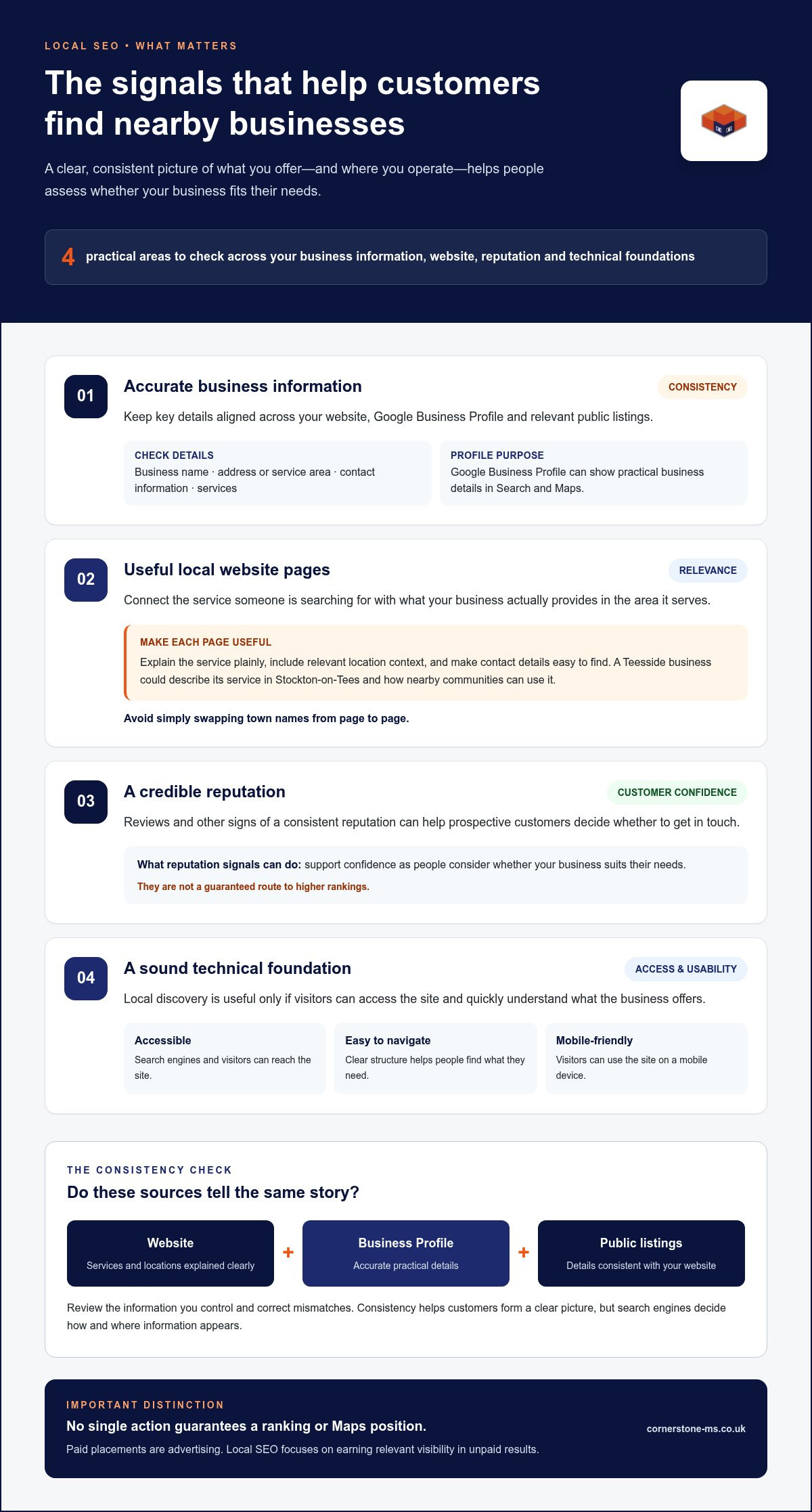
Local discovery works best when a business presents a clear, consistent picture of what it offers and where it operates. Accurate business details, relevant website pages and a credible reputation help potential customers assess whether the business suits their needs. Start by reviewing those details across your website and public listings, then correct any mismatches. Search engines decide how and where that information appears, so no individual action guarantees a particular position.
Consistent, useful business information helps customers feel confident that they’ve found a business suited to their needs.
Business information, service areas and Google Business Profile
Google Business Profile can provide information about a business through Google Search and Google Maps, helping people discover its services and practical details. Keep the profile accurate, and check that key details such as the business name, address or service area, contact information and services align with the website and relevant public listings. This gives customers a consistent picture of the business, though it doesn’t promise a particular place in Maps.
Service-area pages should explain what the business does for customers in each area, not simply swap one town name for another. For example, a Teesside business might describe the service it provides in Stockton-on-Tees and how customers in nearby communities can use it. Include details that are useful to someone considering the service, such as what the business offers and how to take the next step. That helps distinguish genuine local relevance from repetitive place-name targeting.
Website quality, relevant content and local trust
A service page should connect what someone is searching for with what the business actually provides. Explain the service plainly, identify relevant locations where appropriate, and make the next step clear with easy-to-find contact details. Reviews and other signs of a consistent reputation can also help prospective customers decide whether to get in touch. They support confidence, but shouldn’t be treated as a guaranteed route to higher rankings.
Those pages need a solid technical foundation. Search engines and visitors should be able to access the site, move through it easily and use it on a mobile device. Clear navigation and readable content matter because local discovery is only useful if people can quickly understand the offer once they arrive.
For a closer look at how site structure and usability support online visibility, read the Web Design North East guide. Businesses reviewing their local search foundations can also explore Cornerstone’s SEO support as part of a considered, ongoing approach to seo near me.
Must an SEO agency be local? Assessing expertise
Searching for “seo near me” can surface nearby agencies, but an office close to yours isn’t proof of SEO capability. Local proximity may make face-to-face collaboration easier; it doesn’t replace a sound process, relevant expertise or clear communication. A capable partner should explain how its work relates to your business, target area and commercial priorities.
A credible SEO process sets out evidence-led work and measures progress; it doesn’t promise a guaranteed ranking. Ranking positions and website traffic can offer useful context, but they don’t show the full picture on their own. Ask how reporting will connect the work to relevant outcomes, such as enquiries, calls or other actions that matter to your business.
What evidence should you look for in a local SEO partner?
Look for a clear explanation of how research informs technical work, keyword priorities and content recommendations. The agency should show how it will tailor activity to your services and target locations, then report what has been completed and what comes next. Cornerstone Marketing Solutions provides SEO, including ongoing technical improvements, keyword targeting and backlink building, guided by data.
Use the comparison below to distinguish useful detail from vague claims:
- Useful evidence: A clear explanation of planned technical improvements, keyword choices and link-building activity. It answers: What work is being done, and why? Warning sign: A list of tasks with no connection to your objectives.
- Useful evidence: Reporting that shows completed work and progress against relevant measures. It answers: What changed, and what does that mean for the business? Warning sign: Ranking or traffic figures with no context or link to enquiries.
- Useful evidence: Recommendations shaped around your services, customers and service area. It answers: Why are these priorities right for this business? Warning sign: The same generic plan offered regardless of location or market.
Why regional knowledge matters without replacing evidence
Regional understanding can help an agency interpret how people describe services and which areas a business genuinely serves. For a Teesside firm, that may mean distinguishing a Stockton-on-Tees focus from a wider North East service area. This context helps shape research and priorities, but it should support, not replace, technical SEO, data and ongoing measurement. A local office isn’t essential to every successful working relationship; clear communication and relevant expertise matter more than distance alone.
What to expect from an SEO engagement: a practical process and reporting checklist
A clear SEO engagement should make the work understandable from the first conversation through ongoing reviews. The order and pace depend on your website, competition, objectives and available resources. A useful plan sets priorities based on those factors instead of promising a fixed timetable or result.
From initial research to prioritised SEO work
A practical process usually moves through these stages:
- Discovery: Clarify your services, customers, target locations and business objectives.
- Audit: Review the website’s technical condition, existing content and current search visibility.
- Priorities: Use research into audiences, services, locations and competitors to identify the most relevant opportunities and issues to address.
- Implementation: Complete agreed technical improvements and develop relevant keyword, content and backlink activity in line with business goals.
- Measurement: Track completed work and useful indicators of search visibility, website behaviour and enquiries.
- Review: Interpret the findings, discuss what should change and agree the next priorities.
The sequence matters. Technical findings may reveal which pages need attention first, while keyword research can guide content priorities. Backlink activity should support the business’s genuine objectives, not become a disconnected task. Ongoing work gives the plan room to respond to what the data shows.
How to make SEO reporting useful
A report should distinguish between activity and outcomes. Completed work shows what has been delivered; search visibility indicators show how the site is appearing; website behaviour helps explain what visitors do; and enquiry data connects activity to potential business value. Rankings can provide context, but a single position or traffic figure doesn’t explain whether the right people are finding you or taking action.
Look for interpretation, not just charts. A useful update explains what changed, what the information suggests, where there’s uncertainty and what the next step is. Search results can vary, so trends over time are generally more informative than an isolated ranking snapshot. Your agency should explain how its activity supports your objectives without presenting performance as guaranteed.
Use this checklist when reviewing a seo near me engagement:
- Can you see what work was completed and why it mattered?
- Are visibility, site activity and enquiries reported as distinct measures?
- Does the update explain progress in the context of your goals?
- Are the next actions clear, with uncertainties acknowledged?
For a data-guided, ongoing approach to search optimisation, explore Cornerstone’s SEO support.
SEO near me in the North East: how Cornerstone builds a tailored partnership
For businesses searching for an seo near me partner, regional knowledge can make planning more relevant. Cornerstone Marketing Solutions is based in Stockton-on-Tees and works with businesses across Tees Valley and the wider North East. As part of the award-winning Cornerstone Group, Cornerstone combines local context with data-guided SEO work, without treating proximity as a shortcut to search results.
A North East SEO strategy built around your business
SEO priorities should reflect what your business does, who it serves and where it aims to reach customers. A business focused on Stockton-on-Tees may have different needs from one serving customers across Teesside or the wider North East. Understanding those differences helps shape keyword targeting and content around genuine services and audiences.
Cornerstone’s SEO work includes ongoing technical improvements, keyword targeting and backlink building. Each supports a different part of the strategy: technical work addresses how the website is built and functions, keyword targeting aligns pages with relevant searches, and backlink building supports the site’s wider authority. Data helps guide decisions about which priorities to pursue and how to review progress.
The work is tailored, not treated as a one-off ranking fix. Search visibility depends on factors that no agency can fully control, so a dependable partnership focuses on clear priorities, sustained work and reporting that explains what has been done and what comes next. The aim is to support your visibility goals with a structured approach, not to promise a particular position.
Taking the next step with Cornerstone
You don’t need a technical brief to start a useful discussion. Outline your services, the locations you want to reach, the customers you’re trying to connect with and any current challenges, such as limited search visibility or website enquiries that don’t reflect your goals. These details give the conversation a practical starting point.
From there, discuss what you want SEO to support and which priorities may be most relevant to your business. The approach should make the work and its purpose clear, while recognising that the right sequence depends on your website, competition, objectives and available resources.
If you’re considering SEO for your business in Tees Valley or the wider North East, get in touch with Cornerstone Marketing Solutions to discuss your project and objectives. It’s a straightforward way to explore a tailored, ongoing SEO partnership that fits what you’re working towards.
Build a stronger foundation for local search
Choosing an agency for seo near me is about more than finding a nearby office. Look for a clear, tailored process, relevant understanding of your service area and reporting that connects ongoing work to meaningful business goals. Local visibility is supported by accurate business information, useful website content and sustained technical and authority-building activity, but rankings can’t be guaranteed.
Cornerstone Marketing Solutions is based in Stockton-on-Tees and works with businesses across Tees Valley and the wider North East. Its data-guided SEO work includes ongoing technical improvements, keyword targeting and backlink building as part of a tailored programme. Cornerstone is also part of the award-winning Cornerstone Group.
If you’re ready to explore how SEO could support your business objectives, discuss your SEO goals with Cornerstone. Bring your services, target locations and current challenges to start a practical conversation. Get in touch to discuss a data-guided approach to local search for your business.
Frequently Asked Questions
What does SEO near me mean?
“SEO near me” usually describes a search for help improving a business’s visibility in nearby search results. Local SEO aims to connect relevant searches with businesses that serve the area, using clear business information, relevant website pages and a credible online presence. It can support discovery through Google Search and Maps, but typing a town name or “near me” into a page doesn’t guarantee visibility. Search engines decide which businesses appear.
Do I need an SEO agency near my business?
No, your SEO agency doesn’t have to be based nearby. Proximity can make in-person collaboration convenient, but it doesn’t demonstrate expertise or ensure better search visibility. Focus on whether the agency understands your audience and service area, explains its approach clearly and reports progress in a useful way. Regional knowledge can help shape relevant research, while technical work, communication and ongoing measurement remain important wherever the agency is based.
How much does local SEO cost?
Local SEO costs depend on the work your business needs, its website, target locations, competition and objectives. A plan may involve technical improvements, keyword targeting and backlink building, with priorities tailored to the project. Rather than comparing headline figures alone, assess what the proposed work includes, how it will be prioritised and how progress will be reported. A clear proposal should explain the scope and costs for your specific needs.
How long does local SEO take to work?
There isn’t a reliable fixed timeframe for local SEO results. Progress depends on factors such as the website’s current condition, competition, chosen priorities and how consistently the work is implemented. SEO is ongoing, and search engines control how results appear, so a responsible plan won’t guarantee a ranking by a set date. Track completed work and relevant trends over time, including visibility, website activity and enquiries, rather than expecting an instant change.
What should a local SEO agency report on?
A useful report should show what work was completed, what the findings indicate and what happens next. It should distinguish search visibility measures from website behaviour and business enquiries, so you can understand both activity and potential value. Rankings and traffic can provide context, but isolated figures don’t reveal whether the right people are finding you. Look for clear explanations of trends, changes, uncertainties and how the next priorities relate to your objectives.
Can a business rank in nearby towns where it has no office?
A business may appear in searches for nearby towns without having an office in each one, but visibility isn’t guaranteed. Its actual service coverage, the relevance of its pages and the search context can all matter. Make location and service information accurate, and create pages that explain how the business serves customers in each area. Avoid implying you have a local premises where you don’t, or creating thin pages that simply repeat town names.
What is the difference between local SEO and Google Ads?
Local SEO focuses on improving visibility in unpaid search results, including relevant local and map-based results. Google Ads is paid advertising, where businesses pay to run campaigns and eligible adverts may appear in designated placements. They can support different marketing objectives: SEO develops ongoing organic visibility, while Ads provides a paid route to search exposure. Neither guarantees enquiries. Cornerstone Marketing Solutions offers SEO and PPC, with approaches shaped around a business’s goals.