

What if your next customer is searching for exactly what you offer, but finding another business instead? For many Newcastle firms, that gap is frustrating: SEO can sound full of vague promises, while the work behind better visibility is less clear. A practical strategy starts with the search your customers make, including “search engine optimisation Newcastle”, and connects local relevance with measurable improvements to your website.
Start by identifying who you want to reach and where they’re searching. Some businesses need stronger visibility with nearby customers; others need to reach people across the North East or further afield. The right priorities depend on your services, audience and website, not a one-size-fits-all checklist.
This guide explains what effective SEO involves, from technical improvements and on-page content to keyword targeting, backlink building and ongoing, data-led adjustments. You’ll learn how to decide whether local or broader visibility matters most, what to measure beyond rankings, and how a North East-based team can support Newcastle businesses without relying on short-term promises.
Key Takeaways
- SEO helps connect your business with people searching for relevant services, products and locations in Newcastle.
- Assess search engine optimisation newcastle as connected work across your website, content, keywords and links, rather than a single tactic.
- Choose local, wider service-area or informational search priorities based on the customers you want to reach. These approaches can work together.
- Set clear business goals and a baseline, then use Google Search Console and Google Analytics 4 to review relevant indicators and refine priorities.
- Cornerstone Marketing Solutions supports Newcastle businesses from Stockton-on-Tees, with SEO retainers shaped around ongoing, data-led improvements.
Why search engine optimisation matters for Newcastle businesses
Search engine optimisation (SEO) improves a website so search engines can understand its pages and show them to people looking for relevant information, products or services. For a Newcastle business, that might mean helping prospective customers find the right service page when they search locally, or useful information while comparing options across the wider North East. Search engine optimization (SEO) covers a range of methods, but the purpose is practical: make your business easier to find and your pages more useful to the people you want to reach.
For a Newcastle business, SEO is ongoing work to make its website more relevant, useful and discoverable for the searches potential customers make.
Organic search results and paid search ads serve different marketing needs. SEO builds visibility in unpaid results over time, while paid search places adverts for selected searches during a campaign. A business may use either approach or combine them, depending on its objectives, timescales and resources. Neither a ranking position nor a particular volume of enquiries can be guaranteed. Measure useful progress against business outcomes, not rankings alone.
What does SEO help a Newcastle business achieve?
Relevant pages can connect your business with people researching what you offer. A page explaining a service in Newcastle may address a location-led search, while a detailed page about a specialist service across the North East can support a broader search. Each page should answer visitors’ real questions, explain what the business does and make the next step clear.
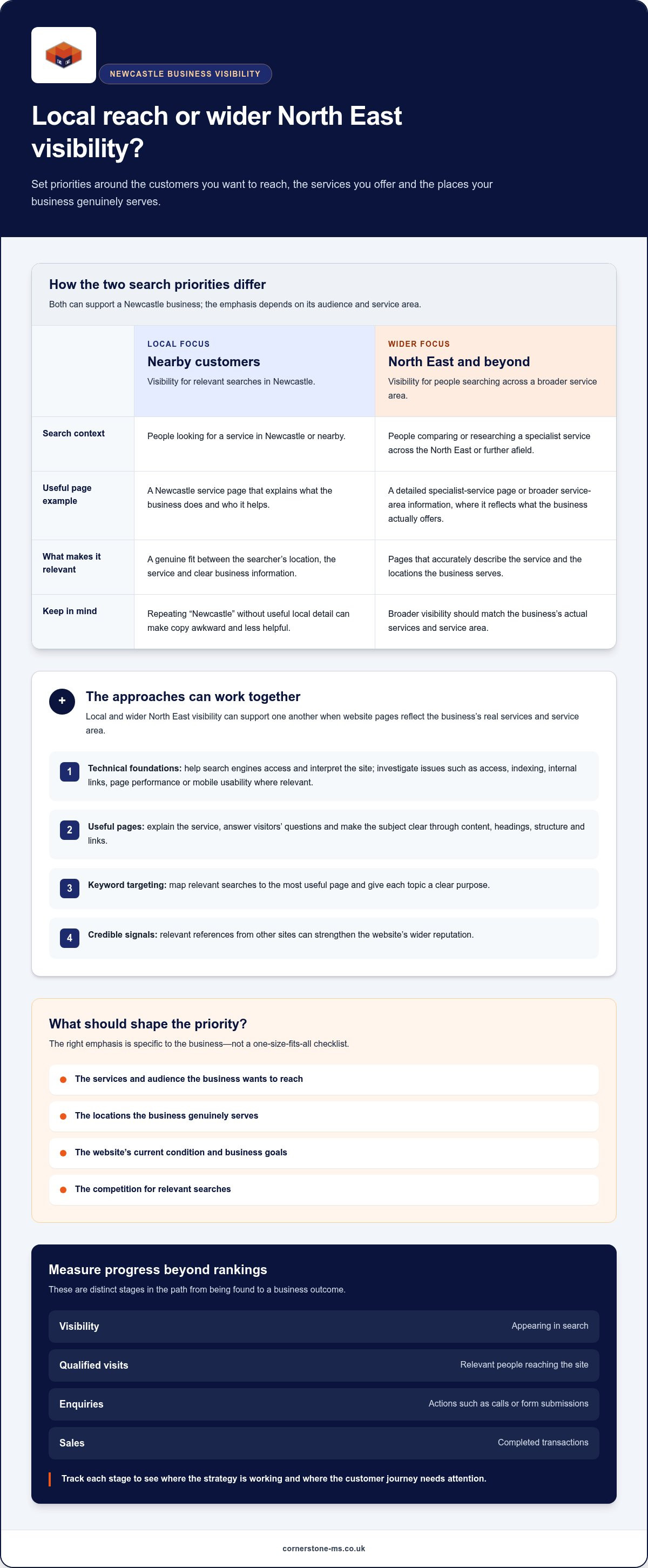
Visibility, qualified visits, enquiries and sales are connected but distinct. Visibility means appearing in search; qualified visits are relevant people reaching your site; enquiries are actions such as calls or form submissions; and sales are completed transactions. Tracking each stage helps show where a strategy is working and where the customer journey needs attention.
Why local relevance is more than adding Newcastle to a page
Local context comes from the fit between a searcher’s location, the service offered and clear, consistent business information. A page should explain the service, who it helps and where it is relevant. Repeating “Newcastle” without adding useful detail can make copy awkward and less helpful. Strong local content gives people a genuine reason to trust that the page addresses their needs.
Local and wider North East visibility can support one another when website pages reflect the business’s actual services and service area. Keep information consistent across your website and business profiles so people can recognise and understand the business. For a practical look at local search priorities, explore this local SEO services guide.
What effective search engine optimisation in Newcastle includes
Effective SEO is a coordinated programme, not a checklist of disconnected fixes. Technical foundations help search engines access and interpret a site; relevant pages give visitors useful answers; keyword targeting guides which searches those pages should serve; and backlink building can strengthen the site’s wider reputation. The right emphasis depends on the website’s current condition, competition, business goals and the locations it genuinely serves.
A joined-up SEO strategy combines a technically sound website with relevant content and credible signals that help search engines and customers understand the business.
Technical SEO and on-page improvements
Technical SEO covers the conditions that help search engines access, read and organise website pages. Depending on the site, work might involve resolving access or indexing problems, improving internal links, or addressing page performance and mobile usability. These are areas to investigate, not fixes every website automatically needs. A review should identify the obstacles that matter for that particular site.
On-page work focuses on what each page communicates. Its content, headings, structure and links should make the subject clear and help visitors find the information they need. Search intent means the purpose behind a search: someone comparing services needs different detail from someone seeking a straightforward answer. Matching the page to that purpose makes it more useful and gives the site a clearer structure.
Web design provides a foundation for this work. A clear, well-organised site can support both visitor experience and search visibility. The Web Design North East guide explores how website foundations can support a business’s wider digital presence.
Keyword targeting and backlink building
Keyword research identifies the words and phrases people use when looking for services, products or information. Map those searches to the most useful page rather than forcing every phrase onto one page. For example, a Newcastle-based business serving customers across the North East may need distinct pages for a core service and broader service-area information, provided each page reflects what the business actually offers.
Good targeting also prevents overlap. If several pages compete to answer the same query, it may be unclear which one best serves the visitor. A clear page plan gives each topic a purpose, connects related information and makes it easier to improve content over time.
Backlink building means developing relevant references to a website from other sites. These links can help search engines understand how a site connects to its wider subject area, but quantity alone is not a sound measure of quality. Links should make sense in context and support a credible online presence, without promises of a particular volume or ranking result.
These workstreams reinforce one another: targeted pages need a sound technical structure, and external references are more useful when they point to relevant, well-organised content. Cornerstone’s SEO approach brings these activities together through ongoing, data-led work tailored to each business.
Local SEO or broader SEO: which fits your Newcastle business?
The right search focus depends on where customers are, how your service is delivered and what the business needs to achieve. A company serving customers at a Newcastle location may prioritise nearby searches, while a specialist working across the North East may need visibility beyond the city. Informational content can support both by answering questions people have before they’re ready to enquire. These priorities can work together.
Location-led searches: Searches that name Newcastle or a nearby area. Prioritise clear local service information and accurate business details when customers need a provider in a particular place.
Wider service-area searches: Searches for services available across the North East. Explain genuine coverage and how the service is delivered, without implying the business has an office in every location.
Informational searches: Searches for guidance, comparisons or answers. Create useful content that introduces your expertise and helps people understand their options before they’re ready to contact a business.
When Newcastle-focused SEO should take priority
Give local SEO more emphasis if customers actively look for your service in Newcastle or nearby areas and your business can serve them there. Locally relevant pages should address real differences in customer needs, service delivery or useful area information. Simply duplicating a page and swapping in a different place name adds little value and can make the site harder to use.
A complete, accurate Google Business Profile can also contribute to local search context. Keep its information aligned with your website, and describe your services and locations clearly. A profile is one part of local visibility, not a promise of a particular position in search results. Effective search engine optimisation newcastle should reflect how the business serves local customers, not just the city name it wants to rank for.
When a wider North East strategy makes sense
A broader approach can suit businesses whose customers come from Newcastle, Tees Valley and other parts of the North East. Build service pages around the work offered and the areas genuinely covered. Make clear how customers access the service, whether it is delivered at their premises, remotely or through another appropriate arrangement. Geographic reach does not require a physical office in every town.
Informational content can extend that strategy. A useful guide answering a common question may reach people before they begin comparing providers, while a focused service page can support those closer to making an enquiry. Together, these pages serve different stages of a customer’s research and give the business a coherent presence across relevant searches.
Set priorities by looking at customer geography, service capacity and business objectives. A local emphasis may suit a location-dependent service; wider coverage may matter more when delivery spans the region. Search results can change, and neither approach guarantees rankings, enquiries or a fixed return. Review what attracts relevant visitors and supports business goals, then adjust the balance as evidence develops.
How to assess SEO progress and choose the next practical step
SEO progress is easier to judge when you connect search activity to a clear business purpose. A higher position can be encouraging, but it doesn’t show on its own whether the right people are visiting or taking useful action. SEO reports should connect search data with business goals so you can see whether greater visibility is helping the business move towards meaningful outcomes.
- Define the business goal. Decide what organic search should support, such as relevant service enquiries, product sales or visits to a particular location. The goal shapes which pages and actions matter.
- Establish a baseline. Record the current state before work begins. Note which queries and pages already attract visibility, how visitors reach key pages, and what enquiry or sales activity comes from organic search.
- Track relevant indicators. Review search visibility, website behaviour and business actions together. Google Search Console shows how a site performs in Google Search, including queries, impressions, clicks and indexed-page information. Google Analytics 4 helps analyse what visitors do after arriving, including engagement with landing pages and recorded conversions when these are configured.
- Refine priorities. Use the evidence to decide what to improve next. A page with search visibility but few clicks may need a clearer result listing; a page that attracts visits but few enquiries may need more useful information or a clearer next step.
Impressions and clicks describe search exposure and visits from search results. They are not the same as enquiries, conversions or commercial outcomes. A conversion is a defined action, such as submitting an enquiry form, and its value depends on the business’s customer journey. Look at how these stages connect rather than treating one metric as proof of success.
Which SEO indicators are useful to review?
Choose indicators that reflect your objectives. Relevant query visibility can show whether the site appears for useful searches. Organic visits show whether people arrive from unpaid search, while landing-page engagement can indicate whether they find the page relevant. Enquiry activity helps connect that visit to a business action. For a longer sales process, a first visit may support research without producing an immediate enquiry, so interpret metrics in context.
Review trends over a suitable period and compare like with like. Search results can fluctuate, and a short-term change or one ranking position rarely tells the full story. Check whether changes affect the pages, searches and actions tied to your goals before shifting the whole plan.
Questions that clarify a credible SEO plan
A clear plan should explain which priorities come first, what work is planned and how progress will be reported. Ask how technical improvements or content changes connect to a specific business goal, and what evidence will inform the next adjustment. This helps distinguish purposeful activity from a list of tasks without a clear outcome.
If you’re ready to assess your current priorities, discuss an SEO approach with Cornerstone. Its ongoing, data-led work helps businesses across Newcastle and the wider North East review technical improvements, on-page work, keyword targeting and backlink building.
How Cornerstone supports search engine optimisation in Newcastle
Cornerstone Marketing Solutions is based in Stockton-on-Tees and supports businesses across Tees Valley and the wider North East, including Newcastle. Its regional perspective helps shape SEO around the customers a business wants to reach, the services it provides and the areas it genuinely serves. The aim is a tailored programme of ongoing work, not a promise of a particular ranking.
For businesses exploring search engine optimisation newcastle, the starting point is understanding the website’s current position and the business priorities behind greater visibility. A local service business may need to strengthen key service pages, while a company serving several North East locations may need a wider content and keyword plan. The work should reflect those differences.
A North East partner for Newcastle businesses
Cornerstone is based in Stockton-on-Tees and serves businesses across the wider North East, including Newcastle. As part of the award-winning Cornerstone Group, Cornerstone Marketing Solutions takes a considered approach to understanding each business and communicating the work clearly. Priorities are shaped by business goals and target customers, rather than a standard package of identical tasks.
Ongoing SEO work, shaped around your website
Cornerstone’s SEO retainers bring several connected areas of work together. Technical improvements address website foundations; on-page work improves the relevance and usefulness of key pages; keyword targeting connects those pages with appropriate searches; and backlink building develops relevant external references. Data-led adjustments help inform what to prioritise as the work progresses.
These activities are more effective as a coordinated approach than as isolated tactics. Keyword research can identify a page opportunity, for example, but the page still needs useful content and a sound technical foundation. Review and adjustment help keep the strategy aligned with business objectives and the searches that matter to its customers. The scope and emphasis can be tailored to the website, target locations and commercial priorities.
A coherent online presence also depends on how the website presents the business. Cornerstone’s web design expertise is relevant when site structure or usability needs attention; branding and creative services can support a consistent presentation when they fit the project. These elements complement SEO, but don’t replace the technical, on-page, keyword and backlink work that supports organic visibility.
Start a conversation about your SEO priorities
Make an initial discussion more focused by identifying what you want search visibility to support, which locations matter, and what challenges you see on your current website. Bring questions about page performance, technical foundations or the right search focus. That gives the conversation a practical starting point without assuming a particular outcome.
If you’re ready to explore a tailored approach, talk to Cornerstone about SEO. A clear discussion of your goals, target customers and current website can help identify a sensible next step for improving organic visibility.
Make your next SEO step a considered one
Lasting organic visibility is built through steady decisions, not a rush to chase every search trend. For search engine optimisation newcastle, start by identifying one customer need your website could serve more clearly, then consider what would make that page genuinely helpful. Small, purposeful improvements can give your wider strategy a firmer foundation.
You don’t need to solve every visibility challenge at once. A focused conversation can turn your business goals and current website questions into practical priorities, with the work shaped around the customers you want to reach.
Discuss your SEO priorities with Cornerstone and take a clear first step towards stronger organic visibility. With a considered plan in place, your business can keep building in the right direction.
Frequently Asked Questions
How long does search engine optimisation take to show results?
There’s no fixed timeframe for SEO results. Timing depends on your website’s starting point, competition, scope of work and the searches your customers make. An early technical improvement may show in site or search data before it leads to sustained commercial outcomes. Agree relevant indicators at the outset, review them consistently and adjust the plan as evidence develops. Avoid judging progress by a single ranking change.
How much does SEO in Newcastle cost?
SEO fees depend on the work required, your objectives, the condition of your website and whether ongoing support is needed. A focused set of improvements differs from a wider programme involving multiple services or locations. A clear proposal should explain the priorities, planned activities and reporting, then connect that work to your business goals. This gives you a practical basis for assessing the scope and deciding whether it fits.
Can a business outside Newcastle target customers in Newcastle through SEO?
Yes, if your business genuinely serves customers in Newcastle, your website can explain the relevant services and coverage. For example, a North East business based elsewhere can describe how it serves Newcastle customers without suggesting it has a city office. Useful, accurate local content matters more than inserting “Newcastle” repeatedly. A search engine optimisation Newcastle strategy should reflect your real service area and give visitors information to help them decide whether you’re relevant.
Is SEO better than PPC for a Newcastle business?
Neither is universally better. SEO supports organic visibility through ongoing website and content work, while PPC uses paid placements and campaign budgets to reach selected audiences. SEO isn’t an instant substitute for advertising, and paid activity doesn’t replace building useful, findable pages. Your balance depends on objectives, timing, audience and available resources. A business might use PPC for a defined campaign while developing organic visibility as part of its longer-term marketing.
Can SEO work without publishing regular blog posts?
Yes. A regular blog schedule isn’t a requirement for every SEO strategy. A business can work on its existing service pages, technical foundations and accurate local information without publishing frequent articles. New content is useful when it answers a genuine customer question or supports a service the website doesn’t yet explain well. Prioritise making important pages clear and helpful; publishing for volume alone can take effort without addressing a real need.
What happens if my Newcastle business changes its website?
A redesign or URL change can affect how search engines find and interpret pages, so include SEO planning before development begins. Identify important URLs, decide how relevant content will be preserved and coordinate changes with the web team. After launch, monitor page accessibility, indexing and search activity so issues can be investigated promptly. The effect varies by project, so avoid assuming a specific ranking change. Plan checks both before and after launch.