


The biggest PPC budget isn’t automatically the best. Your budget pays for ad clicks, not a guaranteed number of new clients.
It’s understandable to want a clear figure before committing. Legal keywords can be competitive, and costs can rise if campaigns aren’t monitored. A useful plan links spend to a defined goal, such as qualified enquiries for a specific service, and uses local targeting to focus ads on areas the firm serves.
This guide explains how to set a practical budget, target relevant searches around Newcastle, and improve the journey from ad click to enquiry. It also covers conversion tracking and the trade-offs between managing campaigns in-house and working with an agency, so you can make decisions based on performance, not clicks alone.
Key Takeaways
- Set a monthly budget around the practice area, local search demand and the number of qualified enquiries your firm can handle.
- Match each landing page to its ad, make it work well on mobile and track meaningful enquiries, not clicks alone.
- Target the areas your firm serves, then use negative keywords to limit spend on searches that are unlikely to become relevant enquiries.
- Review bids, search terms and campaign results regularly; test ad copy and landing pages to find what resonates with local searchers.
- Choose between in-house management and agency support based on the time, legal advertising knowledge and reporting your campaign needs.
Landing pages, lead qualification and conversion tracking
Connect each campaign to a relevant landing page, then track actions that indicate genuine enquiries. Google Ads policies apply to ads and their destinations; for solicitors, legal advertising claims and landing-page content also need to account for the SRA Standards & Regulations, including Principle 6.
Ad Copy and Landing Page Alignment
Keep each ad’s promise consistent with the page it opens. For example, an ad about probate services should lead to a probate landing page, not a general legal-services page. This gives visitors a clear next step and helps you assess whether the message attracts useful clicks.
Before launch, check the page’s headline, service details and enquiry action against the ad. Then test a different headline or call to action while keeping other elements stable. Landing pages should work well across devices, making it easy for mobile visitors to find information and submit an enquiry.
Service-Specific Pages and Ad Assets
Create a separate landing page for each promoted service, such as conveyancing, family law or criminal defence. Each page can address a specific need and give its campaign a clear destination. Avoid sending several unrelated ad groups to one page with broad messaging.
Pair each page with relevant ad assets, such as sitelinks to service information or a call asset for direct contact. Keep every asset accurate and consistent with its destination. Review performance and retain the assets that contribute useful visits or enquiries.
Lead Qualification and Conversion Tracking
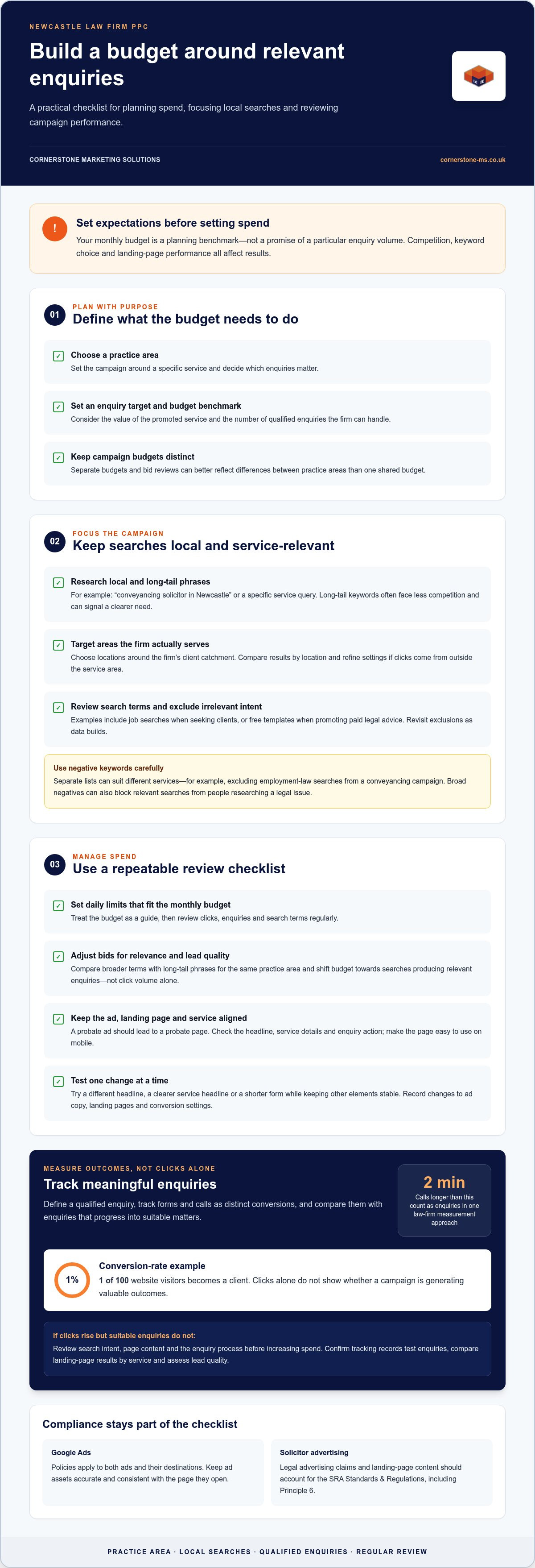
Define what counts as a qualified enquiry before measuring campaign performance. A completed form may need a relevant service request and contact details; a phone enquiry can be assessed by duration and suitability. In one law-firm measurement approach, calls longer than 2 minutes count as enquiries.
Track form submissions and calls as distinct conversions, then compare them with the enquiries that progress into suitable matters. A 1% conversion rate means 1 of 100 website visitors becomes a client. This example shows why clicks alone don’t reveal whether campaigns are producing valuable outcomes.
After launch, follow a simple review sequence: confirm tracking records test enquiries, compare landing-page results by service, and assess lead quality. If clicks rise but suitable enquiries don’t, review search intent, page content and the enquiry process before increasing spend.
Record changes to ad copy, landing pages and conversion settings so results remain clear. Test one change at a time, such as a shorter form or a clearer service headline. This makes it easier to see which adjustment improves the visitor journey and which merely changes click volume.
Budget planning, bid management and negative keywords
For Newcastle upon Tyne firms, Google Ads is a practical starting point for capturing active legal-service searches; Bing and social media can extend reach to other audiences. UK legal ads must follow Google Ads policies and present claims consistently with the SRA Standards & Regulations, including Principle 6 on acting in a way that maintains public trust.
Negative Keyword Lists
Negative keywords stop ads showing for searches that don’t match the firm’s services or client goals. Review the search terms report and exclude irrelevant intent, such as job searches when seeking clients or free templates when promoting paid legal advice. Revisit exclusions as data builds, since useful terms can vary by practice area.
Create separate negative keyword lists when services differ. A conveyancing campaign, for example, may exclude employment-law searches, while a family-law campaign can exclude unrelated probate terms. Apply exclusions carefully: broad negatives can block relevant searches, including people researching a legal issue before contacting a solicitor.
Budget Planning and Bid Management
Set a monthly budget against a clear enquiry target and the value of the promoted practice area. Treat it as a planning benchmark, not a promise of a particular volume. Competition, keyword choice and landing-page performance all affect results.
These differences make separate campaign budgets and bid reviews more useful than one shared budget.
Use this sequence to manage spend:
- Choose a practice area and define which enquiries matter.
- Research local and long-tail phrases, such as “conveyancing solicitor in Newcastle” or a specific service query.
- Set daily limits that fit the monthly budget, then review clicks, enquiries and search terms regularly.
- Adjust bids based on relevance and lead quality, not click volume alone.
Long-tail keywords often face less competition and can attract people with a clearer need. Compare them with broader terms for the same practice area, then shift budget towards phrases producing relevant enquiries. PPC advertising for law firms in Newcastle works best when the keyword strategy, exclusions and landing pages all support the same objective.
For a joined-up approach, consider how search engine optimisation strategy can support visibility beyond paid campaigns.
Can I target specific geographic locations with my PPC campaign?
Yes. Google Ads can target areas your Newcastle upon Tyne firm serves, helping keep campaigns locally relevant. Set locations around your actual client catchment, then assess enquiry quality and direct-contact activity.
Local Geographic Targeting
Choose locations where your legal team can serve clients instead of defaulting to a broad region. A Newcastle firm serving nearby communities, for example, can build its campaign around those areas and compare results by location.
Review location settings alongside campaign performance. If clicks come from outside the firm’s service area, refine targeting. If local searches generate relevant enquiries, retain those areas. This keeps geographic choices aligned with practical capacity.
Catchment-Area Targeting
Define a catchment area based on where clients can realistically reach the firm or where it accepts matters. A firm focused on Newcastle could separate the city from neighbouring areas, then assess which locations produce suitable enquiries for each practice area.
Use separate campaigns or ad groups when service coverage differs. For example, a firm offering in-person appointments in Newcastle but remote support across a wider area can tailor its message to each audience. Make service arrangements clear on the landing page.
Location-Based Search
Local search phrases combine legal intent with a place, such as “family solicitor Newcastle” or “conveyancing solicitor near me”. Include relevant location terms in keyword research and ad copy, then match them to pages describing the corresponding service and location.
A Google search can show local intent without naming a town. Review search terms to identify these queries, then assess whether their clicks generate useful enquiries. Social media targeting can support awareness among selected local audiences, while search campaigns reach people actively seeking legal help.
Direct contact options can shorten the route for someone ready to speak with a solicitor. Add a call asset to relevant Google Ads when phone enquiries suit the practice area, and make the number and call handling clear. Compare calls with form submissions to see which contact route produces appropriate enquiries.
Use a consistent review process for each location:
- List the towns and areas the firm serves for each practice area.
- Group locations where service coverage or client needs differ.
- Check search terms and location reports for out-of-area activity.
- Compare qualified enquiries, calls and conversions by location.
- Refine the targeting and page wording when results show a mismatch.
A Newcastle campaign should reflect the firm’s real service area, not an assumed radius. This helps direct budget towards places that can generate relevant enquiries, while direct contact assets give potential clients a clear way to get in touch.
Managing PPC in-house or through an agency
A law firm can manage Google Ads in-house or delegate campaign work to an agency. The right setup depends on available time, knowledge of legal advertising and the level of reporting needed.
Strategy and Audience Management
In-house management gives a firm direct control over campaign priorities and insight into its legal services. Assign someone to review keywords, audience settings and enquiry quality, and coordinate changes with the solicitors responsible for each practice area.
An agency can bring structured campaign management, but legal-sector knowledge matters. Assess its approach to SRA standards, advertising rules, transparent reporting and account management. For example, ask how it would align a family-law campaign’s audience, keyword and landing page without implying outcomes the firm cannot support.
Bidding and Budget Management
Google Ads budgets can be set and adjusted to suit a law firm’s needs. Whichever route you choose, define who can change bids, how often spend is reviewed, and which results guide decisions. A written approval process helps prevent sudden changes from conflicting with the firm’s monthly budget.
Use a shared performance report to connect clicks with qualified enquiries and signed cases. Review cost per click alongside conversion quality rather than treating visibility as success on its own. An in-house manager might review search terms weekly; an agency should explain its review schedule and the reasons for bid changes.
PPC Management Pricing
The price depends on the case and is given after a quote request; factors include campaign scope, practice areas, account complexity and reporting requirements. Keep management fees distinct from Google Ads spend, so the firm can see what goes to campaign activity and what covers management work.
Compare proposals by scope, communication and reporting, not by the headline fee alone. Legal clients value clarity on pricing, communication and regulation. A useful proposal explains who handles keyword research, bid adjustments, ad reviews and performance updates, with responsibilities stated plainly.
For an in-house setup, assign each task to a named person and provide access to the relevant Google Ads account and conversion reports. Record campaign decisions so another team member can understand why a keyword, bid or audience setting changed.
When assessing agency support, look at legal-sector experience, transparent reporting, account management and demonstrable campaign results. Whether consulting a local team or a full-service marketing agency such as The Atlantic Lifestyle, confirm how the agency will communicate changes and report performance, including which metrics connect campaign activity to enquiries. This helps the firm maintain oversight while delegating day-to-day work.
Either approach needs a clear review routine. Schedule regular meetings to examine spend, search terms, enquiry quality and compliance concerns, then record agreed actions. This gives the firm a consistent basis for deciding whether its approach is improving visibility and attracting relevant enquiries.
Competitor analysis and ad copy
Competitor research helps a Newcastle firm understand how other legal advertisers present services and compete for relevant searches. Use those observations to refine your own message, not to copy another firm’s claims.
Competitor Ad Research
Review the ads appearing for searches linked to each practice area, such as “Newcastle family solicitor” or “personal injury lawyer Newcastle”. Note the services highlighted, calls to action and destination pages. This gives your team a practical comparison without assuming competitors’ messages suit your clients.
Record patterns in a simple table with columns for search term, message, landing page and potential gap. If several ads use broad wording, for example, a specialist service description may make your offer clearer. Check every claim against the firm’s services and advertising standards.
Competition and Cost Per Click
Legal clicks vary by practice area.
Compare campaign costs with enquiry quality and case suitability. A high click cost may still support a viable campaign if relevant enquiries progress; cheap traffic has little value when it doesn’t match the firm’s services.
Ad Copy Development
Use competitor observations to test distinct, accurate messages. A conveyancing ad might highlight the specific service and Newcastle location, while a commercial-law ad could speak directly to business clients. Keep the landing page consistent with each claim, and avoid promises about outcomes or expertise the firm cannot substantiate.
Test one element at a time, such as a headline, service detail or call to action. Compare click-through and conversion rates, then consider which version brings suitable enquiries. Google Ads can provide visibility when campaigns go live, but results depend on the match between search intent, ad copy and landing page.
Before launch, review ads against SRA Standards & Regulations, including Principle 6, which is relevant to legal advertising claims and landing-page content. Check each ad and destination for clear, accurate descriptions, then revisit them when services or campaign priorities change.
Use a repeatable review process: gather competitor examples, identify a relevant difference, write compliant ad variations, and assess their performance. This helps PPC campaigns earn attention through clarity rather than unsupported comparisons. Refine your PPC campaign messaging around the searches and services that matter to your firm.
Cornerstone Marketing Solutions: Social Media Management
Cornerstone Marketing Solutions supports your wider digital presence through Social Media Management and Web Design. These services can help your firm present clear, consistent social content and a website alongside its paid campaigns.
A well-structured website helps prospective clients understand your legal services and find the right next step. Social Media Management can maintain a considered presence across social channels, complementing search activity without replacing the need to measure PPC performance.
If you’re reviewing how your marketing channels work together, contact Cornerstone Marketing Solutions to discuss your requirements.
Build your next marketing decision on campaign learning
Use each campaign review to decide what your firm should learn next. For PPC advertising for law firms in Newcastle, that might mean exploring a new practice-area message, explaining services more clearly, or aligning paid activity with wider communications. Focus on informed decisions rather than simply increasing activity.
Campaign insights can also shape how your firm communicates beyond search ads. Cornerstone Marketing Solutions offers Social Media Management, Web Design and Video Content to support a consistent digital presence across channels. These services can help when your next step is improving the wider experience people have with your firm, not just the first ad they see.
Choose a priority for the next stage, whether that’s clearer service messaging or a more connected online presence. Contact Cornerstone Marketing Solutions to discuss how your marketing can support that direction. A considered next step gives your team a clear foundation for ongoing improvement.
Frequently Asked Questions
How much should my law firm invest in PPC advertising?
Set investment by working backwards from the matters your firm wants and can handle. Estimate what a suitable new case is worth to the practice, decide how many enquiries staff can respond to, and use early campaign results to guide adjustments. A small team, for example, may prioritise one service rather than spread spend across every department. Review the plan as capacity and enquiry quality change.
What Are Some Advanced Techniques for Law Firm PPC Campaigns?
Use offline conversion data to distinguish initial enquiries from matters that progress, then assess which search activity brings stronger prospects. Segment campaigns by service and audience intent, and adjust bids where performance patterns justify it. Google restricts personalised advertising for divorce, domestic abuse and family-related services, so don’t target people based on sensitive interests or behaviour for these services. Keep optimisation grounded in relevant, permitted campaign data.
What is PPC Advertising for Solicitors Firms?
PPC lets a law firm pay for sponsored visibility, typically when someone clicks an advert. A search campaign can show an ad to someone looking for a particular legal service, while social platforms can support other forms of targeted promotion. The firm chooses its campaign objective and spend, then assesses whether visits lead to meaningful engagement or enquiries.
DIY or agency?
Choose in-house management if a named team member has time to monitor campaigns, interpret results and coordinate changes with solicitors. Agency support can suit firms needing specialist campaign skills or more consistent reporting. A practical hybrid is to keep legal-service decisions and claim approval with the firm, while assigning routine account management and analysis externally. Agree who owns each task before campaigns begin.
Does PPC advertising for lawyers work?
PPC can help a firm reach people actively searching for legal services, but success depends on whether those visitors are relevant prospects. A campaign might attract clicks from people whose cases fall outside the firm’s accepted types. Assess results through enquiry suitability and progression, not visibility alone. The firm’s ability to respond clearly and promptly also shapes what happens after an ad generates interest.
How Can PPC Campaigns Remain Effective for my Firm?
Keep campaigns useful by reviewing performance and refreshing messages when they no longer match client needs. Repetitive ads can lose audience response over time, so vary creative thoughtfully rather than changing everything at once. Check that each service still has the right audience, destination and enquiry route. Record changes and compare results to distinguish genuine improvement from ordinary variation.
How Much Does PPC for Law Firms Cost?
Overall costs depend on keywords, practice areas, locations and competition, as well as campaign management arrangements. Separate the advertising budget paid to the platform from any management fee, and clarify what work the fee covers. A personal injury campaign and a wills campaign can face different auction conditions. Review spend alongside suitable enquiries to assess whether the cost aligns with the campaign’s purpose.
How do I make sure my law firm’s PPC ads comply with SRA rules?
Review each advert and its destination for accuracy, clarity and consistency with the service actually provided. The SRA Standards & Regulations, including Principle 6, are relevant to legal advertising claims and landing-page content. Before publishing, have an appropriate person review statements about expertise, services and outcomes. Also check Google Ads requirements, particularly restrictions on personalised advertising for sensitive family-related services.