

With organic reach now dipping as low as 0.5% for many accounts, the traditional “post and pray” method has become a liability for your bottom line. You likely feel the frustration of spending hours on content that earns engagement but fails to move the needle on your revenue. It’s exhausting to manage these platforms internally when the link between a comment and a customer remains unclear. We understand that for a small business, every hour spent on marketing must serve as a foundation for future growth.
This guide demonstrates how measuring social media ROI for small business moves from guesswork to a core pillar of your operational stability. You’ll learn to transform social engagement into measurable commercial growth using a professional framework that prioritizes your bank balance over vanity metrics. We’ll provide a clear overview of the 2026 benchmarks, explain why a 3:1 return is your new baseline, and detail the repeatable system you need to track every dollar of your digital marketing investment with absolute confidence.
Key Takeaways
- Identify the critical distinction between misleading vanity metrics and the sustainable commercial data required for long-term business stability.
- Apply a rigorous method for measuring social media ROI for small business by accounting for hidden costs such as owner time and opportunity loss.
- Implement a practical five-step framework to align daily social media activities with core operational objectives and trackable revenue goals.
- Discover how to balance immediate lead generation with the foundational brand authority that builds lasting community trust and service excellence.
- Learn how transitioning to technical, professional management can accelerate your performance cycle and provide a more predictable path to growth.
Beyond Vanity Metrics: Why Measuring Social Media ROI is Essential for Small Businesses
Social media has evolved from a secondary communication channel into a foundational piece of business infrastructure. For many owners, the initial appeal of “going viral” has been replaced by a more disciplined requirement for commercial stability. When we discuss measuring social media ROI for small business, we aren’t just talking about tracking engagement. We’re talking about the bridge between digital activity and the financial health of your enterprise.
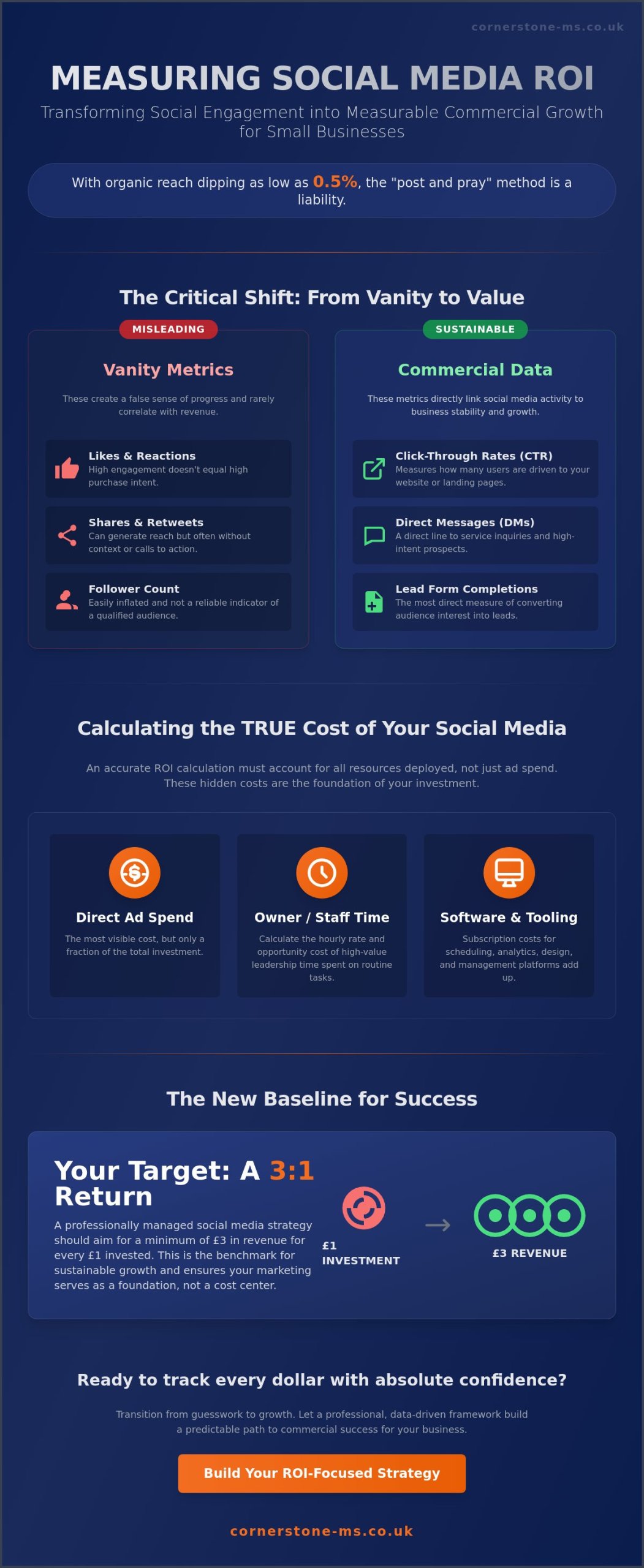
Vanity metrics like likes, shares, and follower counts often create a false sense of progress. While these numbers look impressive on a monthly report, they don’t always correlate with revenue. A post can reach thousands of people without generating a single inquiry. This disconnect occurs because high engagement doesn’t always equal high intent. Professional social media measurement allows us to look past the surface noise. It helps us identify which specific interactions are actually moving a prospect closer to a transaction.
We believe in shifting the focus from shouting louder to converting better. This requires a grounded, technical approach to content creation. Instead of chasing trends that don’t align with your brand, we focus on precision. Every piece of content should serve a specific purpose within your sales funnel. When your decisions are driven by data rather than guesswork, you build a level of institutional trust that flashy campaigns cannot replicate. This methodical style ensures your resources are allocated where they generate the most significant impact.
The Difference Between Engagement and Commercial Success
A viral video might entertain an audience, but unless it includes a clear path to your services, it remains a cost rather than an investment. Commercial success is defined by “Commercial Intent.” This refers to interactions that signal a user is ready to solve a problem. We prioritize metrics that matter: click-through rates to your website, direct messages inquiring about service availability, and lead form completions. These data points provide a much clearer picture of your performance than a simple double-tap on an image. It’s about finding the people who need your expertise, not just those who want to be entertained.
Social Media as Essential Infrastructure for North East Brands
In the North East regional market, social proof acts as a digital handshake. Whether you operate in B2B or B2C sectors, your social presence serves as a verified record of your competence. Consistent, data-backed reporting builds institutional trust with your stakeholders. It proves that your marketing budget isn’t being wasted on shouting into a void. Instead, it shows you’re building a reliable presence that supports long-term growth. By focusing on measuring social media ROI for small business, you ensure your digital footprint is as sturdy as the physical foundations of your company. This disciplined approach ensures that your marketing investment remains secure and efficient.
Calculating the True Cost of Your Social Media Investment
Accurate measuring social media ROI for small business requires a comprehensive view of the “Investment” side of your ledger. Most organizations focus exclusively on direct ad spend, but this is only a fraction of the total commitment. To master this process, we must account for every resource deployed, from monthly subscription fees to the technical labor required for platform optimization. We view these costs not as simple expenses, but as the foundational capital required to build a stable digital presence.
The Internal Resource Audit
The most significant hidden cost is often the business owner’s time. If leadership spends several hours each week creating posts or responding to messages, that time has a quantifiable financial value. We encourage you to calculate your effective hourly rate and compare it against the actual marketing output produced. Opportunity cost is the financial value of the high-level strategic tasks a business owner neglects while managing social media comments or content schedules. Modern algorithms require extreme technical precision to maintain visibility, often making DIY efforts an inefficient use of high-value leadership time.
Software and tooling also contribute to the overall overhead. Subscriptions for scheduling platforms, advanced analytics, and professional graphic design can accumulate quickly. While these tools improve efficiency, they represent a fixed monthly cost that must be justified by the final return. Direct ad spend should be tracked separately from these indirect operational costs to maintain a clear view of your performance.
External Costs: Content Production and Distribution
High-quality visual assets are no longer optional for businesses seeking long-term growth. Professional photography and videography significantly improve conversion rates by establishing immediate credibility with your audience. When you factor in agency fees, you’re often paying for the removal of the “doing it poorly” tax. Poorly executed social media can damage brand authority, leading to a higher long-term cost than the initial professional investment. Establishing actionable social media ROI requires including these production costs in your baseline figures.
Finally, consider the cost of regulatory adherence in your social communications. With the FTC Consumer Review Rule (effective October 2024) and new AI disclosure requirements like the law enacted in New York in June 2025, maintaining compliance requires constant vigilance. Ensuring your communication remains ethical and legally sound is an essential part of operational security. If you find the complexity of these requirements overwhelming, our team provides professional social media management to ensure your brand remains both compliant and profitable.
The ROI Spectrum: Balancing Immediate Leads with Long-Term Brand Authority
Effective measuring social media ROI for small business requires a dual-track approach. You must balance immediate, trackable leads with the steady cultivation of brand authority. While “Hard ROI” provides the data needed for short-term financial security, “Soft ROI” ensures your company’s long-term stability. Focusing exclusively on sales often erodes the trust you’ve worked to build. We view social media as a tool for improving the quality of life for your local audience by providing genuine value and reliable service information.
A “sales-only” content strategy typically results in diminishing returns as users become blind to constant promotion. Instead, we advocate for a balanced distribution of content that supports both immediate revenue and community well-being. High-performing campaigns in 2026 typically aim for a 3:1 return as a standard baseline, while strong paid efforts can reach a 5:1 benchmark. Achieving these numbers requires a disciplined framework that respects the customer journey from initial discovery to final purchase.
Measuring the “Unmeasurable”: Brand Sentiment and Trust
Tracking brand sentiment involves monitoring mentions and community engagement as lead indicators for future sales. This “social listening” provides essential business intelligence, allowing you to adapt your services to meet regional demands. Engaging a branding agency Newcastle ensures your visual identity and messaging reflect a commitment to technical excellence. When your audience perceives your brand as a dependable partner, the cost of customer acquisition naturally decreases. Trust is the invisible foundation that supports every successful transaction.
Direct Attribution: From Post to Purchase
Direct attribution focuses on the technical precision of your conversion tracking. Every social campaign should utilize specific tracking codes to monitor the path from a post to a confirmed lead. However, social media rarely closes the deal alone. Your website serves as the final “closing” foundation where social traffic is converted into commercial growth. A seamless web design North East ensures that users who click through from your social channels don’t encounter friction or technical errors. This integrated approach guarantees that your marketing investment is never lost due to a fractured digital experience. By aligning your social goals with your website’s performance, you create a predictable and high-quality service cycle for every potential client.
A Practical 5-Step Framework for Tracking Social Media Performance
A disciplined approach to measuring social media ROI for small business requires a linear, repeatable process. We utilize a structured framework to ensure every action supports your company’s operational stability. This system moves beyond the guesswork of content creation and establishes a clear path from digital engagement to commercial results. By following these five steps, you create a reliable foundation for your marketing investment.
- Step 1: Aligning Social Goals with Core Business Objectives. Every post must serve a higher purpose, whether that is immediate lead generation or long-term brand authority.
- Step 2: Selecting the Correct KPIs for Your Funnel Stage. We differentiate between metrics that track initial discovery and those that measure final conversion.
- Step 3: Implementing Technical Tracking. This involves the precise use of UTM parameters and tracking pixels to monitor the user journey.
- Step 4: Benchmarking Against Regional Competitors. Understanding the standards within the North East allows us to set realistic and ambitious targets.
- Step 5: Monthly Analysis and Strategic Pivot. Regular reviews ensure your strategy remains responsive to algorithm changes and market shifts.
This methodical framework simplifies the process of measuring social media ROI for small business, turning complex data into a clear plan for growth.
Aligning Goals with Business Outcomes
We begin by differentiating between “Awareness” goals and “Action” goals. For Teesside-based service providers, awareness might mean reaching a specific number of local households, while action focuses on direct inquiries. SMART objectives provide the necessary precision to evaluate these outcomes effectively. Our local SEO services complement these social goals by ensuring your business is visible exactly when local customers search for your expertise. This integrated approach ensures that social media doesn’t operate in a vacuum.
The Technical Setup for Reliable Data
Reliable data is the byproduct of technical precision. We implement UTM parameters for every link shared to track exactly which platforms and posts drive the most traffic to your website. Platform-specific insights from Meta, LinkedIn, and TikTok provide granular data on audience behavior and content performance. However, viewing these in isolation can be misleading. We recommend using a unified dashboard for multi-channel reporting to maintain a clear, holistic view of your digital infrastructure. If you require a partner to handle this technical oversight, our team offers professional social media management to ensure your data is both accurate and actionable.
Maximising Returns: How Professional Management Drives Sustainable Growth
Professional management moves your digital strategy from a cycle of trial and error to a state of technical precision. While the framework provided in the previous section offers a roadmap, the execution requires a disciplined partner who understands the nuances of the 2026 digital landscape. We provide social media management Teesside services that treat your marketing as essential infrastructure rather than a discretionary expense. This level of oversight ensures that measuring social media ROI for small business becomes a predictable part of your monthly operations.
A significant factor often overlooked in standard ROI discussions is the foundational role of branding and web design. High-quality social content cannot overcome a fractured brand identity or a poorly optimized website. If your social traffic lands on a page that is slow or confusing, your ROI will inevitably suffer. We ensure every digital touchpoint is seamlessly integrated. This creates a sturdy foundation that supports every campaign and conversion, protecting your marketing investment from technical friction.
The Cornerstone Approach: Data-Driven Decision Making
We leverage group-wide expertise to deliver local success across the North East. Our approach prioritizes technical precision and adherence to evolving ethical standards, such as the 2025 AI disclosure requirements and the FTC Consumer Review Rule. We provide monthly performance reporting that translates complex metrics into clear, actionable insights for your stakeholders. This transparency builds long-term institutional trust and ensures your brand voice remains both authentic and legally secure. We don’t just post content; we manage a critical business asset with responsibility and care.
Case Studies: Turning Engagement into Regional Authority
Local businesses that transition to professional management often see immediate improvements in their conversion efficiency. For example, B2B marketers report that short-form video content provides the highest ROI at 41% in 2026. By integrating professional videography into your social strategy, you elevate your brand from a simple service provider to a regional authority. This visual quality serves as a shorthand for your commitment to excellence and community well-being. It’s a display of competence that resonates with a demanding audience.
If you’re ready to move beyond vanity metrics and establish a clear link between your social posts and your bank balance, the next step is a professional evaluation. We invite you to request a comprehensive social media ROI audit for your business. Our team will analyze your current performance, identify operational gaps, and provide a roadmap for sustainable, measurable growth. We’re here to provide the stability and expertise your business requires to thrive in a high-stakes digital environment.
Establishing Your Foundation for Sustainable Digital Growth
Mastering the process of measuring social media ROI for small business ensures your marketing budget functions as a secure investment rather than a speculative cost. We’ve explored how identifying commercial intent and accounting for hidden operational expenses provides a clear view of your financial health. By implementing a disciplined framework, you move beyond the noise of vanity metrics and focus on the sustainable growth of your enterprise. This methodical approach protects your resources while building long-term brand authority and community trust.
Our team brings the award-winning Cornerstone Group heritage and specialized North East regional expertise to your digital strategy. We prioritize technical precision and provide data-driven monthly performance reporting to keep your operations transparent and efficient. We invite you to book your Social Media ROI Audit with Cornerstone Marketing Solutions to verify your current performance and identify new opportunities for commercial success. Your business deserves a marketing foundation built on accountability, precision, and genuine care for your long-term success. We look forward to building that future with you.
Frequently Asked Questions
How long does it typically take to see a positive ROI from social media?
You should expect to see measurable results within three to six months of consistent activity. While paid campaigns can generate immediate traffic, organic growth requires time to build the community trust and algorithm favor necessary for conversion. This period allows for the technical calibration of your content strategy and the collection of enough data to make informed adjustments.
Is it possible to track offline sales back to social media efforts?
Yes, you can track offline sales using specific tracking mechanisms like unique promotional codes, QR codes, or digital vouchers. Implementing a “how did you hear about us” protocol at the point of sale also provides valuable qualitative data. These methods bridge the gap between digital engagement and physical transactions, ensuring your offline revenue is correctly attributed to your social media investment.
What is a “good” ROI percentage for a small business on social media?
A 3:1 return on investment is considered a standard baseline for most industries, while a 5:1 return represents a strong benchmark for paid campaigns. In 2026, small businesses often see specific returns based on the platform, such as an average 8.17x ROI for Facebook advertising. We aim for these benchmarks to ensure your social presence provides a sturdy foundation for commercial stability.
Can I measure social media ROI without using expensive software?
You can effectively manage measuring social media ROI for small business using free native tools like Meta Business Suite and LinkedIn Page Analytics. When combined with a properly configured Google Analytics 4 (GA4) account, these platforms provide sufficient data to track conversions and user behavior. While premium software offers deeper automation, these foundational tools are enough to build a reliable tracking system.
How much should a small business in the North East spend on social media?
Most small businesses allocate between 5% and 15% of their total revenue to marketing, with a significant portion dedicated to social media management and PPC. In the North East, your spend should reflect your specific growth objectives and the competitive landscape of your sector. It’s more important to focus on the quality and technical precision of the spend rather than just the total amount.
What is the most important KPI for a local service-based business?
Conversion rate is the most critical metric for local service providers. While reach and engagement indicate brand health, the number of lead form completions or direct inquiries determines the actual commercial impact of your efforts. We prioritize these “action” metrics because they provide the most direct link to your revenue and the overall sustainability of your operations.
How does social media ROI differ between Facebook, Instagram, and LinkedIn?
ROI varies significantly by platform and audience intent. For instance, small businesses gain an average of $5.78 for every $1 spent on Instagram ads, reflecting its strength in visual discovery and social commerce. LinkedIn typically commands a higher cost per click, often over $5.60 for B2B campaigns, but offers higher lead quality for professional services where trust and authority are paramount.
What happens if my ROI is negative in the first three months?
A negative ROI in the initial quarter is often a sign that your strategy requires technical refinement rather than abandonment. We use this period to analyze engagement patterns and identify where potential customers are dropping out of your funnel. Measuring social media ROI for small business is a long-term discipline; we use these early data points to pivot your strategy toward more profitable content formats and audience segments.