


If your website acts more like a static digital brochure than a high-performing engine, you’re likely watching your marketing budget vanish into a void of high bounce rates and missed connections. It’s frustrating to invest in traffic only to see visitors leave because of slow loading times or confusing navigation. You’re likely searching for how to improve my website’s user experience because you need a digital presence that reflects the reliability and expertise of your actual operations. We believe that a website should be a stable foundation for your growth, not a source of technical friction.
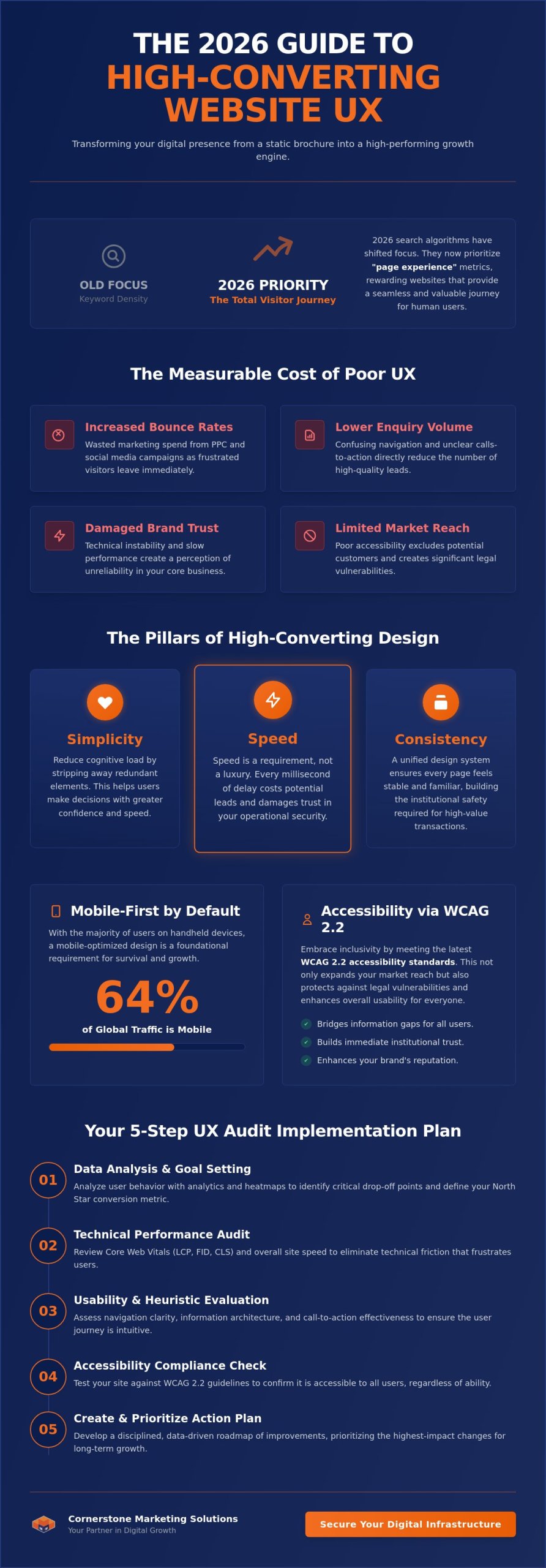
This 2026 growth guide provides the clarity you need to transform your site into a high-converting asset. We’ll strip away the jargon and focus on functional improvements that lower bounce rates and increase enquiry volume. You’ll discover how to meet the latest WCAG 2.2 accessibility standards and leverage mobile-first design to capture the 64% of global traffic now coming from handheld devices. We will walk through the strategic application of video and authentic social proof to build the institutional trust your brand deserves.
Key Takeaways
- Understand why 2026 search algorithms prioritize the total visitor journey over keyword density to protect your digital visibility.
- Implement simplicity and consistency to reduce cognitive load, helping your visitors make decisions with greater confidence and speed.
- Master how to improve my website’s user experience by adopting mobile-optimized design and WCAG 2.2 accessibility standards as foundational requirements.
- Learn to use professional videography and drone footage to bridge information gaps and build immediate institutional trust with your audience.
- Follow a disciplined five-step audit process to identify technical drop-off points and secure your digital infrastructure for long-term growth.
What is Website User Experience (UX) and Why Does It Matter in 2026?
User experience (UX) serves as the foundational business infrastructure for your digital operations, ensuring that every visitor interaction is purposeful, efficient, and secure. While many view a website as a static marketing tool, we see it as a dynamic journey where technical precision meets human behavior. To understand What is Website User Experience (UX), you must look beyond the surface level of icons and colors to the underlying logic that governs how a person feels while interacting with your brand. It’s the total emotional and functional journey of a visitor, from the initial click to the final enquiry.
In 2026, search algorithms have shifted their focus entirely away from simple keyword density. Modern search engines now prioritize “page experience” metrics because they reflect the true value a site provides to a human user. For businesses in the North East looking to scale, there’s a direct correlation between friction-free navigation and commercial growth. When you reduce the effort required for a customer to find a solution, you naturally increase your conversion rates. If you’re asking how to improve my website’s user experience, you must first acknowledge that UX isn’t a one-time project. It’s a commitment to operational excellence.
The Difference Between UI and UX: Why Both Matter
We often see confusion between User Interface (UI) and User Experience (UX). UI represents the visual aesthetics of your site, including your branding, photography, and color schemes. UX is the logical flow and functionality that sits beneath those visuals. A website can be visually stunning yet fail completely if the user journey is confusing or broken. We take a disciplined approach, balancing creative branding with data-driven design to ensure your site is both professional and functional. Beauty without utility leads to user frustration, while utility without beauty fails to inspire the necessary trust to move forward.
The Business Impact of Poor UX
The cost of poor UX is measurable and significant. High bounce rates are often a symptom of technical friction, such as slow loading times on mobile or unclear call-to-action buttons. This isn’t just a technical glitch; it’s a drain on your marketing ROI and wasted ad spend. When a visitor leaves your site out of frustration, it damages long-term institutional trust. They may associate your brand with inefficiency, which can lead to negative social media sentiment. In a demanding industry, your website must act as a dependable partner that respects the user’s time and cognitive load.
- Increased bounce rates lead to wasted PPC and social media marketing spend.
- Confusing navigation lowers the volume of high-quality enquiries and leads.
- Technical instability creates a perception of unreliability in your core services.
- Poor accessibility limits your market reach and creates legal vulnerabilities.
The Core Pillars of High-Converting Website Design
We approach website architecture with the understanding that clarity is the ultimate currency. When you investigate The Core Pillars of High-Converting Website Design, you find that simplicity sits at the top of the hierarchy. We reduce cognitive load by stripping away redundant elements that distract from your primary call to action. This helps users make decisions faster and with more confidence. Consistency follows closely; a unified design system ensures that every page feels like a stable part of the same entity. This familiarity builds the institutional safety required for high-value transactions.
Speed is no longer a luxury. It’s a requirement for operational security. In the North East, where business moves quickly, every millisecond delay costs you potential leads. We ensure that every functional element, from contact forms to navigation buttons, serves a specific business goal. If a feature doesn’t contribute to your North Star metric, it doesn’t belong on your site. This disciplined focus is central to how to improve my website’s user experience effectively. We prioritize functionality to ensure that your site works as a reliable partner in your sales process.
Technical Performance and Core Web Vitals
Technical stability is the bedrock of a high-performing site. In 2026, we measure success through Core Web Vitals: Largest Contentful Paint (LCP), First Input Delay (FID), and Cumulative Layout Shift (CLS). These metrics track how quickly your content appears, how fast the site responds to inputs, and how stable the layout remains during loading. Our approach to web design North East leverages high-quality hosting and clean, efficient code to meet these rigorous standards. We don’t just build sites that look good; we build infrastructure that performs under pressure.
Information Architecture: Mapping the User Journey
We design navigation menus that mirror the searcher’s intent rather than internal company structures. We adhere to the Three-Click Rule, ensuring that any visitor can find their required information within seconds. Strategic internal linking then guides these users from educational content to conversion points. This logical progression turns a casual browser into a qualified lead. If you’re ready to secure your digital foundation, our team can help you refine your web design strategy to ensure long-term stability.
Mobile-First Design and Accessibility: Essential 2026 Standards
In 2026, simply being “mobile-friendly” is an outdated standard that no longer meets the expectations of a sophisticated audience. True operational excellence requires your site to be mobile-optimized. This means the entire interface is engineered specifically for the constraints and opportunities of handheld devices. As of early 2026, mobile devices account for approximately 62-64% of all global web traffic, making the smartphone the primary gateway to your brand for most UK consumers. If you are investigating how to improve my website’s user experience, you must treat mobile users as your primary audience rather than a secondary consideration.
Inclusive design is not merely a technical requirement; it’s a strategic advantage that expands your market reach to all potential users. By removing barriers for those with visual, auditory, or motor impairments, you ensure that your services are accessible to the widest possible community. We view this as both a legal necessity and an ethical responsibility. Following established Digital.gov user experience guidelines helps establish a digital presence that is resilient, compliant, and deeply respectful of every visitor’s unique needs.
Designing for the Thumb: Mobile UX Best Practices
Effective mobile design prioritizes the “thumb zone,” ensuring that all critical touch targets and buttons are sized and positioned for easy interaction on smaller screens. We eliminate intrusive pop-ups that disrupt the user flow and create unnecessary friction for mobile visitors. Our approach to responsive web design ensures that your brand integrity remains intact, whether viewed on a desktop monitor or a compact smartphone. We focus on seamless transitions and logical layouts that maintain a steady sense of security throughout the navigation process.
WCAG 2.2 Compliance: More Than a Checklist
Adhering to WCAG 2.2 standards is a fundamental aspect of modern web design. We prioritize high color contrast, descriptive alt-text, and robust keyboard navigation to ensure full accessibility for all individuals. These elements do more than just help users; they improve your SEO by allowing search crawlers to better understand your site’s structure and content. By committing to these standards, you position your business as a conscientious, community-oriented brand. This level of thoroughness is a key component of how to improve my website’s user experience while building long-term institutional trust through a display of competence and care.
Using Videography and Social Proof to Enhance UX
Trust is the essential foundation of every digital interaction. While technical performance provides the structure, visual storytelling provides the human connection necessary for high-value transactions. Professional videography reduces the information gap, allowing visitors to grasp the scope of your operations without navigating through dense blocks of text. For instance, the cinematic quality produced by Kraft Films demonstrates how high-end production can elevate a brand’s narrative. Integrating high-quality visual assets is a primary strategy for how to improve my website’s user experience. By showing your team, your equipment, and your processes in action, you move beyond being a digital brochure and become a verified partner in the eyes of the user.
Authenticity is the key to modern social proof. We favor original photography over generic stock images because users in 2026 are highly sensitive to staged content. Drone videography offers an even more compelling perspective, showcasing the physical scale of your infrastructure or the geographic impact of your projects. Strategic placement of testimonials and case studies then validates this journey. Research indicates that video testimonials can increase conversion rates by up to 80%, providing the third-party validation needed to anchor your brand’s reliability.
The Power of Video in Reducing Conversion Friction
Explainer videos simplify complex service offerings by breaking down technical requirements into logical, visual segments. This approach respects the user’s time and cognitive load. High-quality video content also increases “time on page,” which serves as a powerful signal for local SEO services. To maintain technical excellence, we implement video with lazy loading and strict auto-play rules. This ensures that media enhances the experience without compromising site speed or mobile data usage. Verified data shows that landing pages featuring video can see conversion increases of up to 86%, making it a critical component of your growth strategy.
Building Local Trust with Regional Social Proof
We believe that local context builds immediate familiarity. Showcasing successful projects within Stockton-on-Tees and across the North East demonstrates your commitment to the regional economy. This grounded approach should be integrated with broader branding agency Newcastle strategies to ensure a consistent identity across all touchpoints. We use third-party validations, such as industry awards or safety certifications, to provide a steady sense of security. If you want to transform your site into a high-converting asset, our team can help you integrate professional videography and web design into your digital infrastructure.
Executing Your UX Audit: A 5-Step Implementation Plan
A systematic audit is the only way to move from guesswork to verified growth. We approach this process as a rigorous health check for your digital infrastructure, ensuring that every element supports your operational goals. If you have been searching for how to improve my website’s user experience, you must begin with a disciplined evaluation of your current assets. This methodical progression identifies technical vulnerabilities and clarifies the path toward a more resilient, high-converting presence.
- Step 1: Conduct a technical performance audit. We utilize modern 2026 diagnostic tools to evaluate Core Web Vitals and server response times. This provides a baseline of your site’s foundational stability.
- Step 2: Map the user flow. We identify “drop-off” points where visitors exit your funnel. Understanding these friction areas allows us to simplify the journey from landing page to enquiry.
- Step 3: Gather authentic user feedback. We employ heatmaps and targeted surveys to observe how real people interact with your layout. This data reveals the “why” behind high bounce rates.
- Step 4: Prioritise fixes. We categorize improvements based on their potential business impact and ease of implementation. We focus on high-yield adjustments that secure your marketing ROI quickly.
- Step 5: Partner for execution. We believe that seamless execution requires a unified team. Partnering with a specialist agency ensures that technical changes don’t compromise your branding or SEO.
Measuring Success: UX Metrics That Matter
Success in UX is measured by the stability of your conversion rates rather than just total traffic volume. We track the ratio of enquiries against bounce rates to determine if your content truly resonates with your audience. We also utilize Google Search Console to monitor “Page Experience” signals, ensuring your site remains compliant with the latest algorithm standards. Continuous A/B testing is essential for long-term stability. It allows us to refine your interface based on evolving user behaviors, keeping your digital asset ahead of the curve in a demanding market.
How Cornerstone Marketing Solutions Elevates Your UX
We provide a unified approach that combines technical Web Design, SEO, and Videography into a single, cohesive strategy. Our team doesn’t just fix broken links; we build foundational digital assets that support long-term North East business growth. We take pride in our workmanship and our commitment to the local community. By integrating professional Drone Videography and Photography, we create a transparent and trustworthy experience for your visitors. If you are ready to see how to improve my website’s user experience through a tailored lens, contact us for a comprehensive UX review of your current site today.
Securing Your Digital Future Through Strategic UX
Your website is the essential infrastructure of your digital operations. By prioritizing mobile-optimized design and adhering to WCAG 2.2 accessibility standards, you ensure that your site remains a stable and inclusive gateway for all visitors. We have explored how professional videography and social proof bridge the information gap, fostering the institutional trust required for conversion. Implementing these pillars is the most effective way to transform a static page into a high-performing business asset.
Understanding how to improve my website’s user experience is not just a technical task. It’s a commitment to your customers’ well-being and your brand’s long-term growth. As specialists in North East business growth, we offer a comprehensive integration of SEO, videography, and award-winning Cornerstone Group expertise to fortify your presence. Elevate your website’s performance with Cornerstone’s expert web design services.
We look forward to helping you build a digital foundation that is as reliable and professional as the service you provide every day. Your site should be a source of confidence for your team and your community.
Frequently Asked Questions
What is the most important factor in website user experience?
The most important factor in website user experience is clarity of purpose. A visitor must understand what your business offers and how to take the next step within seconds of landing on your page. We prioritize reducing cognitive load so that users feel in control of their journey. This ensures that your digital infrastructure serves as a reliable support for your customer’s needs and builds institutional trust from the first interaction.
How does UX design affect my website’s SEO rankings?
UX design directly impacts your SEO rankings because modern search engines prioritize “page experience” metrics like loading speed and mobile responsiveness. If you are researching how to improve my website’s user experience, you should know that high bounce rates signal to search engines that your site isn’t providing value. We focus on technical stability to ensure your site remains a high-performing asset in search results, protecting your digital visibility and marketing ROI.
Is it better to use a template or a bespoke website for good UX?
A bespoke website is typically superior for user experience because it allows for precise customization of the user journey. Templates often carry bloated code that slows down performance and limits your ability to address specific operational requirements. We build tailored solutions that align with your unique branding and functional goals. This ensures a seamless integration between your digital presence and your physical operations, providing a more stable foundation for growth.
How often should I update my website’s UX design?
You should treat UX as a continuous process of refinement rather than a static project. We recommend a comprehensive technical audit every 12 to 18 months to stay aligned with evolving standards like WCAG 2.2. Regular updates ensure that your site remains compatible with new devices and changing user expectations. This disciplined approach maintains the long-term reliability of your digital assets and ensures you are never left behind by technical advancements.
Can I improve my UX without a full website redesign?
You can certainly how to improve my website’s user experience without committing to a full redesign. Small but impactful changes, such as optimizing image sizes for speed or refining your call-to-action buttons, can significantly lower bounce rates. We often start with a technical performance audit to identify these high-yield adjustments. This allows for a methodical improvement of your site’s efficiency over time, providing a clear path to better performance without unnecessary complexity.
How do I know if my website has poor user experience?
High bounce rates and low conversion volumes are the most common indicators of poor user experience. If users leave your site quickly or fail to complete enquiry forms, there’s likely a friction point in their journey. We use data from Google Search Console and heatmaps to identify these drop-off points. This technical insight helps us understand where your digital infrastructure requires reinforcement to better serve your community and meet your business objectives.
What is the difference between accessibility and usability?
Usability focuses on how easily a general visitor can navigate your site, while accessibility ensures that your site is functional for everyone, including those with visual or motor impairments. Both are essential components of a professional digital presence. We follow WCAG 2.2 standards to ensure that your site is inclusive and community-oriented. This dual focus builds a more resilient and versatile platform for all users, reflecting a brand that values thoroughness and ethical standards.
How much does a professional UX audit cost for a local business?
The cost of a professional UX audit varies based on the complexity of your site and the depth of the technical evaluation required. We focus on providing a thorough assessment that identifies specific operational challenges and regulatory requirements. A comprehensive audit typically covers technical performance, accessibility compliance, and user flow mapping. You should contact a specialist to discuss a tailored review that meets your specific business goals and ensures the long-term security of your digital operations.