


Your website is no longer just a digital brochure; it’s a high-performance infrastructure asset that either accelerates or sabotages your entire business strategy. If you’re struggling with a platform that’s difficult to update or watching competitors in Teesside and Newcastle win leads through superior user experiences, you aren’t alone. Many professionals find it difficult to bridge the gap between technical necessity and executive approval. You know the current site is failing, but you need a structured way to prove its cost to the bottom line.
This guide provides the roadmap for how to convince my boss we need a new website by shifting the conversation from design features to financial impact. We’ll show you how to translate day-to-day frustrations into a compelling case for growth and risk mitigation. You’ll learn how to leverage 2026 data, from the 64% global mobile traffic dominance to the strict WCAG 2.1 accessibility requirements, to position a new site as an essential foundation for the company’s future success. By the end of this article, you’ll have the tools to secure a funded project and earn recognition for driving business growth.
Key Takeaways
- Reframe your website as a high-performance infrastructure asset rather than a static digital brochure to align with executive priorities.
- Discover a data-driven framework for how to convince my boss we need a new website by translating technical debt into lost revenue opportunities.
- Identify the “silent killers” of your digital presence, including Core Web Vitals and accessibility standards that may be sabotaging your search rankings.
- Learn a step-by-step proposal structure that uses Google Analytics data to build an undeniable case for a modern, high-converting platform.
- Understand how an integrated strategy combining web design with SEO and social media creates a stable foundation for long-term business growth.
The Business Case for a New Website in 2026
In 2026, we view a website as a high-performance conversion engine rather than a static digital brochure. It serves as the central hub for all operational and marketing activities. When you are researching how to convince my boss we need a new website, start by emphasizing that “good enough” is now a high-risk strategy. A legacy site doesn’t just look dated; it actively obstructs business agility and revenue generation. We treat the website as the Digital Foundation. Without a stable foundation, investments in other channels like social media or paid search will fail to deliver their full potential.
Successful digital transformation relies on adhering to the principles of effective web design to ensure usability and technical stability. When leadership views a website as a cost center, remind them that the expense of a new build is often lower than the cumulative cost of lost leads. Every day an outdated site remains live, it acts as a barrier between your brand and your prospects. We focus on building systems that don’t just exist, but perform with precision and reliability.
The Cost of Inaction: Why Staying Static is Losing Revenue
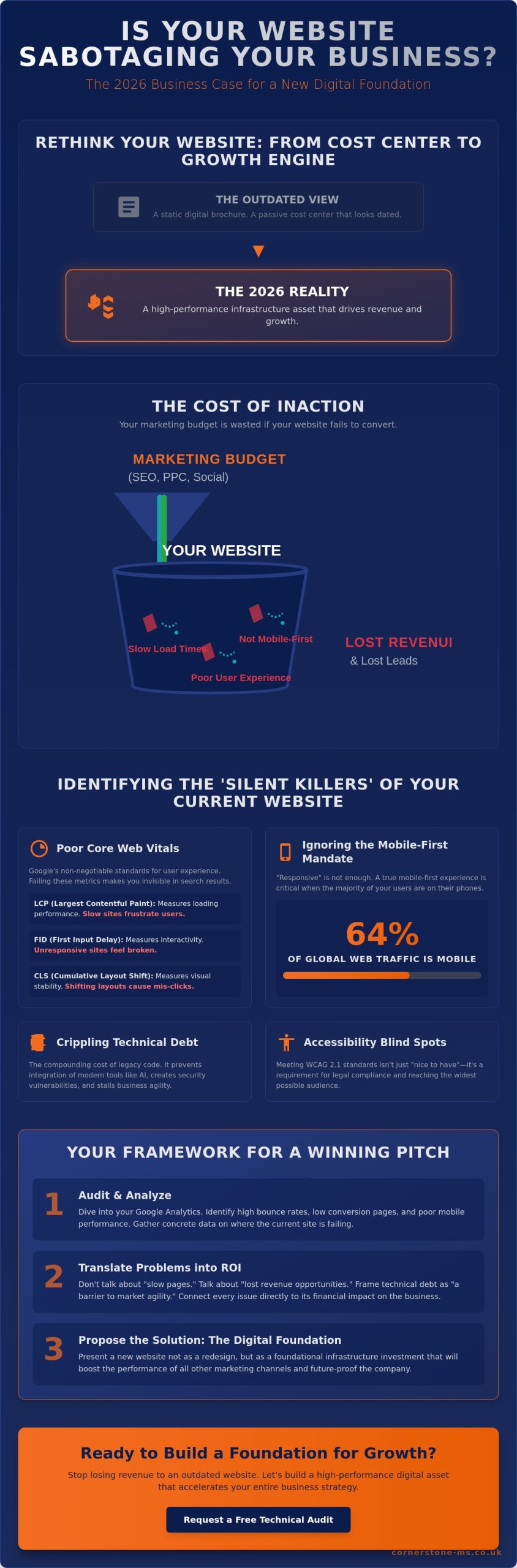
Staying static is a choice to lose market share. An outdated interface erodes brand trust immediately, often before your sales team has a chance to engage. We call this the “Leaking Bucket” effect. You might be spending significant budget on SEO or PPC, but if the destination site fails to convert visitors, that capital is effectively wasted. Technical debt refers to the compounding cost of maintaining legacy code and obsolete systems that restrict your ability to integrate modern AI tools or security protocols, ultimately stalling business agility in 2026.
Evolving User Expectations in the North East Market
Local buyers in Teesside and across the North East have shifted their behavior. They expect frictionless, mobile-first experiences that respect their time. A slow-loading page creates a psychological barrier, signaling a lack of professional care to time-poor decision-makers. A strategic web design North East approach incorporates local trust signals and high-speed infrastructure to meet these demands. When you determine how to convince my boss we need a new website, highlight that your competitors are likely already optimizing for these regional expectations. We help you bridge that gap through technical excellence and a commitment to the end-user experience.
Identifying the ‘Silent Killers’ of Your Current Website
Directors and senior stakeholders often judge a website by its visual appearance. We look deeper. A site can look modern while its underlying infrastructure is actively sabotaging your business objectives. These “silent killers” are the technical failures that remain invisible to the untrained eye but manifest as high bounce rates and lost revenue. When you are determining how to convince my boss we need a new website, your strongest arguments will come from these structural deficiencies that hinder performance and growth.
One of the most significant internal pressures is the “CMS struggle.” If your marketing team requires hours of manual work or developer intervention just to update a simple landing page, your current system is a liability. We prioritize operational efficiency, ensuring that your team can respond to market changes with agility rather than being stalled by a rigid, outdated backend.
Technical Debt and Core Web Vitals 2026
Google’s standards for user experience are stricter than ever. Core Web Vitals are the primary metrics used to quantify this experience. Largest Contentful Paint (LCP) measures how quickly your main content loads. First Input Delay (FID) tracks how fast the site responds to a user’s first click. Cumulative Layout Shift (CLS) monitors whether elements jump around while loading. In 2026, these aren’t just suggestions; they are foundational requirements for organic visibility in competitive areas like Stockton and Newcastle. Legacy code acts as a barrier, preventing the seamless integration of modern AI tools and automated chatbots that today’s buyers expect. If you suspect your current platform is holding you back, we can help you identify these hidden risks through a professional technical audit.
The Mobile-First and Accessibility Mandate
Mobile devices account for approximately 64% of global web traffic in 2026. Simply having a “responsive” site that shrinks to fit a screen is no longer sufficient. We now design for “thumb-friendly” interaction to combat the 58-60% bounce rates typically seen on mobile devices. Accessibility has also moved from a “nice-to-have” to a core regulatory requirement. As of April 24, 2026, entities serving populations over 50,000 must comply with WCAG 2.1 Level AA standards. Adhering to recognized web accessibility guidelines is essential to protect your business from legal risks and to ensure you aren’t excluding a significant portion of your audience. Use this checklist to determine if your site is technically obsolete:
- Slow Server Response: Your Time to First Byte (TTFB) exceeds industry standards, causing users to abandon the site.
- Non-Semantic HTML: The code structure is outdated, making it impossible for screen readers or search engines to interpret your content correctly.
- Broken API Integrations: Your site cannot reliably connect with modern CRM or marketing automation software.
By highlighting these technical vulnerabilities, you shift the conversation from subjective design preferences to objective business risks. This is the most effective strategy for how to convince my boss we need a new website in a data-driven corporate environment.
Translating Technical Needs into Executive ROI
Performance is the primary currency of the executive suite. While a marketing team might focus on aesthetics, leadership prioritizes the bottom line. To understand how to convince my boss we need a new website, you must shift the narrative from visual appeal to measurable return on investment (ROI). We view a website as a financial instrument. If your current platform converts at the global average of 2.35%, a mere 1% lift in conversion efficiency through better user experience can result in a significant increase in total lead volume. For a business receiving 5,000 visitors a month, that small adjustment generates an additional 600 leads annually without increasing your advertising spend.
We also evaluate the hidden costs of maintaining legacy infrastructure. Older systems often require frequent, expensive patches to remain secure and functional. A modern, scalable platform reduces these overheads and allows for seamless integration with updated business tools. When you present this to leadership, contrast the high cost of constant “emergency” maintenance against the predictable performance of a new build. Use competitor benchmarking to highlight where your firm is falling behind. A simple speed and functionality audit of three local rivals often provides the necessary spark to drive executive action.
From Vanity Metrics to Conversion Engines
Raw traffic numbers are vanity metrics if your site suffers from a high bounce rate. In 2026, mobile users typically show bounce rates between 58% and 60% when faced with slow or clunky interfaces. A new website serves as a high-performance engine that captures this traffic rather than letting it leak away. This technical stability significantly enhances the efficiency of your local SEO services, ensuring that the visitors you attract actually reach the checkout or contact form. For B2B firms, a streamlined digital experience shortens the sales cycle by providing decision-makers with the information they need immediately, reducing the friction that often stalls high-value contracts.
Competitor Benchmarking: The North East Landscape
The digital landscape in Stockton, Middlesbrough, and Newcastle is increasingly competitive. We recommend performing a “Gap Analysis” to show your boss exactly where your digital presence is being outpaced. If a competitor offers an intuitive portal or faster load times, they are actively siphoning away your potential market share. Your website is often the first interaction a prospect has with your brand identity. From the perspective of a branding agency Newcastle, an outdated URL and slow interface can sabotage even the most prestigious reputation. Presenting a clear comparison of “Their Performance vs. Our Performance” is a powerful strategy for how to convince my boss we need a new website based on objective market data.
Preparing the Pitch: A Step-by-Step Proposal Framework
Securing executive buy-in requires a shift from subjective complaints to a structured business case. When you are preparing how to convince my boss we need a new website, your presentation must follow a logical, data-driven sequence that mirrors a professional investment proposal. We recommend a three-stage framework: the Problem Statement, the Proposed Solution, and the Call to Action. This methodical approach demonstrates that you aren’t just asking for a new design; you’re proposing a strategic asset that will drive the company’s 2026 growth objectives.
The entity approaches the pitch as a strategic alignment between technical necessity and commercial success. Start by presenting a clear problem statement backed by your current site’s performance metrics. Once the risk of inaction is established, introduce the new website as the solution that solves these specific bottlenecks. Finally, end the meeting with a low-risk next step, such as a discovery phase or a technical audit. This allows leadership to commit to a process rather than a final price tag immediately.
Gathering the Evidence: Data vs. Opinion
Executives respond to evidence, not anecdotes. We advise bringing three specific Google Analytics metrics to the table: Bounce Rate, Conversion Rate, and Average Session Duration. A high bounce rate indicates that users are rejecting your brand within seconds, while a low session duration suggests the content fails to engage decision-makers. To make the friction visible, utilize heatmaps to show exactly where users struggle or abandon their journey. Qualitative proof is equally vital. Sharing a single sentence of customer feedback regarding a difficult checkout or confusing navigation provides a human element that data alone sometimes lacks. If you need assistance gathering these insights, you can partner with our technical team for a comprehensive site evaluation.
Overcoming Common Executive Objections
Anticipating resistance is part of a disciplined pitch. When a director claims a new site is “too expensive,” counter with a multi-year value breakdown. Explain that the investment is amortized over the site’s lifespan, often costing less per month than a single underperforming ad campaign. If the objection is “we don’t have time,” propose a phased launch or a Minimum Viable Product (MVP). This approach allows the business to go live with essential features quickly while adding complex integrations later. For the subjective “I like the current site” objection, rely on your user-centric data. It is difficult to defend a personal preference when heatmaps and conversion data clearly show that the target audience finds the platform obstructive. By addressing these concerns with quiet confidence and verified facts, you position yourself as a reliable partner in the company’s long-term success.
Partnering for Performance: The Cornerstone Approach
Cornerstone Marketing Solutions operates as a disciplined, expert partner for firms across the North East. We recognize that a website is essential infrastructure, not a discretionary expense. Our team provides the high-level technical expertise and unwavering reliability required to manage complex digital assets. When you are finalizing your strategy for how to convince my boss we need a new website, choosing a partner with a proven track record of stability is essential. We don’t just deliver a standalone site; we provide an integrated approach that combines Web Design, SEO, and Social Media Management to create a unified growth engine.
We provide the security and peace of mind that comes from being part of the wider Cornerstone Group. This institutional stability ensures that we value long-term collaboration over short-term gains. We take pride in our workmanship and our commitment to operational excellence. To help you build a verified case for leadership, we offer a comprehensive Digital Audit. This audit identifies specific technical vulnerabilities and quantifies the potential for performance improvement, giving you the objective data needed to secure executive buy-in.
Why a Local North East Agency Matters
We believe in the value of grounded, human-centric collaboration. Operating from Stockton-on-Tees, we provide face-to-face strategy sessions that national “template” agencies cannot replicate. This local presence allows us to understand the specific nuances of the North East business landscape. We are deeply committed to the economic growth of our community and the success of the businesses within it. Our local market knowledge ensures that your digital foundation is tailored to the expectations of regional decision-makers, providing a level of customization that drives genuine trust and engagement.
Building a Future-Proof Digital Foundation
Technical precision and regulatory adherence are the hallmarks of our delivery process. We ensure that every project meets the rigorous standards of 2026, from mobile-first performance to WCAG accessibility compliance. Our developers focus on seamless integration, ensuring that your new platform communicates effectively with your existing CRM and marketing automation tools. We eliminate the “CMS struggle” by providing intuitive, scalable systems that empower your team to act with agility. This commitment to thoroughness ensures that your investment remains a high-performance asset for years to come. If you are ready to move from a problem to a verified solution, we invite you to book a strategy call to build your bulletproof business case.
Securing Your Digital Future through Strategic Alignment
Transitioning from technical frustration to a funded project requires a clear shift in perspective. You’ve seen that a modern website is the essential foundation of your entire marketing ecosystem. Mastering how to convince my boss we need a new website depends on your ability to present technical debt as a financial risk and a modern platform as a primary revenue driver. By focusing on 2026 performance standards and regulatory accessibility requirements, you provide leadership with an undeniable business case for change.
We’re here to help you bridge the gap between technical necessity and executive approval. As specialists in North East business growth, we apply a data-driven UI/UX design approach to ensure every visitor interaction is purposeful. We utilize the award-winning expertise of the Cornerstone Group to provide the stability and precision your operations demand. Get a Professional Web Audit to Support Your Pitch and take the first step toward a high-performance digital presence. You have the roadmap; now it’s time to build the foundation for your company’s next phase of growth.
Frequently Asked Questions
How much does a new business website typically cost in 2026?
Market data from June 2026 indicates that professional web development projects typically range from $1,000 to over $150,000. A majority of agencies quote between $1,000 and $15,000 for standard business sites, while e-commerce platforms often start between $2,000 and $7,000. These figures reflect industry averages for the technical infrastructure required to maintain security and performance in a competitive digital economy. We focus on providing transparent, value-driven solutions that align with your specific operational needs.
How long does it take to build a professional website from start to finish?
A standard professional build usually requires eight to twelve weeks from the initial discovery phase to the final launch. This timeline allows for a methodical progression through strategy, design, and rigorous technical testing. More complex projects involving custom applications or extensive API integrations may extend beyond this period. We prioritize a disciplined schedule to ensure the final product serves as a stable and reliable foundation for your business operations.
What is the most important metric to show my boss when requesting a new site?
The conversion rate is the most critical metric for demonstrating business impact to leadership. While traffic volume is a useful indicator, the percentage of visitors who become leads or customers directly correlates with company revenue. If you’re researching how to convince my boss we need a new website, focus on how a low conversion rate on the current platform is effectively wasting your marketing budget. Highlighting this inefficiency provides a clear financial incentive for an upgrade.
Can we just ‘refresh’ the design instead of building a whole new website?
A design refresh often fails to address the underlying technical debt that compromises site performance. While the interface may look updated, legacy code continues to slow down load times and limit mobile functionality. We recommend a full rebuild when the core infrastructure no longer supports modern security standards or seamless tool integration. A stable, future-proof foundation is ultimately more cost-effective than repeatedly patching an obsolete system that hinders growth.
How do I prove the ROI of a website redesign to a non-technical director?
You prove ROI by translating technical improvements into projected revenue growth. Calculate the potential increase in leads that a modest lift in conversion rates would generate based on your current traffic. Presenting this data alongside a reduction in the annual maintenance costs required for legacy systems creates a compelling business case. This approach helps you understand how to convince my boss we need a new website by focusing on the bottom line.
What are the risks of keeping an outdated website for another year?
The primary risks include declining search visibility and increased vulnerability to security breaches. Search engines prioritize sites that meet current speed and accessibility standards, meaning an outdated platform will likely lose organic rankings to more modern competitors. You also face the risk of non-compliance with evolving legal requirements for digital accessibility. These structural failures can lead to lost market share and brand erosion that is difficult and expensive to recover.
Should we use a template or a bespoke web design for our business?
Bespoke web design is the superior choice for businesses requiring high levels of customization and operational security. While templates offer a lower initial cost, they often include bloated code that hinders site speed and limits your ability to scale. A custom build ensures that every element of the site aligns with your specific business objectives and regulatory requirements. We focus on creating tailored solutions that provide long-term reliability and a superior user experience.
How often should a company realistically update its website?
Most businesses should consider a significant technical overhaul every three to five years. Digital standards and user expectations evolve rapidly, making older platforms less effective at converting modern traffic. Regular incremental updates are necessary to maintain security and functionality, but a full strategic review ensures your digital infrastructure remains a competitive asset. Consistent attention to your digital foundation prevents the accumulation of technical debt and ensures long-term stability.