


Market leadership isn’t built by being everywhere. It’s earned when local customers recognise what you do well and see consistent proof of it. A marketing plan to look like a market leader in the north east starts with a clear point of difference, not a longer list of disconnected activities.
If your marketing feels busy but isn’t supporting commercial priorities, it can be difficult to explain why customers should choose you or tell whether your activity is building reputation and demand. A focused plan helps connect what you say, where you say it and how you judge progress.
Start by defining what leadership means for your business, identifying the evidence that will make your position credible, and prioritising marketing around your goals and capacity. Local insight, consistent messaging and joined-up channels can build recognition and trust across the North East. Clear measures help show whether the plan is working.
Based in Stockton-on-Tees, Cornerstone Marketing Solutions works with businesses across Tees Valley and the wider North East. Its services include SEO, web design, social media management and visual content. The same principle underpins an effective plan: every activity should support one clear direction.
Key Takeaways
- Define market leadership through customer preference, reputation and relevant evidence, then focus on the parts of the North East that matter to your business.
- Connect business objectives to customer insight, competitor research and a distinct position to build a marketing plan to look like a market leader in the north east.
- Choose channels such as SEO, social media, web, email and PPC for their role in your plan, not simply because they’re popular.
- Turn your strategy into a prioritised 90-day action plan with clear owners, milestones and a small set of measures tied to your objectives.
- Bring strategy, web design, SEO, social media and visual content together to strengthen recognition and trust.
What Does a Market-Leader Marketing Plan Look Like in the North East?
A market leader isn’t simply the business with the loudest advertising or the broadest list of services. For a regional service business, leadership is earned when the right customers prefer its offer, recognise its reputation and can see credible evidence behind its claims. That evidence might include relevant customer feedback, repeat enquiries or clear examples of work. Calling a business “number one” without defining the category and showing proof can weaken trust rather than build it.
The North East is not one uniform market. Customer expectations in Tees Valley may differ from those in Newcastle, Sunderland or rural areas. A business selling to other organisations will also need a different approach from one serving households. Define the customers, service category and locations you aim to lead, then connect your marketing choices to that position. A plan coordinates objectives, research and decisions. It is more than a list of channels or occasional promotions. For a broader overview, see the components of a marketing plan.
What does being a market leader mean for your business?
Be specific about who should choose you and why. A specialist service firm might aim to become a recognised option for a particular customer group across Tees Valley, rather than claim leadership across every sector and the whole North East. This distinction keeps ambition credible and helps customers understand the value you provide.
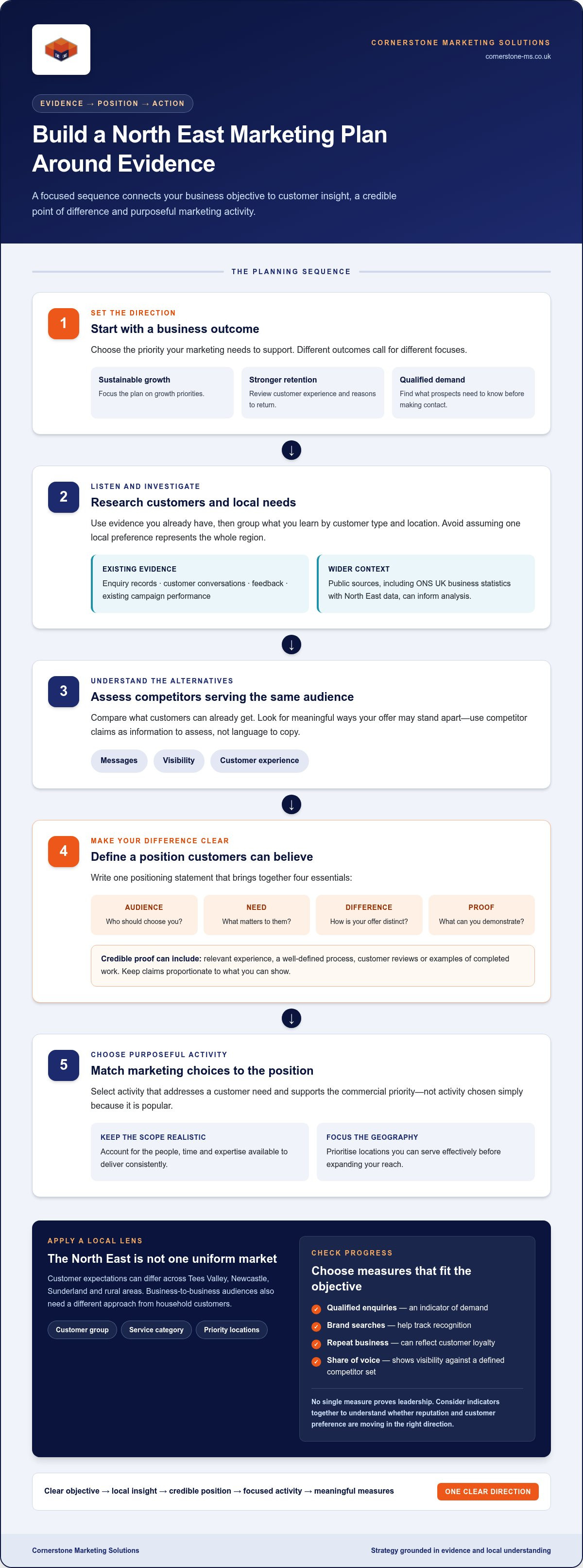
Set a baseline before choosing targets. Review customer feedback, enquiry sources, repeat business and retention data where available. Then choose measures that fit your objective. Qualified enquiries can indicate demand, brand searches can help track recognition, repeat business can reflect customer loyalty, and share of voice can show visibility against a defined competitor set. No single measure proves leadership. Taken together, these indicators help show whether reputation and customer preference are moving in the right direction.
Why do North East businesses need a focused plan?
Map where you can serve customers effectively, separating current priority locations from places you may want to reach later. A Stockton-on-Tees business serving Tees Valley and the wider North East, for example, should decide which locations matter most rather than treat the region as one audience. Research customer needs and competitors in those areas using current, verifiable sources. Then identify where your offer has a meaningful point of difference.
Match your ambition to your delivery capacity. Account for the people, time and expertise available to carry out activity consistently. A few well-supported priorities are more useful than a long campaign list that cannot be maintained. This focus gives each action a clear purpose and creates a sound basis for the next planning decisions.
Build a North East Marketing Plan Around Evidence and Positioning
Define your position before choosing channels. Otherwise, you risk investing in activity that looks busy but does not address a customer need or support a commercial priority. Build the plan in sequence: set objectives, research customers, assess competitors, define your position, then choose activity that can deliver it.
Start with a business outcome. Sustainable growth, stronger retention and more qualified demand are useful priorities, but each calls for a different marketing focus. If the goal is to attract better-qualified enquiries, investigate what prospective customers need to know before they make contact. If retention matters more, review how existing customers experience your service and what encourages them to return. Set measures that help you judge progress against the chosen objective.
How should you research customers and competitors?
Use evidence you already have: enquiry records, customer conversations, feedback and the performance of existing campaigns. Group findings by customer type and location so you can spot differences without assuming that one local preference applies across the region. Public sources, including the Office for National Statistics’ UK business statistics, including North East data, can help inform analysis of business activity and location.
Next, review competitors serving the same audiences. Compare their messages, visibility and customer experience to understand what customers can already get and where your offer may stand apart. Treat competitor claims as information to assess, not language to copy. The aim is to understand the market and find a position you can support with your own evidence.
How do you turn evidence into a credible position?
A positioning statement defines the audience, the need, the difference and the proof. Write one sentence covering all four, then check that customers can understand it and your team can deliver it consistently. A broad promise such as “excellent service” is difficult to distinguish. A specific explanation of who you help and how your approach meets a need gives customers a clearer reason to choose you.
Support your position with relevant, accurate evidence, such as experience, a well-defined process, customer reviews or examples of completed work. Keep claims proportionate to what you can demonstrate. This is how a marketing plan to look like a market leader in the north east becomes a practical guide for decisions, rather than an unsupported claim of being the best.
Once your position is clear, assess each proposed activity against it: does it reach the intended audience, reinforce your difference and support the objective? Businesses looking to bring strategy and delivery together can explore tailored marketing strategy support.
Compare Marketing Channels for North East Market Leadership
Choose channels based on how your customers make decisions, not on which platforms are currently popular. A service business seeking local enquiries may need to be easy to find and straightforward to assess. A business focused on existing customers may get more value from useful follow-up. Give each channel a defined role, a realistic level of effort and a measure linked to your objectives.
Which channels support awareness, consideration and enquiries?
Channels can work together across the customer journey. Social media can build visibility, encourage community engagement and keep messages consistent. A well-structured website gives interested customers a place to understand your services and take a next step. SEO can help people discover relevant pages through search, while email can support ongoing communication with existing audiences. PPC can target specific demand, with spend and resulting enquiries tracked against agreed objectives.
Consistent activity matters more than occasional bursts. This North East social media management guide explores how planned social content can support business growth.
| Channel | Potential role | Useful measures and planning considerations |
|---|---|---|
| Social media | Awareness and engagement | Track relevant interactions, reach and referral activity; plan for regular content and responses. |
| SEO | Discovery and consideration | Monitor relevant search visibility, visits and enquiries; allow for sustained optimisation. |
| Website | Assessment and action | Review visits to key pages and enquiry completion; keep information clear and useful. |
| Retention and follow-up | Measure engagement and meaningful actions; use it for relevant, planned communication. | |
| PPC | Targeted demand | Track spend, enquiries and lead quality; define the audience and conversion before launch. |
How should you prioritise channels with limited resources?
Score each option against four practical questions: does it fit customer behaviour, support the strategic objective, match your delivery capacity and have a clear way to measure performance? Prioritise channels that perform well across these criteria. A channel that needs more content or management than your team can sustain may be a poor fit, even if it attracts attention.
Set a baseline and put suitable tracking in place before judging results. Without those foundations and consistent execution, it is difficult to know whether a channel is contributing to demand or reputation. For a closer look at local search, read the local SEO services guide. A marketing plan to look like a market leader in the north east connects channel roles under one direction, so customers encounter a clear, recognisable business wherever they engage.
Turn Your North East Marketing Strategy into a Measurable Action Plan
A strategy becomes useful when every priority has an owner, a delivery date and a way to assess progress. A 90-day roadmap gives the team a manageable planning horizon, but adapt the pace to your capacity, approvals and business needs. Allow time for the work behind visible activity: producing and reviewing content, publishing campaigns and following up with prospective customers.
What belongs in a practical 90-day marketing roadmap?
Organise the roadmap into three stages. First, establish the foundations, such as recording current performance, agreeing messages and correcting key website information. Next, deliver the initial campaigns and supporting assets. Then review results and make evidence-led adjustments. The stages can overlap, but dependencies matter. Campaign content may rely on approved messaging, while paid activity may need suitable website pages and tracking in place first.
For every priority, name a responsible owner, set a milestone and agree how much time the work can realistically take. Coordinate social media, website content, SEO and campaign assets around the same audience and message, rather than creating separate workstreams that compete for attention. If website improvements are part of the plan, the North East web design guide explores how a clear digital foundation can support customer journeys.
How should you measure and adjust the plan?
Begin with a baseline, then choose a small set of measures that connect directly to the agreed objective. For a qualified-demand goal, track relevant website enquiries alongside indicators such as visits to priority pages. For a retention objective, monitor repeat business and engagement with planned customer communications. Leading indicators can show whether activity is reaching people. Commercial outcomes help assess whether it is contributing to business priorities.
Set a regular review point that fits the team’s working rhythm. Compare results with the baseline, record what customers responded to and note where delivery was delayed or capacity became stretched. Keep what is supported by evidence, refine what needs improvement and pause activity that no longer serves the objective. Don’t change direction based on one isolated result. Look for useful patterns over time.
A marketing plan to look like a market leader in the north east needs a steady link between positioning, delivery and measurement. To explore support for putting a coordinated plan into action, explore Cornerstone’s marketing services.
Deliver a Consistent Market-Leader Presence with Cornerstone
A strong plan needs coordinated delivery. If social posts, website pages and search content each communicate a different promise, customers may struggle to understand what sets the business apart. Cornerstone Marketing Solutions brings together tailored strategy, social media management, web design, SEO and visual content, so each activity can support the same audience, position and objective.
Based in Stockton-on-Tees, Cornerstone works with businesses across Tees Valley and the wider North East. Its regional focus helps ground planning in the locations and customers a business wants to reach, while data-led decisions provide a basis for reviewing activity. The aim is to build a recognisable, credible presence through clear messaging and consistent delivery.
How does joined-up marketing support a stronger reputation?
Customers may encounter a business through search, social media, its website or a recommendation. Consistent language and visual content across relevant touchpoints can reinforce what the business does and who it serves. Repeated exposure alone isn’t enough. Each interaction should be useful and reflect a position the business can genuinely support.
Planned social activity can help maintain a steady conversation with an audience, while performance reviews show which messages receive meaningful engagement. A clear website can explain the offer and guide visitors towards an appropriate next step. SEO helps connect relevant search needs with useful pages, and video can bring the same position to life through people, process or examples of work. These elements work best when they share a strategic direction, rather than operating as separate campaigns.
What are the next steps for your business?
Begin with three decisions: name one priority audience, choose one business objective and record a measurable baseline. This gives the plan a clear starting point and makes it easier to assess whether marketing is contributing to progress. Then identify the messages and activity that fit your goals, customer needs and delivery requirements.
Cornerstone tailors its approach to each organisation’s objectives and capacity, bringing planning and creative delivery together across suitable channels. This makes a marketing plan to look like a market leader in the north east a practical framework for building recognition, not simply a statement of ambition. If you’re ready to discuss a plan suited to your business, plan your next stage of marketing with Cornerstone.
Put Your North East Marketing Plan into Action
Credible market leadership starts with a clear audience, a meaningful point of difference and evidence that your marketing is building recognition and demand. A focused plan connects those foundations to suitable channels, realistic delivery and measures that help you learn and improve.
Building a marketing plan to look like a market leader in the north east doesn’t mean doing everything at once. It means choosing priorities your business can deliver consistently, then aligning each customer touchpoint around the same position. Over time, that consistency can strengthen familiarity and trust.
Based in Stockton-on-Tees and serving businesses across Tees Valley and the wider North East, Cornerstone Marketing Solutions brings together social media management, web design, videography, SEO and other marketing services. As part of the award-winning Cornerstone Group, Cornerstone connects tailored strategy with creative delivery and data-led decisions.
Set your next priority and take a practical first step. Plan your next stage of marketing with Cornerstone and build a steady foundation for stronger recognition across the region.
Frequently Asked Questions
What should a marketing plan include to establish market leadership?
A marketing plan to look like a market leader in the north east should connect commercial objectives to customer needs and evidence. Include priority audiences, competitor research, a clear point of difference, suitable channels, owners, timelines and measures. Define leadership in terms you can assess, such as customer preference, reputation or relevant commercial performance. Avoid unsupported claims of being number one. Build a position you can demonstrate through consistent delivery and credible proof.
How can a small business look like a market leader without a large marketing budget?
A small business can build a credible presence by focusing on consistency and relevance before expanding activity. Identify the audiences and North East locations that matter most, explain what makes your offer useful, and choose channels you can maintain well. Use customer feedback and available performance data to refine messages and priorities. A focused website and regular, purposeful social activity can reinforce recognition more effectively than scattered campaigns that are difficult to sustain.
How do you identify your competitors in the North East?
Start with the businesses your target customers genuinely compare with, not every organisation operating across the North East. Consider shared services, customer needs, sectors and locations. Review competitors’ public messaging, service information, visibility and customer experience, then compare those findings with sales conversations and customer feedback. Build a relevant comparison set for each audience. This helps reveal where your business can offer a meaningful difference without copying another organisation’s claims or positioning.
Which marketing channels help a business become more visible locally?
The right mix depends on customer behaviour and the outcome you want. A clear website and SEO can support discovery and help potential customers assess your services. Social media can maintain visibility and engagement, while email can support ongoing relationships with existing audiences. PPC may help reach a defined audience through targeted campaigns. Set a purpose and measure for each channel, then coordinate messaging so customers receive a consistent impression of your business.
How long does it take for a marketing plan to show results?
The timing depends on your starting point, objectives, chosen channels and consistency of delivery. You may see campaign indicators before changes in organic search visibility, reputation or repeat business become clear. Set realistic milestones and record a baseline before activity begins, then review progress at agreed intervals. Avoid promising a fixed result or changing direction based on one early signal. Use accumulated evidence to decide whether to continue, refine or reprioritise activity.
How should a North East business measure whether its marketing plan is working?
Choose a small set of measures that directly reflect your objectives. These could include relevant enquiries, website actions, search visibility, audience engagement or customer retention. Record a baseline and report consistently so you can compare progress over time. Where possible, connect marketing indicators to commercial outcomes and consider customer feedback alongside the numbers. This helps distinguish meaningful progress from activity alone and shows whether the plan remains realistic for your team to deliver.