


What if the detail that makes a prospective client hesitate isn’t your expertise, but how clearly your firm presents it? For professional services firms in Middlesbrough, branding should make complex expertise easier to understand and help people know what to expect at each decision point. A clear identity helps people recognise what the firm does, while inconsistent materials can make that message harder to follow. That’s the practical purpose of branding for professional services firms middlesbrough.
A new logo alone won’t resolve every challenge. Your brand needs to work across the places clients encounter your firm, from your website and social media to stationery and other printed materials. A joined-up approach helps those elements feel consistent, credible and recognisably yours.
This guide explains how to assess branding support, prepare a useful project brief and define what the work should achieve beyond a visual refresh. It also looks at how graphic design, web, social and video content can support a consistent identity. With a clear framework, your firm can make informed branding decisions and present its expertise more clearly across relevant touchpoints.
Key Takeaways
- Identify the signals that can help prospective clients feel confident about an unfamiliar professional services firm.
- Turn specialist expertise into clear client-facing language, then align your positioning, tone and visual identity.
- Use a practical framework to assess branding support for a Middlesbrough professional firm, focusing on strategy, design scope, communication and relevant experience.
- Build a useful project brief by defining the challenge, audience and desired impression, then gathering materials and noting inconsistencies.
- Explore how Cornerstone Marketing Solutions’ Graphic Design can express a firm’s identity across stationery and large-scale vinyl printing.
Why branding for professional services firms in Middlesbrough starts with client confidence
Professional services are built on expertise, judgement and relationships. A prospective client may first encounter a firm through a search result, a social post or a document shared by a colleague. Before speaking to anyone, they’re trying to understand what the firm does, who it helps and whether its approach feels credible. Clear brand signals can answer those questions without overstating what the firm delivers.
For a Middlesbrough or Teesside firm, that means making expertise understandable and recognisable wherever a client encounters the business. Clear, consistent branding helps clients understand what a professional firm does and what they can expect from it. This is the practical starting point for branding for professional services firms middlesbrough: reduce uncertainty with a coherent client-facing identity, not visual change for its own sake.
What does branding mean for a professional services firm?
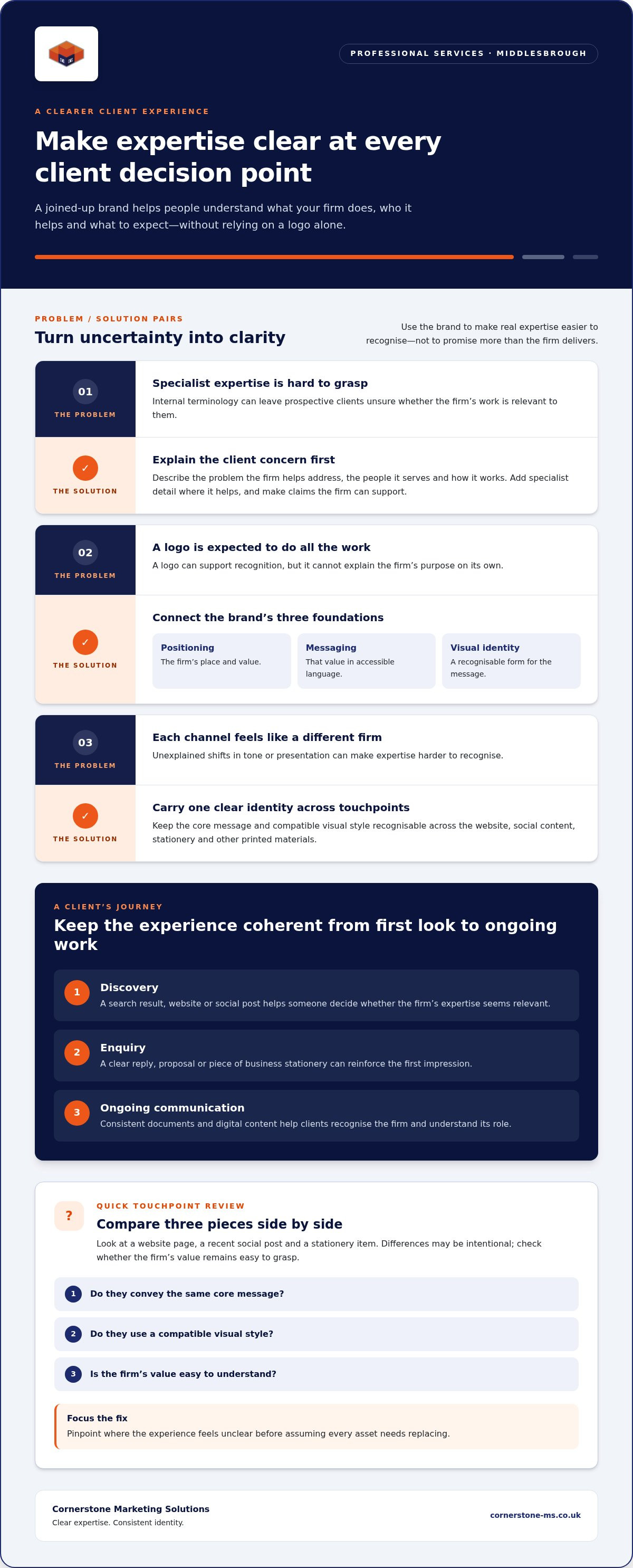
A firm’s brand is bigger than its logo. It is the combined impression created by its positioning, messages, tone and visual expression. A logo can help people recognise the firm, but it cannot explain its purpose on its own. The same is true of a colour palette or typeface: these assets are most effective when they support a clear account of the firm’s expertise and value.
The idea applies across professional services, including consultants, accountants and legal practices. Each has to make specialist knowledge relevant to the people it serves. Positioning sets out the firm’s place and value; messaging explains that value in accessible language; visual identity gives the message a recognisable form. Together, they create a consistent foundation for communication.
Where do clients encounter a firm’s brand?
Think of the client journey as a series of decision points. During discovery, someone may find the firm through its website or social content and decide whether its expertise seems relevant. At enquiry, the tone and clarity of a reply, proposal or piece of business stationery can reinforce that first impression. During ongoing communication, consistent documents and digital content help clients recognise the firm and understand its role.
Each touchpoint should feel like part of the same organisation, even when the format changes. Compare a website page, a recent social post and a stationery item side by side. Do they convey the same core message? Do they use a compatible visual style? Is the firm’s value easy to grasp? Differences may be intentional, but unexplained shifts in tone or presentation can make expertise harder to recognise.
Use this review to pinpoint where the experience feels unclear, rather than assuming every asset needs replacing. A consistent brand gives prospective clients a clearer path from recognition to understanding and supports a more coherent relationship once they become clients.
Build a professional services brand around expertise, clarity and consistency
A strong brand starts with what the firm genuinely knows and the value clients receive from that expertise. It shouldn’t promise a particular business result or rely on specialist language that prospective clients may not recognise. Instead, translate knowledge into a clear explanation of the problems the firm helps address, the people it serves and the way it works.
A professional firm’s brand should reflect its actual expertise and client value, expressed clearly and consistently at every relevant touchpoint. This principle keeps creative decisions grounded in the firm’s real offer rather than passing trends.
Make specialist expertise easier for clients to understand
Start with the client’s concern, not the firm’s internal terminology. A consultant might replace a technical description of a methodology with a plain-language explanation of the business issue it addresses. An accountant could describe a service in terms of the client task it supports, then add specialist detail for readers who need it.
Clear service descriptions help prospective clients decide whether the firm is relevant to them. Check each description against three questions: Is the intended audience clear? Is the work described in language that audience uses? Can the firm support every claim with its actual experience and approach? Specific, credible wording is more useful than broad promises of success.
Keep visual identity and messaging working together
Positioning defines the place a firm aims to occupy in clients’ minds and the value it offers. Tone shapes how that value sounds, while visual identity gives it a recognisable appearance. These elements are connected, but they aren’t interchangeable: polished design cannot clarify a vague position, and well-written copy can still feel disjointed if its presentation changes from one channel to another.
Agree on the firm’s core character first, then use it to guide design choices. Typography, colour and imagery can reinforce qualities such as precision, approachability or stability, provided those qualities reflect how the firm actually works. A deeper look at brand positioning strategy can help clarify the thinking behind those choices.
Consider a hypothetical Teesside consultancy that wants to communicate practical, dependable advice. Its website could describe a client problem and explain the consultancy’s approach in direct language. A printed proposal using the same visual style and tone would carry that message into an offline conversation. The details differ, but the underlying impression remains coherent.
To put this into practice, write a short brand reference covering the firm’s audience, client value, preferred tone and visual principles. Use it when reviewing web pages, social content and printed materials. For support expressing the identity across design and digital touchpoints, Cornerstone Marketing Solutions’ branding and graphic design can bring consistency to materials from stationery to large-scale vinyl.
How to compare branding support for a Middlesbrough professional firm
Branding can feel subjective because visual preferences differ. But a project’s suitability can be assessed through observable criteria: whether the work addresses a defined challenge, whether the proposed scope fits the firm’s needs and whether the process is clear. Look at the thinking behind the work as well as its appearance.
A useful proposal connects the firm’s audience and business challenge to practical outputs. Use the table below to assess that connection.
| Area | What to look for | Useful question |
|---|---|---|
| Strategic thinking | A clear account of the firm’s audience, expertise and brand challenge. | Does the proposed direction respond to a real client or communication need? |
| Design scope | Defined design work and outputs, such as identity elements or materials for specific touchpoints. | Will the work address where the current presentation feels unclear or inconsistent? |
| Communication | A straightforward process for discussing the brief, reviewing work and making decisions. | Are responsibilities and next steps explained in plain language? |
| Relevant experience | Examples that show an understanding of professional audiences and the need to explain specialist services clearly. | Can you see how the work makes the organisation and its offer easier to recognise? |
What should a branding proposal make clear?
A useful proposal describes the brief, intended audience and challenge without relying on vague phrases such as “stand out” alone. It sets out the design scope and relevant outputs, then shows how they relate to the firm’s actual materials. If the priority is a clearer first impression online, for example, the proposal should explain how the work applies to the website, not just present a new visual mark.
Fit matters. A full identity project may be broader than a firm needs if its main issue is that existing materials don’t feel consistent. Conversely, a logo-only update may leave that issue unresolved if the website and stationery also need a coordinated approach.
How can firms assess fit without relying on promises?
Review examples for clarity, consistency and practical application, rather than choosing on visual preference alone. Can you understand the organisation’s offer? Does the identity hold together across different formats? Look for evidence of a considered process and finished work, not promises of guaranteed enquiries or commercial results.
Communication is also part of the experience. A clear explanation of design decisions and next steps helps the firm contribute useful feedback. If the website is a key brand touchpoint, consider how its design supports a coherent online identity, including the principles discussed in web design across the North East.
Use these criteria to identify which approach fits the challenge and where the work will be applied. That gives the firm a sound basis for discussing scope and judging the proposed response, without treating personal taste as the only measure.
Prepare a practical branding brief for your Middlesbrough firm
A focused brief gives a branding project a clear starting point. It helps you explain what needs to change, who the identity must speak to and where it will appear. For firms exploring branding in Middlesbrough, preparation also helps keep the work grounded in the firm’s expertise and client needs.
Use this sequence to organise your thinking before discussing the project:
- Define the challenge. Describe what prompted the review. Perhaps prospective clients struggle to understand a service, your materials look different from one another, or the firm’s presentation no longer reflects its work. Be specific about the issue, not just the wish for a “fresh look”.
- Describe the audience. Note the clients you want to reach, what they need help with and what they should understand about your firm. A clear audience helps shape useful language and design decisions.
- Set the desired impression. Choose qualities that fit how the firm works, such as precise, approachable or dependable. Explain what you want a prospective client to understand or feel, rather than requesting a style based only on personal taste.
- Map the touchpoints and practical constraints. Identify the materials that matter, who needs to review the work and any existing elements that must be retained or updated. This helps keep the project discussion realistic and relevant.
Set the project context and audience
Summarise the firm’s services in plain language, name its intended clients and state why you’re reviewing the brand now. Gather current materials such as website pages, social posts, stationery and proposals. Mark where the message, tone or visual presentation feels inconsistent. These examples give everyone involved a shared view of the issue and help distinguish necessary changes from changes driven only by preference.
For further strategic context, graphic design and branding guidance can help connect the brief to the wider decisions behind a firm’s identity.
Choose touchpoints and signs of progress
Prioritise the places clients encounter the firm, rather than trying to address every channel at once. You might focus first on the website, enquiry documents and social content because they support discovery, evaluation and ongoing communication. Social posts should carry the same core identity, even when their format and subject vary. Social Media Management in Teesside is relevant when social content forms part of the brand brief.
Set practical signs of progress before work begins: can a reader describe the firm’s offer after reviewing its key materials? Do the selected touchpoints share a consistent tone and visual approach? These checks don’t promise a particular commercial result. They give the firm a clear way to assess whether the work has addressed its original challenge. Cornerstone Marketing Solutions provides branding and design support for firms’ key touchpoints.
How Cornerstone Marketing Solutions can support branding for Middlesbrough firms
For professional firms, a brand has to work in the materials clients actually encounter, not only in a presentation or logo file. Cornerstone Marketing Solutions is a digital marketing agency based in Stockton-on-Tees, supporting businesses in the Tees Valley and wider North East. Its branding and related creative services help firms bring a clearer identity into practical, public-facing touchpoints.
Start with the challenge you have identified. If key materials look disconnected, consider which items need a consistent visual approach. If your website or social content doesn’t explain your expertise clearly, think about how the message and presentation could better reflect the firm’s work. A defined priority keeps the project focused on useful outputs.
Bring brand expression into practical materials
Cornerstone’s Graphic Design service covers branding from stationery items to large-scale vinyl printing. This gives firms a way to consider how their identity appears across different formats, from materials used in client communications to larger-scale applications. The right choices depend on the firm’s needs and where its audience encounters it.
A website is another important brand touchpoint. Cornerstone designs high-quality, mobile-friendly websites, giving firms a digital setting to present their services and identity. As you plan the work, consider how the site’s content and visual design should relate to other materials, rather than treating each asset as a separate project. The goal is a coherent presentation that makes the firm easier to understand.
For example, a firm might want its stationery and website to feel recognisably connected while making its service descriptions clearer. A practical project discussion can identify which materials matter most and how design should express the firm’s established expertise. The scope should follow the challenge, not assume every touchpoint needs to change.
Connect content with a consistent firm identity
Social content and video can also contribute to how a professional firm presents itself. Cornerstone’s Social Media service uses in-house talent to create content. Its Video Content includes professional 4K video footage and high-definition images. These formats can help a firm communicate visually, while a consistent identity and tone guide how its services are represented.
Before work begins, bring together the key project details: the audience you want to reach, the message clients should take away and the touchpoints that matter most. This gives the creative work a practical reference point and helps maintain consistency across design, web and content. Cornerstone can shape its support around the firm’s priorities, focusing on useful brand expression rather than unsupported promises of results.
If you’re ready to discuss your priorities and how they could translate into practical brand materials, discuss your branding project with Cornerstone.
Give your next brand decision a clear purpose
Your firm doesn’t need to change everything at once. Choose one client-facing moment where a clearer message or more consistent presentation would help, then use that priority to guide the next decision. It could be the first explanation of your services or the way a prospective client moves from initial interest to an enquiry.
That focus makes branding a practical business consideration, not simply a design exercise. A well-defined purpose also gives your team a useful reference for future communications, helping each new piece of content or material support the same understanding of your firm.
When you’re ready to turn that priority into a considered project, discuss your branding project with Cornerstone Marketing Solutions. Start with the touchpoint that matters most and build an identity that reflects your firm’s expertise and gives clients a more coherent experience.
Frequently Asked Questions
Is branding more than a logo for a professional services firm?
Yes. A logo is one visual asset, while branding also shapes how a firm describes its services and presents itself in everyday communications. For example, a proposal cover might carry the same tone and visual style as the firm’s website while explaining the service in client-friendly language. Review these elements together to see whether they present a clear, recognisable picture of the firm.
Can a professional services firm refresh its brand without changing its name?
Yes. A firm can update its identity while keeping the name clients already know. It might refine service descriptions, adjust visual elements or bring selected materials into closer alignment. Before making changes, identify what recognition the firm wants to preserve, such as a familiar name or established colour. Then define the specific reason for the refresh so the work responds to a real need.
How much does branding cost for a professional services firm in Middlesbrough?
Branding costs depend on the project’s scope, materials and level of support required, so there isn’t one figure that suits every firm. A focused update will involve different work from a broader project covering several materials. Identify the challenge, audience and intended outputs first, then use that brief to define a suitable project scope.
What should a professional services branding brief include?
A useful brief should state what the firm does, who it wants to reach and why it is reviewing its brand. Add examples of current materials, such as a proposal or service webpage, and note what feels unclear or inconsistent. Include the impression clients should take away and any practical constraints, such as existing assets the firm wants to retain. This gives project discussions specific context.
Do professional services firms need separate brands for every service?
No, separate identities aren’t automatically needed. Consider whether clients see the services as part of one connected firm or as distinct offers for different audiences. Related services may be easier to navigate under one identity with clear, differentiated descriptions. Separate branding can add complexity, so first decide whether it would genuinely help clients understand the offer or make the relationship between services less clear.
How can a firm tell whether its branding is working?
Assess it against clear objectives set before the work begins. Ask someone unfamiliar with the firm to review a key service page and explain what the firm offers, then compare that understanding with your intended message. Check whether selected materials use a coherent tone and visual approach. Feedback can reveal where further clarification is needed, but branding alone can’t guarantee a change in enquiries or business performance.