

A costly-looking website won’t make your business look credible if its details don’t add up. Avoiding looking like an amateur business online isn’t about chasing the latest design trend; it’s about giving people a consistent, useful experience wherever they encounter you. A dated website, mismatched branding or unanswered social messages can leave visitors unsure whether they can trust your business.
If your website and social channels feel inconsistent, it’s understandable to wonder which issue is doing the most damage. Design matters, but so do clear copy, mobile usability, accurate information and a straightforward way to enquire. You don’t have to overhaul everything at once.
This guide will help you spot details that weaken first impressions and prioritise realistic improvements across your website, social channels and customer journey. You’ll learn how consistent branding and messaging build confidence, where to focus your time and how to create a joined-up online presence that makes it easier for potential customers to take the next step.
Key Takeaways
- Recognise inconsistencies and points of friction that can make visitors hesitate, without assuming you need to replace your whole online presence.
- Understand how your website, social channels and search listings work together, and which details to keep accurate and easy to find.
- Compare DIY updates, focused project support and ongoing marketing management by considering your time, skills and need for consistency.
- Use a practical audit to record issues, assess their impact on customers and choose realistic next steps.
- Make avoiding looking like an amateur business online manageable by turning audit findings into a focused brief for your priority channels.
What makes a business look amateur online, and why does it matter?
An imperfect online presence is fixable. You don’t need to replace your entire website or restart every social channel. Often, a handful of avoidable inconsistencies or points of friction make it harder for visitors to understand your business and feel confident taking the next step.
Online credibility is the confidence people gain when your business presents clear, accurate and consistent information across the places they encounter it. Visitors quickly judge whether your offer is relevant, your information is easy to understand and your business appears dependable. A weak point on one channel can create doubt, even if the service itself is sound. Managing how your business appears across those channels is part of online identity management.
Common warning signs include broken links, inconsistent branding, unclear services and outdated information. These details don’t prove that a business is unreliable, but they can make trust harder to establish. A local tradesperson, for example, might have a polished social profile but an old phone number on their website. A small consultancy might describe its offer differently on its homepage and business listing. In both cases, visitors have to work out which information is correct.
Which online details weaken a first impression?
Compare your logos, colours, tone of voice and practical business details across your website, social profiles and search listings. A branding change may be intentional, but inconsistent versions can make your channels feel disconnected. Vague service descriptions add another hurdle: “quality solutions” tells a potential customer little about what you actually do. If it’s unclear how to call, email or submit an enquiry, people may simply leave.
Why does consistency matter across customer touchpoints?
A potential customer might find your business in a search result, visit your website to understand your services, then check a social profile to see whether your business is active. Each touchpoint contributes to the same impression. If the contact details, service descriptions or visual identity don’t match, a legitimate business can appear less dependable than it is. Consistency helps visitors recognise that they’re dealing with the same organisation.
That doesn’t mean every channel needs expensive polish. A useful, accurate website with clear service information and an easy contact route can build more confidence than an elaborate design that leaves basic questions unanswered. Focus first on reducing uncertainty for the customer. That makes avoiding looking like an amateur business online a practical process, not a costly exercise in appearances.
How to build a credible online presence across your website, social media and search
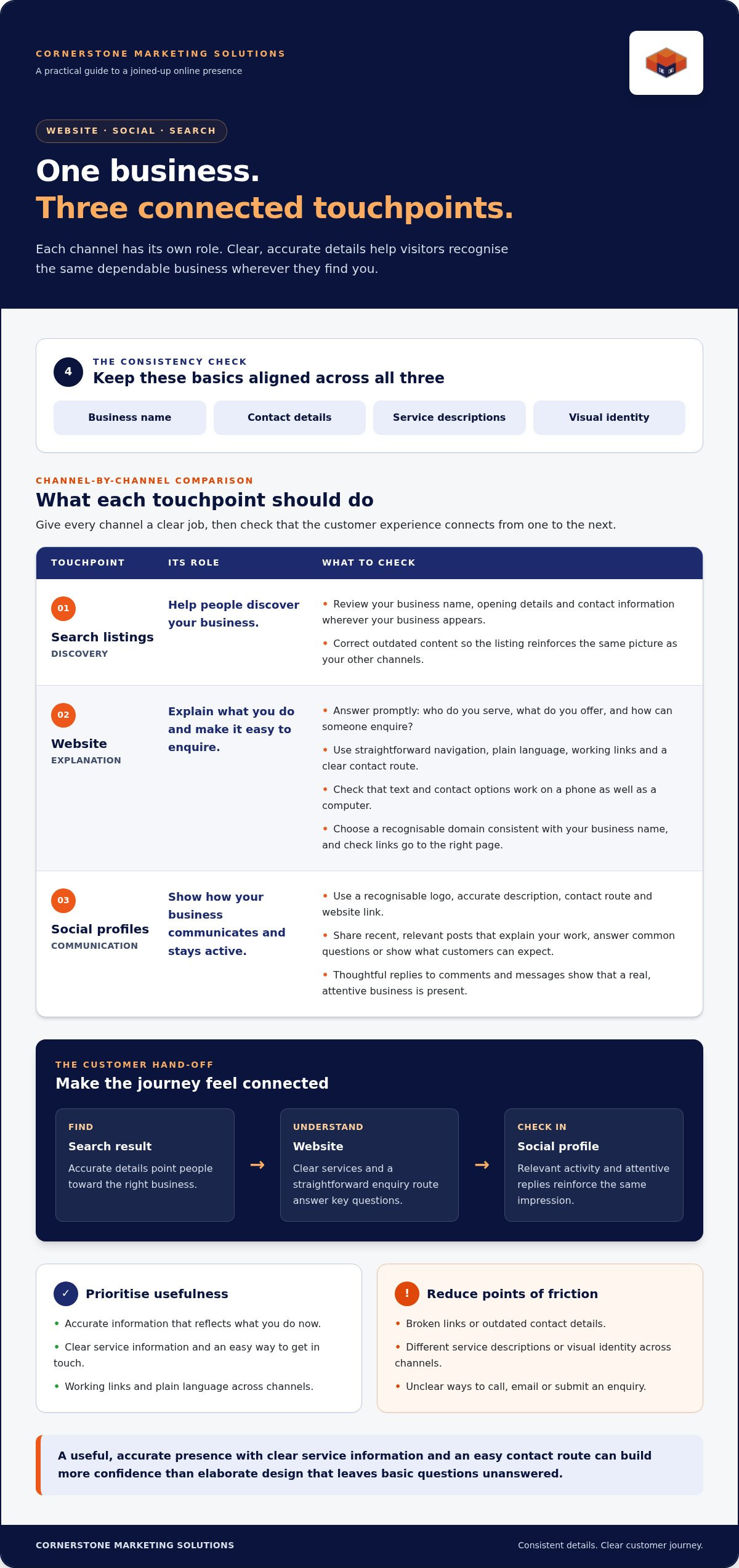
Your website, social channels and search listings each have a different role. Search helps people discover you, your website explains what you do, and social profiles show how your business communicates and stays active. Together, they form one customer experience. Keep the basics aligned across all three: your business name, contact details, service descriptions and visual identity.
Start with accuracy and usefulness. Make sure visitors can understand your services, find a working way to get in touch and see content that reflects what you do now. Check links, use plain language and give each page a clear next step, such as calling, emailing or completing an enquiry form. Consistent colours, logos and tone help people recognise your business, while each channel can still serve its own purpose.
What should a professional business website make clear?
Answer three questions promptly: who do you serve, what do you offer, and how can someone enquire? Organise pages and navigation around the information visitors need, rather than your internal business structure. Keep menus straightforward, and check that text, buttons and contact options work on a phone as well as a computer. For further ideas, explore this web design guidance for North East businesses.
Choose a domain that’s easy to recognise and consistent with your business name. Use it across your website and profiles, and check that links take visitors to the right page. A simple, memorable web address supports recognition and helps customers move between channels without wondering whether they’ve found the right business.
How can social media reinforce business credibility?
Complete each profile with a recognisable logo, an accurate description, a contact route and a link to your website. Share recent, relevant posts that explain your work, answer common questions or show what customers can expect. Thoughtful replies to comments and messages show that a real, attentive business is present. For practical support with a coordinated approach, read about social media management for Teesside businesses.
Search listings should reinforce the same picture. Review your business name, opening details and contact information wherever your business appears, and correct outdated content. A North East service business, for example, should make it easy for a prospective customer to match its search listing with the right website and social profile. If you’re avoiding looking like an amateur business online, make those hand-offs clear before adding more channels. Businesses looking to align their website, branding and social activity can explore coordinated digital marketing support.
DIY marketing or professional support: which route fits your business?
You don’t have to choose between doing everything yourself and handing over your entire marketing operation. The right approach depends on the problem, the skills in your team, the time you can assign and whether several channels need to work together. For some businesses, a few well-managed updates are enough. Others may benefit from specialist input on a defined project or ongoing support.
| Approach | Best suited to | Consider |
|---|---|---|
| DIY updates | Clear, simple fixes and someone with time to make them | Assign an owner and a regular review so details don’t drift again. |
| Selective project support | A specific need, such as a website refresh, branding or a set of social content | Agree the scope and priorities, while keeping day-to-day decisions in-house. |
| Ongoing marketing management | Several channels that need regular coordination and attention | Set responsibilities and a workable process for approvals and updates. |
When is a DIY improvement enough?
Start in-house if the task is straightforward: correct a phone number, update a service description, replace an old profile image or remove an outdated offer. A short review routine can help keep information aligned across your website and social profiles. DIY is most workable when one person has clear ownership, the right access and enough capacity to make and check the changes.
If improvements keep slipping because no one has time, or the same inconsistency appears across channels, you may need a different level of support. That doesn’t mean committing to a complete redesign or long-term arrangement. You can retain control of your marketing and bring in expertise for the specific work that needs it.
When can specialist marketing support help?
Specialist input can help when the challenge spans connected areas, such as aligning your brand identity with a website, developing social content or improving search visibility. Cornerstone brings relevant creative and digital services together around a defined project, shaped by your priorities. Explore this strategic branding guidance for North East businesses if your identity needs clearer direction.
Before deciding, identify the main customer-facing problem, the skills needed to address it and who will maintain the result. This keeps the work proportionate. Avoiding looking like an amateur business online is about fixing the right points of friction, not buying the most support. Set a clear brief, agree what is in scope and assess the work against those priorities.
How to improve your online presence: a practical business credibility audit
A focused audit helps you find what’s confusing customers without turning every small flaw into a major project. Look at your business as a potential customer would, then record each issue, its effect on customers, the effort involved and who will own the fix. This makes avoiding looking like an amateur business online a sequence of manageable decisions rather than an open-ended redesign.
What should you check on your website and social profiles?
- Search your business name. Review the results a customer is likely to see. Note outdated pages, old contact details or profiles that no longer represent the business.
- Review your profiles. Compare your business name, services, phone number, email, opening information and website links. Check that descriptions and recent posts reflect what you currently do.
- Test the website journey. Open key pages on a phone and a computer. Follow the route from a service page to its enquiry option, testing links, forms and contact details along the way.
- Check clarity and accuracy. Ask whether a visitor can understand your offer and identify a sensible next step. Record vague service descriptions, missing information and any detail that conflicts with another channel.
Keep the audit practical. A broken enquiry link deserves attention before a minor colour preference because it can prevent someone from contacting you. Visual refinements still matter, but prioritise fixes that affect accuracy and the customer journey.
How should you prioritise fixes without taking on everything?
Group findings into three levels: urgent accuracy issues, customer-journey problems and longer-term improvements. For every item, note its customer impact, estimated effort, responsible person and review date. This clarifies ownership and helps you choose realistic actions instead of collecting a list no one has time to complete.
A sample 30-day sequence could start with correcting essential business details, then move to repairing key website journeys, followed by reviewing social content and planning broader refinements. Treat this as an example, not a fixed timetable. Adjust it to your team’s capacity and the complexity of each task. If search visibility is a priority, explore this local SEO guidance for North East businesses.
Prioritise credibility fixes by addressing what is inaccurate first, what blocks customers next, and what improves presentation after that. If you’d like support turning your audit into a focused plan, discuss your digital marketing priorities with Cornerstone.
Turn a more professional online presence into lasting customer confidence
Lasting confidence comes from being clear, consistent and useful at every stage of the customer journey. A polished appearance can help, but it can’t replace accurate information, a clear offer or an easy next step. Turn your audit findings into a focused brief so each improvement has a purpose and you can decide what to address first.
What should a practical marketing brief include?
Keep the brief grounded in what your business and customers need. Record:
- Audience: who you want to reach and what they need to understand.
- Goals: the business priorities the work should support.
- Obstacles: the gaps or friction points identified in your audit.
- Priority channels: what needs attention now and what can follow later.
- Customer actions: what you want visitors to do, such as enquire or call.
- Measures of progress: realistic ways to assess whether the work is serving its purpose.
This keeps the project focused on useful change rather than surface-level activity. For example, if customers struggle to understand your services, clearer website content may take priority over a visual refresh. If your business details differ across channels, correcting those discrepancies may be the more important first step.
How can joined-up support keep your online presence consistent?
Branding, web design, social media and SEO each have a distinct role, but they should support the same understanding of your business. A clear brand direction can guide how your website looks and sounds; social content can reinforce key messages; and SEO can help people find relevant information through search. Coordinating these elements creates a more coherent experience without making every channel identical.
Cornerstone Marketing Solutions is based in Stockton-on-Tees and works with businesses across the North East. Its web design, social media management, branding and SEO services can be brought together around your project priorities. The scope can reflect your brief and the work required, without assuming every channel needs attention at once.
For businesses avoiding looking like an amateur business online, the next step is to turn identified problems into clear priorities and a practical plan. If you’d like to explore support shaped around your goals, discuss a tailored marketing project with Cornerstone.
Make your next online improvement count
Building customer confidence doesn’t require a complete digital overhaul. Clear, accurate information and a consistent experience across your website, social channels and search listings make it easier for people to understand your business and take the next step. Start with the issues that create the most uncertainty, then choose improvements that fit your time, skills and priorities.
Avoiding looking like an amateur business online is about more than appearances. Use your audit to keep essential details current, remove friction from the customer journey and set a focused brief for any further work. Consistency and usefulness provide a stronger foundation for trust than superficial polish alone.
Cornerstone Marketing Solutions is based in Stockton-on-Tees and serves businesses across the North East. As part of the award-winning Cornerstone Group, it brings together services including web design, social media management, videography, branding and SEO to support coordinated digital projects. To discuss an approach shaped around your priorities, talk to Cornerstone about a tailored digital marketing project.
Choose a practical first step, then build from there.
Frequently Asked Questions
What makes a business look unprofessional online?
Outdated details, broken links, inconsistent branding and unclear service information can make a business appear less dependable. Visitors may also struggle if they can’t find a contact route or understand what the business offers. These issues don’t mean the business itself is unprofessional, but they can create doubt. Review your website, social profiles and search listings together to find discrepancies and make the next step clear for potential customers.
How can I make my small business look more professional online?
Start by making your business information accurate and your offer easy to understand. Use consistent names, contact details, descriptions and visual cues across your website and social profiles. Check that important pages and enquiry routes work on mobile and desktop, then keep content current. For a North East small business, make it straightforward for local customers to understand what you do and how to take the next step.
Can a business look professional online without a large marketing budget?
Yes. Professionalism depends on clear, accurate and useful information, not on spending heavily across every channel. Correct outdated contact details, fix broken links, clarify service descriptions and use the same logo and business details across profiles. Choose improvements based on their impact on customers and the time or skills available. If a task needs specialist expertise, focus support on that project rather than overhauling everything.
What should I fix first on my business website?
Fix anything that prevents customers from understanding your offer or getting in touch. Check that your key services are clearly explained, contact information is accurate, links work and enquiry forms can be completed. Then test the main pages on a phone and computer to catch navigation or usability problems. Visual refinements can follow. This prioritises practical customer needs over lower-impact design preferences.
How often should a business update its website and social media?
Update information whenever it changes, such as services, contact details or opening information, and review key pages and profiles regularly. Social content should reflect current activity and the business as it operates now, rather than follow an arbitrary posting schedule. Set a review routine that suits your team and capacity. The priority is to keep essential details accurate and respond appropriately to customer enquiries across the channels you use.
Does inconsistent branding make a business look unprofessional?
It can make a business harder to recognise and leave visitors unsure whether they’re viewing the same organisation across different channels. Differences in logos, colours, tone or business descriptions can create that impression, especially when contact details also conflict. Your website and social profiles don’t need to be identical, but they should share a recognisable visual direction and consistent core messages that accurately represent your business.
Should I hire a marketing agency to improve my online presence?
It depends on the work required, the skills in your team and the time available. You may be able to manage straightforward updates yourself, while joined-up branding, web design, social media or SEO may benefit from specialist support. Cornerstone Marketing Solutions is based in Stockton-on-Tees and serves businesses across the North East, bringing relevant digital and creative services together around project priorities. To discuss a project shaped around your needs, contact Cornerstone Marketing Solutions.