

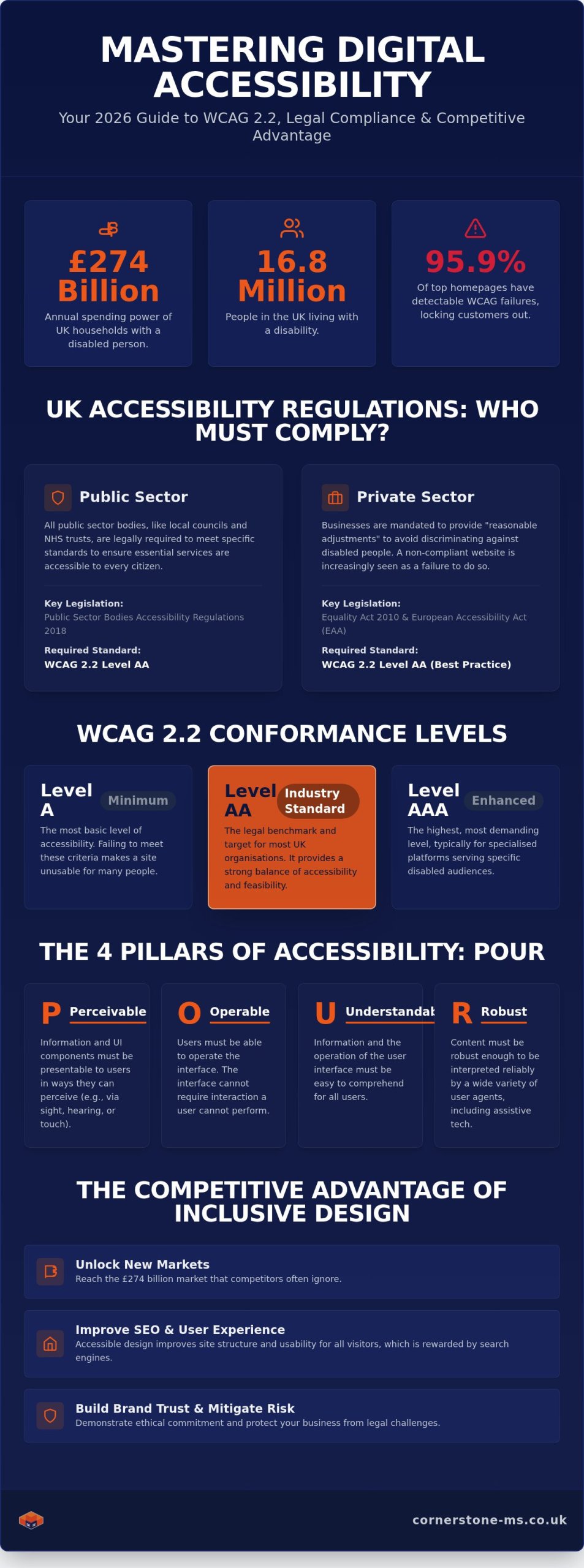
Families with at least one disabled person in the UK hold a combined spending power of £274 billion every year. Despite this massive market, many North East businesses unknowingly lock these customers out because their websites fail to meet modern accessibility standards. It’s common to feel confused about the transition from WCAG 2.1 to the 2.2 requirements. You might also worry about the legal repercussions of the Equality Act 2010 or find it difficult to explain the technical necessity of these updates to your stakeholders.
We’re here to provide the stability and technical precision your brand needs to thrive. This guide helps you master the latest requirements to ensure your digital presence is inclusive, compliant, and competitive in the 2026 landscape. By treating accessibility as a core digital foundation rather than a checkbox, you protect your business and improve the experience for every visitor. We’ll provide a clear roadmap for compliance, explain the vital link between inclusive design and SEO, and help you identify a reliable local partner to manage the technical implementation for you.
Key Takeaways
- Understand the transition to WCAG 2.2 and why these specific updates are essential for maintaining a compliant digital presence in 2026.
- Learn how your business can meet modern accessibility standards to satisfy the “reasonable adjustments” requirement of the Equality Act 2010.
- Discover the technical link between inclusive web design and SEO, ensuring your site ranks higher by serving a more diverse audience.
- Master the four POUR principles to build a stable, functional foundation that prioritises the end-user experience for all visitors.
- Find out how a unified team approach to bespoke web design balances aesthetic excellence with rigorous regulatory adherence.
What are Digital Accessibility Standards (WCAG 2.2)?
Digital accessibility isn’t a trend; it’s a structural requirement for any modern business. At the heart of this requirement are the Web Content Accessibility Guidelines (WCAG). These serve as the internationally recognised benchmark for creating inclusive digital experiences. In 2026, the industry has transitioned fully to version 2.2, which builds upon previous iterations to address the evolving ways we interact with technology. These accessibility standards provide a rigorous framework to ensure that websites are usable for everyone, including individuals with visual, auditory, motor, or cognitive impairments.
We view these standards as the foundation of a high-quality web build. While some might see them as optional suggestions, the reality is that they function as essential operational requirements. In a digital environment where 95.9% of the top one million homepages still show detectable failures, adhering to these rules sets your brand apart. It moves your digital presence from being merely functional to being truly reliable for the 16.8 million people in the UK living with a disability. This commitment to technical precision builds long-term trust with your audience.
The Three Levels of Conformance: A, AA, and AAA
To provide a clear roadmap for compliance, the guidelines are categorised into three tiers of success criteria. Level A represents the absolute minimum level of accessibility. Without meeting these requirements, a website is essentially unusable for many people. Level AA is the industry standard and the legal benchmark for most UK organisations, including public sector bodies. It strikes a balance between technical feasibility and broad inclusion. Level AAA is the most demanding tier, reserved for specialised platforms that serve specific audiences with high-intensity accessibility needs. For most North East businesses, achieving Level AA is the goal for a secure and ethical digital presence.
New Success Criteria in WCAG 2.2
The update to version 2.2 introduced nine new success criteria that specifically address modern user challenges. There is a heavy emphasis on mobile accessibility, ensuring that touch targets are large enough for users with motor impairments to interact with accurately. It also introduces better support for people with cognitive and learning disabilities by reducing the complexity of authentication processes. Consistent navigation and help mechanisms must now be placed in the same relative location across all pages. This level of technical precision ensures that once a user learns how to navigate your site, they don’t face unexpected barriers on subsequent pages.
UK Accessibility Regulations: Who Must Comply in 2026?
Compliance in the digital age is no longer a matter of choice; it’s a matter of law. The Public Sector Bodies (Websites and Mobile Applications) Accessibility Regulations 2018 set a clear precedent. This legislation requires all public sector organisations, such as local councils in the North East or regional NHS trusts, to meet specific accessibility standards. Specifically, these entities must align with the Web Content Accessibility Guidelines (WCAG) 2.2 at Level AA. This ensures that essential services remain reachable for every citizen, regardless of their physical or cognitive abilities.
Private businesses in Teesside and the wider region often assume these rules don’t apply to them. That’s a dangerous misconception. The Equality Act 2010 mandates that all service providers make “reasonable adjustments” to ensure they don’t discriminate against disabled people. In 2026, the courts increasingly view a non-compliant website as a failure to provide such adjustments. If your business trades within the European Union, the European Accessibility Act (EAA) adds another layer of necessity. It enforces strict digital requirements for products and services sold in the EU market, making compliance a prerequisite for international growth and ethical operations.
Public Sector vs. Private Sector Obligations
For local authorities and schools, the mandate is absolute. They must monitor and report on their digital inclusion efforts. Private B2B and B2C companies face different, yet equally pressing, pressures. Consumers expect ethical practices, and large corporate clients often require proof of compliance before signing contracts. Some firms attempt to cite a “disproportionate burden” to avoid updates. In 2026, this clause is rarely a valid excuse for established businesses. As technology makes inclusive design more affordable, the legal threshold for what constitutes a burden has risen significantly. We recommend building a robust bespoke web design foundation to avoid these legal risks from the outset.
Accessibility Statements: A Legal Requirement
A compliant website must feature a clear accessibility statement. This isn’t just a footer link; it’s a formal document that outlines your current level of adherence to accessibility standards. It should identify any known barriers and provide a clear roadmap for future fixes. Transparency is key. By being honest about where your site currently stands, you build trust with users and demonstrate a commitment to improvement. You should place this statement in a prominent location, typically the website footer, to ensure it’s easily found by both users and regulatory auditors. This proactive approach reduces the risk of reputational damage and potential legal challenges.
The Competitive Advantage of Accessible Web Design
Viewing accessibility standards as a mere legal hurdle misses a significant commercial opportunity. In 2026, inclusive design serves as a powerful differentiator for North East businesses. By building a website that accommodates everyone, you aren’t just avoiding risk; you’re actively engaging a massive, underserved market. Families with at least one disabled person in the UK have a combined spending power of £274 billion. Ignoring this demographic means leaving revenue on the table. We believe that a truly robust digital foundation must be built to serve all users, regardless of their physical or cognitive needs.
SEO Benefits of Accessible Code
Search engines and screen readers share a common goal: they both need to understand the content of a page without “seeing” it the way a human does. When we implement high-level accessibility standards, we naturally improve a site’s SEO performance. This technical synergy occurs through several key practices:
- Alt text and image descriptions: Descriptive text helps search engines index your images, which improves your visibility in image search results.
- Semantic HTML: Using a clear heading structure (H1, H2, H3) allows Google to crawl your site more efficiently. It helps the algorithm identify the most important information on your page.
- Video transcriptions: Adding captions and transcripts makes your video content searchable. This provides more “crawlable” text for search engines to index, which can boost your rankings for relevant keywords.
Reducing Friction and Increasing Conversions
Accessibility is the ultimate form of user experience (UX) optimisation. An accessible site is, by definition, an easy-to-use site. When you simplify navigation and ensure that touch targets are appropriately sized, you reduce friction for every visitor. This leads to lower bounce rates and higher engagement levels. People stay longer on sites that don’t frustrate them. We see this most clearly in the performance of web forms. An accessible form ensures that a user with a motor impairment can complete a purchase or enquiry as easily as anyone else. This direct impact on conversion rates is why we prioritise inclusive design in every project.
Beyond the data, there’s the human element of brand reputation. North East communities value transparency and care. Demonstrating a commitment to social responsibility through your digital presence builds long-term institutional trust. It shows that your brand is conscientious and community-oriented. In a demanding industry, being the partner that values everyone’s experience creates a stable foundation for long-term growth.
The 4 Pillars of Digital Accessibility: POUR Principles
The Web Content Accessibility Guidelines are built on four essential principles: Perceivable, Operable, Understandable, and Robust. These pillars serve as the structural framework for all modern accessibility standards. By adhering to these principles, we ensure that a digital platform isn’t just compliant but genuinely functional for every user. We treat these pillars as the core architecture of any digital foundation we build. They move the conversation away from simple checklists and toward a more human-centric model of service provision.
Perceivable content ensures that users can identify information through their senses. This often involves providing text alternatives for non-text content or ensuring that audio-visual materials include captions. Operable design focuses on how a user interacts with the interface. It guarantees that every function on a website is accessible via a keyboard alone. We prioritise these elements to remove the barriers that often prevent users with motor or visual impairments from accessing vital services. When a site is operable, it respects the user’s pace and preferred method of navigation.
Actionable Steps for “Perceivable” and “Operable” Content
Implementing these principles requires technical precision and thorough attention to detail. We start by ensuring high colour contrast for all text and interface elements. This adjustment makes content legible for users with low vision or those viewing screens in bright sunlight. We also provide “Skip to Content” links at the top of every page. This allows keyboard users and screen reader software to bypass repetitive navigation menus and reach the primary information immediately. Whenever possible, we remove time limits on forms and interactions. This provides users with the space they need to process information and complete tasks without unnecessary pressure.
Achieving “Understandable” and “Robust” Experiences
An understandable website is predictable and clear. We use plain English and avoid unnecessary jargon to improve cognitive accessibility. This ensures that the core message of a brand is never obscured by complex language. We also maintain consistent navigation patterns across the entire site. This stability allows users to build a mental map of the platform, reducing the effort required to find information. To ensure these accessibility standards remain effective over time, we conduct rigorous testing across different devices and browsers. Robustness refers to the ability for content to be interpreted by a wide variety of user agents, including assistive technologies.
Our unified team approach ensures that these technical requirements are seamlessly integrated into your brand’s identity. If you’re unsure how your current platform performs against these benchmarks, you can request a comprehensive web design audit to identify and resolve existing barriers.
Implementing Accessibility with Cornerstone Marketing Solutions
We take full responsibility for your digital infrastructure. Our unified team approach brings together specialists in web design, SEO, and technical development to build inclusive foundations from the ground up. We don’t view WCAG 2.2 compliance as a separate task; we weave it into the fabric of every bespoke project. This ensures that your brand remains visually striking while meeting the highest technical requirements. Our goal is to provide a sense of security for our clients, knowing their platforms are both ethical and efficient. By aligning your digital assets with accessibility standards, we help you build long-term institutional trust with your audience.
Our Accessibility Audit and Implementation Process
The journey begins with a comprehensive technical audit. We examine your existing site to identify specific compliance gaps against current accessibility standards. Once we’ve gathered this data, we move into strategic planning. We prioritise fixes based on their direct impact on the user experience. This logical progression ensures that the most critical barriers are removed first. We then integrate these accessibility features into your existing brand identity, ensuring that thoroughness never compromises aesthetics. Our process is methodical and purposeful, designed to guide you from a complex problem to a verified, inclusive solution.
Partnering for Long-Term Success in the North East
We’ve built our reputation on being a dependable presence for businesses in Stockton, Middlesbrough, and Newcastle. Our commitment to societal impact means we view our clients as long-term collaborators rather than short-term gains. Because the digital landscape is constantly shifting, we provide ongoing technical support to maintain your site’s performance. This includes regular SEO monitoring and updates to ensure your content remains searchable and compliant as your business grows. We take pride in our workmanship and our ability to deliver stability in a demanding industry.
Our heritage as part of the award-winning Cornerstone Group informs our grounded, human-centric approach. We understand the high-stakes nature of regulatory adherence and operational security. By choosing a local partner, you gain access to a team that understands the specific needs of North East communities and public sector bodies. We’re ready to help you construct a stable, future-proof platform. Contact us today to discuss your web design North East project and ensure your brand is ready for 2026.
Building a Future-Proof Digital Foundation
Adhering to modern accessibility standards is no longer a secondary concern; it’s a fundamental requirement for any resilient North East brand. By mastering the transition to WCAG 2.2 and embracing the POUR principles, you protect your business from legal risks while opening your doors to a wider audience. This commitment to inclusion directly enhances your SEO performance and builds long-term institutional trust with your community.
We bring over 15 years of experience to every project. As a member of the award-winning Cornerstone Group, we specialise in WCAG 2.2 compliant web design that balances technical precision with aesthetic excellence. We’ve helped countless local organisations build stable, high-performing digital foundations that serve every user with care and responsibility.
Ensure your business is compliant and inclusive; contact our North East web design team today.
Your digital presence should be a welcoming space for everyone. We’re ready to help you make that a reality.
Frequently Asked Questions
Is web accessibility a legal requirement for UK businesses in 2026?
Yes, digital accessibility is a legal obligation for all UK organisations. While the Public Sector Bodies Regulations 2018 mandate specific adherence for government entities, the Equality Act 2010 requires private firms to provide “reasonable adjustments” for disabled users. In 2026, failing to meet these accessibility standards can lead to discrimination claims and legal challenges. We help North East businesses navigate these legal frameworks with technical precision and care.
What is the difference between WCAG 2.1 and WCAG 2.2?
WCAG 2.2 is the current international standard, building on version 2.1 by adding nine new success criteria. These updates specifically target mobile device interactions, touch targets, and support for users with cognitive or learning disabilities. It also mandates more consistent help mechanisms across a website. By adopting version 2.2, we ensure your platform remains future-proof and accessible to the 16.8 million people in the UK living with a disability.
How much does it cost to make a website accessible?
The investment for accessibility varies depending on the complexity of your current digital infrastructure and the scale of the required updates. A bespoke web design project built from a compliant foundation is often more cost-effective than retrofitting an older site. We focus on delivering high-quality, stable solutions that provide long-term value. Every project involves a thorough audit to identify the most efficient roadmap for your specific operational needs.
Can I use automated tools to meet accessibility standards?
Automated tools are useful for identifying surface-level issues, but they cannot verify full compliance on their own. Research indicates that automated checkers typically catch only a portion of WCAG failures. A truly inclusive experience requires manual testing and expert human oversight to ensure complex interactions work for everyone. We combine technical tools with professional audits to provide a reliable and thorough validation of your site’s accessibility.
Do accessibility standards apply to mobile apps as well as websites?
Yes, mobile applications must meet the same rigorous accessibility standards as websites. The Public Sector Bodies Regulations 2018 explicitly include mobile apps, and the Equality Act 2010 applies to all digital services. Ensuring your app is perceivable, operable, and understandable is essential for maintaining brand consistency and reaching your entire audience. We apply our technical expertise across all digital touchpoints to ensure a seamless experience for every user.
What is an accessibility statement and do I need one?
An accessibility statement is a formal document that outlines your website’s level of compliance and identifies any known barriers. It provides users with a clear point of contact for assistance and demonstrates your commitment to ethical standards. Public sector bodies are legally required to publish one, but it is also a vital transparency tool for private businesses. We help you draft and position these statements to ensure maximum clarity and regulatory adherence.
How does digital accessibility affect my SEO rankings?
Google prioritises websites that provide a high-quality user experience, and many accessibility features directly improve search visibility. Semantic HTML, clear heading structures, and descriptive alt text help search engines crawl and understand your content more effectively. By building an inclusive site, you naturally improve your technical SEO foundation. This synergy leads to better rankings and higher engagement, as your platform becomes easier for both humans and search algorithms to navigate.
What are the POUR principles of web accessibility?
The POUR principles are the four pillars of the WCAG framework: Perceivable, Operable, Understandable, and Robust. These principles ensure that users can see or hear content, navigate the interface, understand the information provided, and use the site with various assistive technologies. We treat these pillars as the core architecture of our web design process. They allow us to create stable, human-centric digital foundations that serve the diverse needs of the North East community.