

One morning, you try to access your site to make an urgent update, but your password fails and your emails to the developer start bouncing. With 2,130 web design businesses operating in the UK as of 2025, the landscape is crowded, and many business owners unfortunately find themselves stranded without administrative access. It’s a vulnerable position that can make you feel like you’ve lost the keys to your own storefront. Understanding what to do when your web designer disappears is the first step toward securing your digital infrastructure and protecting your hard-earned investment.
We believe that technical expertise should provide peace of mind, not a barrier to entry. This guide offers a methodical framework to help you reclaim your domain through Nominet, secure your hosting environment, and transition to a stable, long-term partnership. We’ll preview the essential steps to regain full control of your assets, including the 2026 updates regarding the World Intellectual Property Organisation’s role in UK domain disputes, so you can move forward with confidence and clarity.
Key Takeaways
- Identify the difference between a temporary communication delay and a total business failure to determine your immediate recovery strategy.
- Follow a systematic checklist on what to do when your web designer disappears, beginning with a WHOIS lookup to verify your legal ownership status.
- Navigate the specific recovery protocols for .uk domains through Nominet, including the administrative transition to WIPO effective from July 2026.
- Implement “God-level” administrative safeguards and generic company email registrations to maintain permanent control over your digital infrastructure.
- Learn how professional intervention can rescue orphaned websites and integrate them into a stable growth plan through expert web design and branding.
The “Ghosting” Crisis: Why Web Designers Disappear and How to Stay Calm
Silence from a partner responsible for your digital storefront is unsettling. We understand that a website isn’t just a collection of code; it’s an essential infrastructure for your business operations. The ‘Ghosting’ Crisis in professional services often stems from a lack of operational resilience rather than intentional malice. Identifying the root cause is the first step toward a verified solution. Typical triggers include personal crises, business insolvency, or technical overcommitment. A designer might take on a project beyond their capability and simply stop responding when the technical complexity becomes overwhelming.
Distinguishing between a delayed response and a total disappearance requires a methodical approach. A delay might last 48 hours during a busy period. A disappearance is characterized by deactivated social profiles, bounced emails, and disconnected phone lines. When this happens, do not rush to buy a new domain name. This is a common mistake that fractures your SEO value and confuses your customer base. Instead, focus on documentation. Record every email sent, every call made, and every missed deadline. These records are vital if you need to escalate the matter to Nominet or the World Intellectual Property Organisation (WIPO) to reclaim your assets.
The Reality of the Freelance “Single Point of Failure”
Immediate Triage: Protecting What is Left
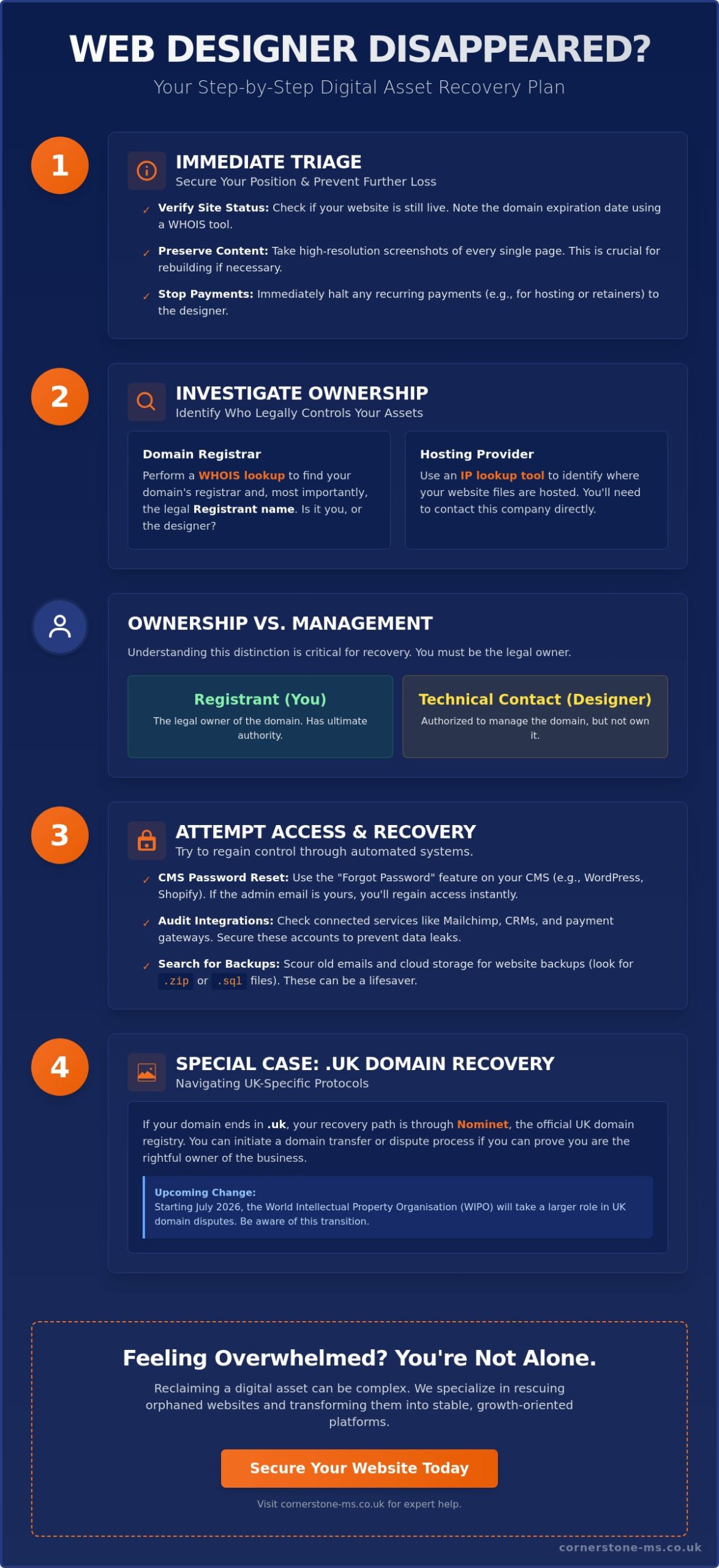
We recommend taking immediate, disciplined steps to secure your current position. First, verify if your site is still live and check the domain expiration date using a WHOIS tool. If the site is functional, take high-resolution screenshots of every page. This preserves your visual design and content, which is crucial if you need to rebuild elsewhere. Finally, stop all recurring payments to the designer if they were managing your hosting. This prevents further financial loss while you determine what to do when your web designer disappears. Protecting your remaining assets ensures that your eventual transition to a new partner is seamless and thorough.
Securing Your Digital Assets: A Step-by-Step Recovery Checklist
Reclaiming control of your digital presence requires a methodical audit of your infrastructure. We recommend starting with a WHOIS lookup to identify your domain registrar and, more importantly, the legal registrant of the domain. This public record confirms whether you or your designer holds the legal title to the URL. Simultaneously, use an IP lookup tool to locate your hosting provider. Knowing where your website files physically reside allows you to contact the hosting company directly to explain the situation, though they’ll require proof of identity before granting access.
Once you’ve identified the “where,” focus on the “how.” Attempt to log in to your Content Management System (CMS), such as WordPress or Shopify, using the “forgot password” feature. If the designer used your company email for the admin account, you can reset the credentials immediately. You should also audit your third-party integrations. Check for active API keys, email marketing platforms like Mailchimp, or CRM links. Determining what to do when your web designer disappears involves securing these peripheral assets to prevent data leaks or service interruptions. We often find that historical backups are tucked away in old email threads or cloud storage folders; search your archives for any .zip or .sql files that might serve as a restoration point.
Identifying Ownership vs. Management
There’s a critical distinction between being the “Registrant” and the “Technical Contact.” The registrant is the legal owner, while the technical contact is merely the person authorized to manage settings. If your designer registered the domain in their own name, you’re in a position of “informal ownership” that requires formal correction. Verify that your primary business email is the one associated with the main accounts. If you find the designer’s details in the registrant field, you may need to utilize Nominet’s Dispute Resolution Service to initiate a transfer. Our team frequently assists businesses in navigating these administrative hurdles to ensure their foundation is legally sound.
Preserving Your SEO and Content
The rescue phase is a high-stakes period for your search engine rankings. You must avoid changing URLs or deleting pages while you’re regaining control. Sudden structural changes signal instability to search engines and can result in a rapid loss of visibility. If your site has already gone offline, use the Wayback Machine to recover text and layout structures. This digital archive is a vital resource for reconstructing your brand’s voice. Maintaining your rankings during this transition is essential, and leveraging local SEO services can help stabilize your presence while you resolve backend issues. Understanding what to do when your web designer disappears means prioritizing your existing search authority just as much as your technical access. If you’re unsure of your current standing, we can perform a comprehensive web design audit to identify what can be saved and what needs professional restoration.
UK Domain and Hosting Recovery: Navigating Nominet and ICANN
Determining what to do when your web designer disappears involves understanding the regulatory frameworks that govern your digital property. For businesses using .uk, .co.uk, or .org.uk extensions, Nominet serves as the central authority. From 7th July 2026, the administration of Nominet’s Dispute Resolution Service (DRS) transfers to the WIPO Arbitration and Mediation Centre, though the mediation processes remain consistent. If you hold a .com or .net domain, the ICANN Uniform Domain-Name Dispute-Resolution Policy (UDRP) applies instead. This global standard was updated in August 2025 to reflect new Registration Data Policies, ensuring that legitimate business owners have a clear path to reclaim assets from unresponsive third parties.
When a designer is unreachable, your primary goal is to move the domain into an account you control. If the designer registered the site through a reseller, you may need to escalate the request directly to the registrar. Legal considerations are also paramount. Consulting the UK Intellectual Property Office can provide clarity on your rights regarding the underlying code and design. If a significant investment is at risk, a solicitor can help draft a formal notice for breach of contract, though many disputes are resolved through the registrar’s internal recovery protocols without litigation.
The Nominet Recovery Process for .uk Domains
We find that the Nominet “Online Service” is the most efficient route for domestic businesses. You can file an “Update Registrant” request if the current administrator fails to respond. You must provide documentation such as a utility bill, a certificate of incorporation, or a passport copy to verify your identity and business ownership. Once you submit these details and pay the necessary administrative fees, such as the £200 + VAT summary decision fee if the designer fails to reply, the process typically concludes within 5 to 10 working days. This methodical approach ensures you regain legal title without relying on the missing designer.
Bypassing the Designer with Hosting Providers
Hosting recovery requires a different set of evidence. Providers like SiteGround, WP Engine, or Bluehost are bound by strict security protocols, but they often grant access if you provide verifiable proof of payment. This usually involves bank statements showing transactions directly to the hosting company. If the site is on a “Developer-Owned” account, the provider may not be able to give you direct access to the designer’s dashboard. In these cases, we recommend a migration solution where a new partner transfers the public-facing site to a secure environment you own. This restores your operational security and ends the designer’s control over your digital infrastructure. Knowing what to do when your web designer disappears means acting decisively to move your files to a platform where you hold the primary keys.
Building a Resilient Future: How to Prevent Your Next Designer from Vanishing
Recovering from a lost partnership is a reactive necessity, but building a resilient infrastructure is a proactive choice. To avoid searching for what to do when your web designer disappears in the future, you must establish an ownership protocol from day one. This begins with your domain registration. Always register the domain in your business name using a generic company email address like admin@yourbusiness.co.uk. This ensures that access is never tied to a single individual’s personal inbox or a designer’s private account. We advocate for “God-level” administrative access to all platforms, including your CMS, hosting panel, and registrar, before the project even begins.
A robust contract serves as your primary safeguard. It should explicitly define that you own all Intellectual Property (IP) rights upon payment. This avoids the common trap where freelancers retain copyright by default under general UK contract law. Ensure your agreement includes clear exit clauses that mandate a full digital handover if the relationship ends. By codifying these requirements, you create a foundation of transparency and accountability that protects your operations from sudden disruptions.
Agency vs. Freelancer: Choosing for Stability
While the UK has 4.2 million freelancers as of 2025, the “single point of failure” risk remains a significant concern for essential business infrastructure. Choosing established web design North East firms provides access to a collective brain. Agencies offer institutional memory; if one developer leaves, the team retains the knowledge of your site’s architecture. This continuity is often backed by long-term support retainers that provide predictable, high-quality service. During procurement, watch for red flags like a lack of physical office space or an inability to provide a clear disaster recovery plan. A dependable partner values long-term collaboration over short-term gains.
The Essential “Digital Handover” Document
Operational security relies on organized data management. We recommend creating a master digital handover document that lists every platform and credential associated with your site. Store these in a secure vault like LastPass or 1Password rather than an unencrypted spreadsheet. This document should also define the frequency of off-site backups and confirm that you, the client, own those backup files. Establish emergency access protocols for key stakeholders within your business so that multiple people can step in if a primary contact becomes unavailable. If you want to ensure your site is built on a foundation of stability, our team can help you transition to a more secure web design framework that puts you in permanent control.
Restoring Your Digital Presence with Cornerstone: From Rescue to Growth
Once you have initiated the recovery steps, the focus shifts from crisis management to sustainable growth. We specialize in adopting orphaned websites that have been neglected due to a sudden breakdown in professional relationships. Our team knows exactly what to do when your web designer disappears, providing a disciplined transition that secures your existing assets while identifying hidden technical debt. We don’t just patch holes; we integrate your site into a broader branding agency Newcastle strategy that aligns your digital presence with your long-term commercial objectives.
Transitioning from a broken site to an integrated marketing ecosystem requires more than just a new set of login credentials. It involves a thorough evaluation of your site’s security patching and structural integrity. We take accountability for your digital foundation, ensuring that every line of code serves a purpose. By moving beyond simple fixes, we help you reclaim your market position and build a platform that is resilient, scalable, and fully under your control.
The Cornerstone Rescue Audit
We begin every rescue mission with a deep dive into your site’s architecture. This comprehensive audit examines code quality, SEO health, and potential security vulnerabilities left behind by the previous developer. We identify “Quick Wins” to restore your business visibility and ensure you are appearing in front of customers as quickly as possible. This process provides a stable, North East-based home for your digital assets, moving them away from the uncertainty of a vanished freelancer to a team that values institutional trust. You receive a clear report of our findings, ensuring total transparency as we stabilize your operations.
Future-Proofing with Integrated Solutions
A functional website is only the starting point for business growth. We align your restored site with a tailored social media management Teesside programme to maximize your digital impact. Our regular maintenance programmes provide a safety net, ensuring your software, plugins, and security protocols never fall behind the industry standard again. Our human-centric approach means you always have a dedicated point of contact in our Stockton office. You won’t be left wondering what to do when your web designer disappears because we prioritize long-term collaboration and community-oriented service over short-term gains. We provide the structural stability your business needs to thrive in a demanding digital landscape.
Reclaiming Your Digital Autonomy
Rebuilding your digital foundation requires a shift from immediate crisis management to long-term operational resilience. By following a methodical recovery framework, you can reclaim your domain through Nominet and secure your hosting environment from unresponsive third parties. Establishing “God-level” administrative access and choosing a partner with institutional redundancy ensures your business remains protected against future disruptions. Knowing what to do when your web designer disappears is about more than just technical fixes; it’s about restoring the stability of your essential business infrastructure.
As an award-winning member of the Cornerstone Group, we provide local accountability from our Stockton-on-Tees office. Our comprehensive in-house team of designers and SEO experts is dedicated to moving your site from a state of rescue to a position of market growth. Secure your website’s future with a reliable partner; contact Cornerstone today. Your website is the cornerstone of your operations, and we are here to ensure it remains a secure and powerful asset for your business and community.
Frequently Asked Questions
My web designer has disappeared and I don’t have my login details. What is the first thing I should do?
Identify your domain registrar and hosting provider using WHOIS and IP lookup tools immediately. Once you know where your digital assets are held, you can begin the formal recovery process with these providers. This initial audit provides the clarity needed to proceed without the original designer’s cooperation and secures your position as the rightful owner.
Can I get my domain back if it is registered in my designer’s name?
Yes, you can reclaim ownership through the registrar’s dispute resolution process. For .uk domains, Nominet provides a service to update registrant details if you can prove you are the rightful business owner through official documentation. For global domains like .com, the ICANN UDRP process offers a similar path to recovery when a designer holds a domain in bad faith or refuses to transfer access.
How much does it cost to recover a website from a disappearing developer?
Recovery costs vary based on the complexity of the technical debt and the specific fees charged by registries. For example, Nominet’s summary decision fee for .uk disputes is £200 + VAT as of June 2026. Professional intervention typically involves an audit and a migration fee to move the site to a secure environment, though we recommend a custom assessment to determine the full scope of the rescue.
Will I lose my Google rankings if my web designer vanishes?
You won’t lose rankings immediately, but visibility will drop if the site goes offline or becomes insecure due to a lack of maintenance. Search engines prioritize stability and user safety. If you act quickly to secure the hosting and maintain the current URL structure, you can preserve your search authority while determining what to do when your web designer disappears.
Is it better to start a new website or try to fix the one my designer abandoned?
This decision depends on the quality of the existing code and your level of access to the database. If the site is built on a standard platform and the design still aligns with your brand, fixing it is often the most efficient route. However, if the technical debt is high or the site is severely outdated, starting fresh with a reliable partner ensures a more stable foundation for future growth.
How long does the recovery process usually take via Nominet?
The standard timeframe for an “Update Registrant” request through Nominet is typically between 5 and 10 working days. This period allows the registry to verify your documentation and provide the current administrator time to respond. If you are unsure of what to do when your web designer disappears, starting this process early is essential to minimize operational downtime.
What legal action can I take against a web designer who stops responding?
You can pursue a claim for breach of contract or seek an injunction to reclaim your digital property. UK contract law generally requires that work paid for should be delivered, though intellectual property rights often depend on your specific agreement. We recommend consulting a solicitor to review your contract and documenting every failed contact attempt to serve as evidence for your case.
Can a new agency take over a half-finished website?
Yes, a professional agency can audit and complete unfinished work if they have access to the source code and assets. We frequently adopt projects that have stalled, beginning with a deep dive into the existing architecture to ensure it meets our standards for security and performance. This methodical approach allows us to turn an abandoned project into a functional and reliable marketing tool.