


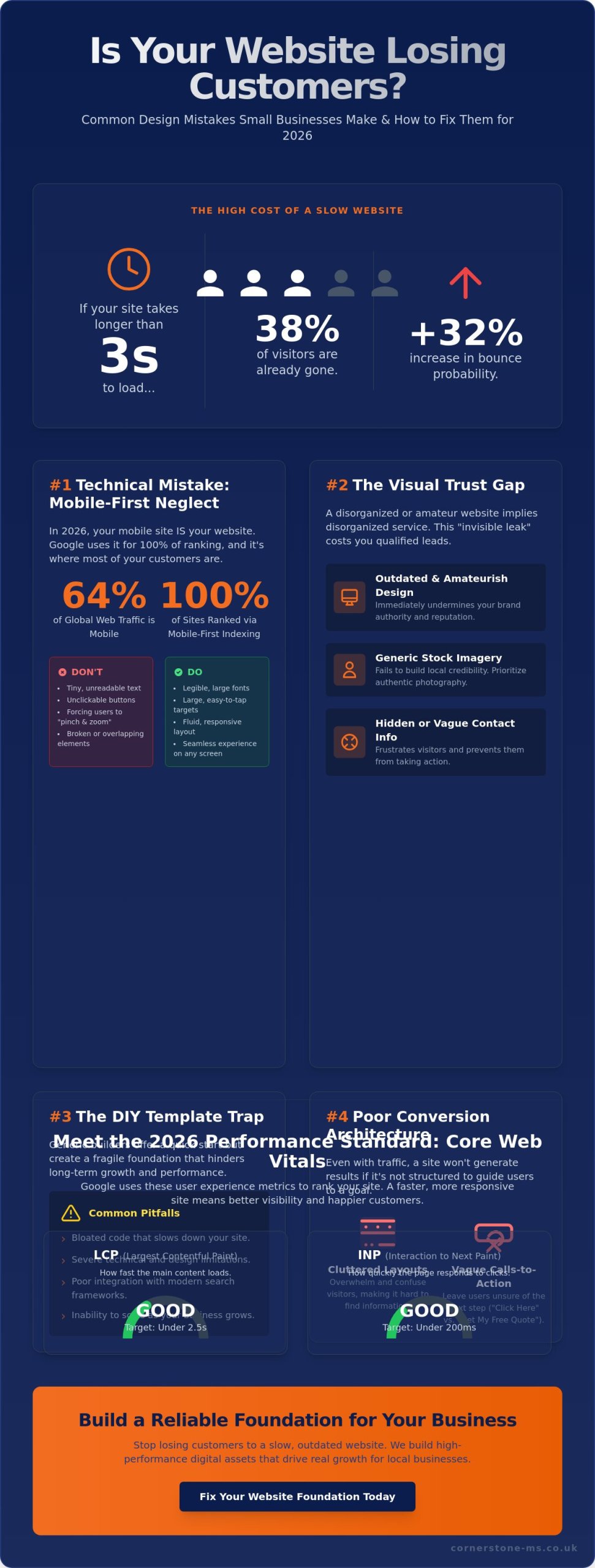
If your website takes longer than three seconds to load, you’ve likely already lost 38% of your potential customers before they even see your logo. It’s a sobering reality for many local firms who find themselves losing ground to competitors with faster, more polished sites. We understand that you’ve likely felt overwhelmed by technical demands or frustrated by a digital presence that fails to generate real results. You deserve a platform that acts as a reliable foundation for your growth; it shouldn’t be a source of constant stress. To help you regain control, we’ve identified the common website design mistakes small businesses make that actively prevent visitors from becoming loyal customers.
Our team believes in a grounded, human-centric approach to technical excellence. In this guide, we’ll show you how to rectify critical errors and understand the true ROI of professional web design. We’ll explore the updated 2026 standards for Google’s Core Web Vitals, such as maintaining an Interaction to Next Paint under 200 milliseconds, and discuss the latest ADA compliance extensions. You’ll gain a clear, actionable list of fixes designed to increase your local enquiries in Teesside and ensure your business remains a dependable presence in an increasingly mobile-first market.
Key Takeaways
- Learn how to align your site with 2026 mobile-first standards to maintain visibility in search rankings and improve user retention.
- Discover how to bridge the visual trust gap by prioritizing authentic photography over generic stock imagery to build local credibility.
- Identify the common website design mistakes small businesses make that lead to high bounce rates, such as cluttered layouts and vague calls-to-action.
- Understand why transparent contact information and streamlined navigation are essential for converting visitors into loyal customers.
- Gain a structured audit checklist to evaluate your website technical foundation and ensure it meets modern performance benchmarks.
The Impact of Poor Web Design on North East Small Businesses
A website in 2026 is no longer a passive digital brochure; it is the essential foundation for your operational security. When small businesses in Teesside operate with a fragmented or confusing interface, they incur a significant psychological cost. Potential customers equate a disorganized website with disorganized service. We view this as an “invisible leak” where qualified leads are lost simply because the user journey lacks technical precision. Adhering to fundamental web design principles ensures that your digital presence reflects the same level of care you provide in your physical operations. This grounded approach builds the institutional trust necessary for long-term collaboration.
First Impressions and Brand Authority
Your digital storefront is often the first point of contact for stakeholders in the North East market. Within seconds, a visitor evaluates your brand authority based on the stability and clarity of your layout. A site that feels amateurish or outdated immediately undermines your local reputation, suggesting a lack of attention to detail. We emphasize the importance of a professional digital presence to position your firm as a disciplined leader. By prioritizing a clean, functional interface, you demonstrate accountability and a commitment to service excellence. This creates a reassuring sense of security that guides the reader from their initial problem to your verified solution.
The Problem with the DIY Template Trap
One of the most common website design mistakes small businesses make involves falling into the DIY template trap. While these generic builders offer a low barrier to entry, they often lack the structural integrity required for long-term growth. These platforms frequently suffer from technical limitations and bloated code that can hinder your ability to scale or integrate with modern search frameworks. Moving from a basic digital business card to a strategic foundation requires a higher level of customization. We focus on creating custom environments that prioritize efficiency and user clarity, ensuring your digital infrastructure remains a reliable, high-quality asset that serves the community effectively.
Mobile-First Neglect: The #1 Technical Design Mistake
In 2026, a website that isn’t optimized for handheld devices is essentially invisible to the market. Google now utilizes mobile-first indexing for 100% of websites, meaning your mobile version is the primary foundation for your search rankings. For local businesses in Stockton-on-Tees, where mobile devices account for approximately 64% of global web traffic, a poor mobile experience translates directly into lost revenue. Mobile-first neglect remains one of the most common website design mistakes small businesses make when they prioritize desktop aesthetics over functional portability. We see many local sites with unclickable buttons and tiny text that force users to pinch and zoom, leading to immediate frustration and high bounce rates.
When a site fails to load within three seconds, the probability of a bounce increases by 32%. This technical friction is more than a minor inconvenience; it’s a structural failure that erodes trust. According to industry analysis on common small business website design mistakes, sparse content and poor typography on mobile are primary drivers of user abandonment. We believe that a robust web design North East strategy must treat the smartphone experience as the priority rather than an afterthought.
Responsive vs. Mobile-Friendly: Knowing the Difference
We distinguish between “mobile-friendly” sites and truly responsive platforms. A mobile-friendly site is often just a scaled-down version of a desktop layout, which frequently leads to broken elements and overlapping text. In contrast, responsive design uses fluid grids to ensure your content adjusts seamlessly to any screen size. We avoid the “desktop-only” mindset during the initial design phase to ensure that navigation remains intuitive for users on the move. Testing your site on real-world mobile connections across the North East is essential for verifying that your infrastructure performs reliably under varied signal strengths.
Core Web Vitals and User Retention
Google’s 2026 ranking factors place a heavy emphasis on Core Web Vitals. To remain competitive, your site must achieve a Largest Contentful Paint (LCP) of under 2.5 seconds and an Interaction to Next Paint (INP) of under 200 milliseconds. Layout shifts, or CLS, are particularly damaging on mobile; if a button moves just as a user tries to tap it, they’re likely to leave and never return. We focus on optimizing images and streamlining code to ensure your Cumulative Layout Shift remains under 0.1. A one-second delay in mobile load times can impact your conversion rates by up to 20%. Our approach to Web Design prioritizes these technical benchmarks to keep your audience engaged. Evaluating your current mobile performance is a critical first step toward securing your digital future.
The Visual Trust Gap: Low-Quality Imagery and Hiding Contact Info
Visual communication acts as the digital handshake between your business and the community. One of the most common website design mistakes small businesses make is falling victim to “Stock Photo Syndrome.” When a potential client in the North East visits your site, they expect to see the authentic faces and facilities they will encounter in person. Relying on generic, high-gloss images of people in unfamiliar offices erodes local credibility. We believe in replacing these shortcuts with high-quality, professional assets that reflect your actual operations. This grounded approach turns a sterile interface into a reassuring, human-centric experience that builds long-term institutional trust.
Effective design also requires a disciplined visual hierarchy. Your most important information must never compete with background decorations or secondary content. We use intentional contrast, purposeful spacing, and professional Graphic Design to guide the user’s eye toward your primary value proposition. This prevents the cluttered layouts that often paralyze a visitor’s decision-making process. By creating a logical flow, you ensure that your message remains clear and your authority remains unquestioned.
Building Trust Through Professional Media
Professional Photography and Videography are not merely aesthetic choices; they are essential tools for building rapport. High-quality video content significantly increases time-on-site and allows you to tell a cohesive brand story that resonates with your audience. We often suggest showcasing your Stockton-on-Tees team to humanize your brand and demonstrate accountability. Utilizing Drone Videography can also provide a unique perspective on your local projects, offering a sense of scale and professionalism that stock footage cannot replicate. These authentic assets serve as a verified shorthand for your commitment to excellence and quality workmanship.
Accessibility and Local Contact Clarity
Transparency is a cornerstone of reliability. We frequently see businesses bury their contact information in a footer or a deep sub-menu, which creates unnecessary friction for the user. Your contact details must be visible and accessible on every single page. On mobile devices, your phone number should be “click-to-call” to ensure a seamless transition from browsing to enquiry. Integrating an embedded Google Map further strengthens your local SEO and helps customers find your physical presence in Teesside.
Accessibility is both a legal and ethical responsibility. While the Department of Justice has extended certain ADA Title II deadlines for government entities to 2027 and 2028, the Web Content Accessibility Guidelines (WCAG) 2.1 Level AA remains the industry benchmark for all professional sites. We ensure that your digital infrastructure is usable for everyone, regardless of their physical abilities. This commitment to inclusivity not only protects your brand reputation but also expands your reach to the widest possible audience in the North East market.
Conversion Architecture: Why Your Website Isn’t Selling
We believe a website must function as a disciplined conversion engine rather than a static brochure. If your platform isn’t generating leads, the issue often lies in its conversion architecture. One of the most common website design mistakes small businesses make is the use of vague, passive calls-to-action. Phrases like “Learn More” fail to provide the clear, authoritative direction that modern users expect. We recommend using direct, action-oriented language that highlights the specific benefit of the interaction. This approach reduces ambiguity and reinforces your position as a reliable service provider.
Your digital infrastructure should also align seamlessly with your social media management Teesside strategy. A fragmented brand experience across different platforms erodes trust. We ensure that the transition from a social media enquiry to your website is logical and technically sound. When every touchpoint reflects the same level of professional excellence, you build the institutional trust necessary for long-term client relationships. With average e-commerce conversion rates in 2026 hovering between 2.5% and 3.0%, there’s no room for technical or strategic inconsistency.
Designing for the User Journey
We map the user’s path from the initial homepage visit to the final contact form submission. Shorter forms are essential in 2026; every unnecessary field acts as a barrier to conversion. We use strategic white space to isolate your primary goals, preventing a cluttered layout from paralyzing the user’s decision-making process. This methodical reduction of friction ensures that your primary value proposition remains the focal point of the page. When you simplify the journey, you respect the user’s time and increase the likelihood of a successful enquiry.
Social Proof and Local Credibility
Social proof serves as a verified shorthand for your competence. We place testimonials at critical decision points, such as near contact forms or service summaries, to provide maximum psychological impact. Using detailed case studies allows you to demonstrate your specific North East expertise and the tangible impact of your work. We also integrate third-party validations, such as industry awards or quality certifications, to reinforce your identity as a seasoned, dependable partner. To ensure your platform is optimized for performance, you can secure your foundation with a professional Web Design audit to identify and fix hidden conversion leaks.
Fixing the Foundation: A Small Business Website Checklist
A website should never be viewed as a one-time project. In the 2026 digital environment, it’s a dynamic asset that requires regular maintenance to remain effective. Many owners overlook this, leading to common website design mistakes small businesses make as their site’s technology ages and performance degrades. To ensure your platform remains a reliable tool for growth, we recommend a methodical approach to identifying and resolving technical debt. By following a structured checklist, you can verify that your digital infrastructure meets the rigorous 2026 standards for performance and user experience.
- Audit your mobile performance: Verify that your Largest Contentful Paint (LCP) is under 2.5 seconds and your Interaction to Next Paint (INP) is under 200 milliseconds to meet Google’s direct ranking thresholds.
- Review visual assets: Replace generic stock images with professional Photography and Videography to build authentic trust with your local audience.
- Simplify your navigation: Implement a “three-click rule” where any essential piece of information or service detail is accessible within three clicks from the homepage.
- Optimize for local SEO services: Ensure your contact details are consistent across your site and easy for search engines to index, helping you remain visible in Teesside search results.
- Consult with a professional partner: Bridge the technical gap by seeking expert advice on complex requirements like WCAG 2.1 Level AA accessibility compliance.
The 10-Minute Website Self-Audit
You don’t need a technical degree to spot the most obvious issues currently hindering your site’s performance. Start by checking for broken links and outdated content that might mislead your visitors or damage your credibility. Test your contact forms manually to ensure enquiries are actually reaching your inbox; a broken form is a silent killer of conversion. Our team also suggests evaluating your site on three different screen sizes: a desktop, a tablet, and a smartphone. If the experience feels fragmented or slow on any of these devices, your foundation needs immediate attention. These small checks prevent the invisible leaks that often cost businesses valuable leads in the North East.
Partnering for Long-Term Growth
There comes a point where a DIY fix is no longer sufficient to maintain your competitive edge in a demanding industry. When technical requirements like AI-powered search optimization or advanced Web Design benchmarks become too complex, professional intervention becomes necessary. Cornerstone Marketing Solutions builds digital foundations in Stockton that are designed for stability and high performance. We focus on long-term collaboration rather than short-term gains, providing the ongoing maintenance and SEO support necessary to keep your business at the forefront of the market. Investing in a professional redesign ensures that your website remains an essential, high-functioning component of your operational security and community impact.
Securing Your Digital Future in the North East
We’ve explored how technical precision and authentic communication form the bedrock of a successful online presence in 2026. Prioritizing mobile performance and replacing generic imagery with professional photography ensures your platform remains a reliable asset rather than a liability. Avoiding the common website design mistakes small businesses make is not just about aesthetics; it’s about building a disciplined conversion engine that supports your long-term operational goals and builds institutional trust with your community. When you align your digital infrastructure with the rigorous standards of modern SEO and user experience, you create a stable foundation for growth.
As an award-winning North East agency, we specialize in local business growth through integrated expertise across Web Design, SEO, and Videography. We understand the unique challenges facing firms in Stockton and the wider Teesside area. We invite you to book a free website audit with our Teesside experts to identify hidden friction points and strengthen your digital foundation. Your business deserves a digital presence that reflects your commitment to excellence and serves as a dependable platform for your future success. We look forward to helping you build a site that truly works for your business.
Frequently Asked Questions
How much does a professional website redesign cost for a small business in 2026?
The investment required for a professional redesign depends on the technical complexity and the specific functional requirements of your business operations. We recommend focusing on the long-term ROI of a site that acts as a reliable conversion engine rather than seeking the lowest initial price. A customized approach ensures that your digital infrastructure is built to meet modern performance standards and regulatory requirements.
Can I fix my website design mistakes without starting from scratch?
You can often rectify specific errors without a full rebuild if your site foundation is technically sound. We focus on auditing high-impact areas such as mobile responsiveness, navigation logic, and page speed to identify what can be salvaged. However, if your current platform relies on outdated code that cannot meet 2026 Core Web Vitals thresholds, a strategic redesign may be the more responsible choice for your long-term security.
Why is my website slow even though I used a popular template?
Popular templates often include bloated code and unnecessary third-party scripts that degrade your loading times. These “one-size-fits-all” solutions prioritize generic features over technical precision, making it difficult to achieve a Largest Contentful Paint of under 2.5 seconds. We prefer custom, streamlined code that ensures your site remains an efficient and dependable foundation for your client operations.
How often should a small business update its website design?
A small business should consider a significant design refresh every two to three years to stay aligned with evolving technical standards and user expectations. The digital environment in 2026 requires constant attention to performance benchmarks and accessibility rules. Treating your website as a dynamic asset rather than a static brochure ensures you don’t lose customers to competitors with more modern, functional platforms.
What are the most important pages every small business website must have?
Your site must include a high-performing Homepage, detailed Service pages, a transparent About Us section, and an easily accessible Contact page. We also suggest a dedicated area for Case Studies to demonstrate your North East expertise and build institutional trust. These core pages provide the essential structure needed to guide a visitor from their initial enquiry to a successful conversion.
Is SEO included in professional web design services?
Search Engine Optimisation is a foundational discipline that must be integrated into the design process from the start. We ensure that technical elements, such as site architecture and mobile optimization, are correctly configured to meet 2026 ranking factors. While initial technical SEO is part of a robust build, ongoing strategy is required to maintain visibility in an increasingly competitive local market.
Do I really need professional photos, or can I use my phone?
Professional Photography is a critical requirement for establishing brand authority and avoiding the common website design mistakes small businesses make when using amateurish visuals. While phone cameras have improved, they often lack the technical precision and professional lighting needed to project an image of unwavering reliability. High-quality, authentic media serves as a verified shorthand for your commitment to excellence and quality workmanship.
How do I know if my website is mobile-friendly enough for Google?
You can verify your mobile performance by testing your site against Google’s 2026 Core Web Vitals benchmarks. Your site must achieve an Interaction to Next Paint of under 200 milliseconds and a Cumulative Layout Shift of under 0.1 to be considered high-performing. Since Google uses mobile-first indexing for 100% of websites, meeting these technical standards is essential for maintaining your search visibility and user retention.