

For a tech startup in Tees Valley, branding costs depend on the scope: strategy, visual identity, website requirements and any ongoing support. A branding agency for tech startups in Tees Valley should define the work and deliverables before setting a price. The right engagement gives your team a consistent foundation for its next stage of growth, rather than simply the largest package.
It’s reasonable to want a clear budget before committing, particularly when startup priorities can shift. This guide explains what affects branding costs, when to bring in an agency and how project-based, ongoing and focused engagements differ. It also offers practical ways to compare potential partners and choose an approach that fits your goals and gives your brand room to grow.
Key Takeaways
- Separate brand strategy from visual identity to define what your startup needs before setting a project scope.
- Match the engagement to your growth stage, goals and available budget, and prioritise the work that supports your next milestone.
- Assess agencies for relevant tech or B2B experience, clear case studies and an approach that makes complex offers easier to understand.
- For a fast-growth startup, choose a brand system that can stay consistent across customer, investor and digital touchpoints as the business develops.
- Consider social media management, web design and visual content when you need practical support to carry your brand into market.
How much do your branding services cost?
Branding costs depend on the work involved, not just the finished logo. A technology startup may need positioning, messaging, visual identity and a website to launch coherently. Another may already have a clear strategy and need an identity for its product and sales materials. A branding agency for tech startups in Tees Valley should define these needs before setting the scope and deliverables.
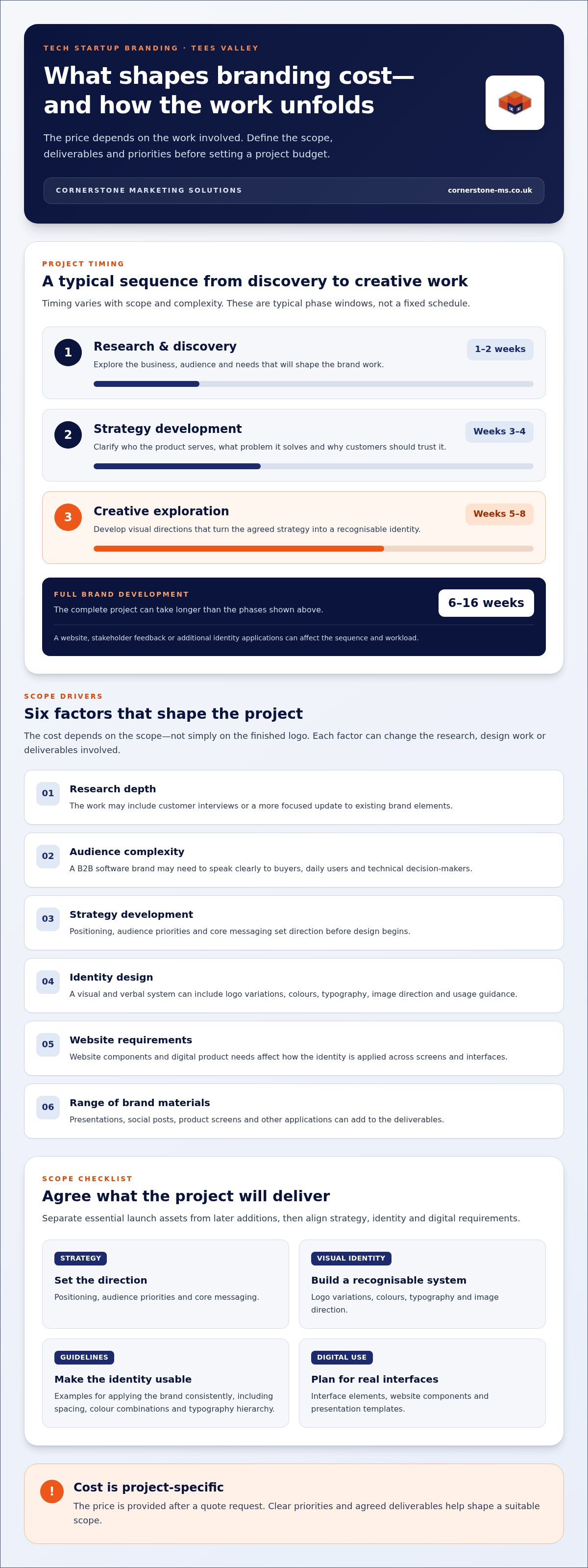
The price depends on the project and is provided after a quote request. Key cost factors include research depth, audience complexity, strategy development, identity design, website requirements and the range of brand materials. A project involving customer interviews is different from one focused on updating colours and typography. Clear priorities help shape a suitable scope.
Brand strategy sets direction before design begins. It clarifies who the product serves, what problem it solves and why customers should trust it. For a B2B software startup, the strategy might distinguish buyers, daily users and technical decision-makers. Messaging then gives each audience a consistent explanation of the product’s value, rather than relying on different descriptions across a pitch deck and website.
Brand identity turns strategic direction into a recognisable visual and verbal system. It can include a logo, colour palette, typography, image style and practical usage guidance. For a technology business, the identity also needs to work across product interfaces, presentations, social posts and small digital formats. A mark that reads clearly in a website header may need a simplified version for an app icon.
Agree on the scope and deliverables together. A useful project outline can identify:
- Strategy: positioning, audience priorities and core messaging.
- Visual identity: logo variations, colours, typography and image direction.
- Guidelines: examples that show how teams apply the identity consistently.
- Digital use: interface elements, website components and presentation templates.
Brand guidelines make an identity usable beyond the original design project. They can show spacing, colour combinations, typography hierarchy and messaging in context. For example, the team can apply the same approved logo treatment to a product screen and an investor presentation. Clear guidance helps prevent inconsistent adaptations as more people create brand materials.
A digital product identity needs to function, not simply look distinctive. Consider contrast, legibility, interface states and how visual elements support navigation. A technology brand can use one visual language across its website and software while adapting layouts to suit each screen. This keeps the experience recognisable without forcing marketing graphics into product interfaces.
Project timing also shapes planning. Research and discovery typically takes 1-2 weeks, strategy development takes place during weeks 3-4, and creative exploration typically takes place during weeks 5-8. Full brand development usually takes 6-16 weeks, depending on scope and complexity. A website, stakeholder feedback or additional identity applications can affect the sequence and workload.
When choosing a branding agency for tech startups in Tees Valley, list the decisions your brand must support, such as launch messaging, a product interface or investor materials. Separate essential launch assets from later additions. This helps align strategy, visual identity and digital requirements while giving the project a clear foundation for growth.
When should a startup hire a branding agency?
Hire an agency when your positioning, messaging or visual identity no longer reflects what the business sells. A change in product, target audience or funding stage can expose gaps between the pitch deck, website and sales materials. You don’t need to wait for a launch: start when inconsistent descriptions make your offer harder to understand.
Budget for the outcome, not a generic package. The price depends on the project and is provided after a quote request. Scope, research, stakeholder involvement, identity deliverables and website requirements all affect the work. Refreshing a logo and core guidelines, for example, differs from defining positioning, messaging and a complete identity across multiple platforms.
Before speaking with an agency, define the business need and the decision the work should support. A founder preparing to enter a new market might need clearer audience positioning. A team launching software may need brand direction that carries consistently from its website to product screens and sales presentations. Write down the required outputs, who will approve them and what can follow later.
Choose an engagement structure that matches the work. A fixed-scope project suits a defined milestone, such as preparing core brand materials for a product launch. Ongoing creative support can suit a team with continuing needs across campaigns and platforms. A focused pilot can help founders assess the collaboration through a contained deliverable before extending the scope.
Plan the budget alongside the project timeline. The market guidance in this article suggests successful tech startups allocate 10-20% of their marketing budget to branding initiatives. Treat that as a planning reference, then prioritise work by launch date and business risk. If the budget is limited, agree which assets must be ready first and which can wait.
Set a process with clear decision points. Start by agreeing on the brief, audience and approval roles. Review strategy and creative work against those aims, rather than changing direction without a clear reason. Consolidate feedback from founders and stakeholders into one response at each review. This reduces conflicting revisions and keeps the work moving towards a usable identity.
Brand projects can run into delays when decision-makers join late or requirements keep changing. Name an internal lead, gather existing materials and schedule review time before work begins. If a product release is approaching, align brand approvals with the launch plan and allow time to apply the approved assets across relevant platforms.
Startups in Middlesbrough, Stockton, Hartlepool, Darlington and Redcar can access branding support from agencies serving Tees Valley. Compare potential partners by relevant technology experience, project approach and ability to work with your team’s schedule.
Tees Valley founders can explore startup grants and business-support schemes, but branding costs are eligible only when the scheme’s rules include that type of spend. Review the eligible-cost terms before factoring grant funding into a project plan.
If you’re defining the scope now, discuss your brand priorities as part of your next marketing planning step.
Criteria for choosing a startup branding agency
Start with the business problem, then assess each agency against it. A software startup selling to IT teams needs different expertise from a consumer app seeking broad awareness. Look for relevant sector experience, a portfolio that shows comparable challenges and work that makes technical offers clear. Creative quality matters, but it should support a defined business vision.
Review case studies for the decisions behind the finished identity. A useful example explains the audience, the original challenge, the agency’s role and how the work was applied. For instance, a B2B platform’s case study should show how its positioning and messaging became clearer across a website, sales presentation or product interface. References can help you understand how the agency handled feedback and project decisions.
Use these checks when comparing portfolios and proposals:
- Niche fit: Has the team worked with technology companies, technical services or B2B platforms?
- Strategic thinking: Does its process connect audience insight, positioning and visual choices?
- Relevant examples: Can you see how identity works across digital products and customer touchpoints?
- Defined scope: Does the proposal describe deliverables, review stages and responsibilities?
- Evidence: Are case studies and references available to explain the working relationship?
Ask how the team turns a complex product into clear, credible messaging. A cloud platform might serve technical users and business buyers, each with different concerns. The agency should identify those audiences, develop a shared core story and adapt supporting messages without changing the underlying promise. This gives founders language they can use consistently with customers, staff and investors.
Clarity in the project process matters as much as the creative work. Before choosing, establish who leads strategy, who presents design options and how feedback is consolidated. A practical first step is to share the same brief with shortlisted agencies. Compare how each frames the challenge, the questions it asks and whether its proposed outputs address your priorities.
Remote and Newcastle-based agencies can be practical options for Tees Valley startups. Workshops, presentations and feedback can take place online, while in-person sessions may help when teams need closer collaboration. Choose a working format that suits your founders, decision-makers and project needs.
Finally, consider whether the proposed identity can develop with the product. A startup adding a new platform feature should be able to extend its visual system without creating a disconnected brand. Ask to see guideline examples, interface applications and messaging in context. These materials show whether the agency has built a usable foundation rather than attractive but isolated concepts.
Branding agencies for fast-growth tech startups
Fast growth puts pressure on a brand to stay recognisable as products, audiences and teams change. An agency supporting a technology startup should build a system that can expand, not just deliver launch artwork. For example, a software company adding a platform can extend its core identity across product screens, sales materials and customer communications.
Ask how the agency connects brand strategy to practical use. Positioning should explain the company’s value clearly, while the visual identity should work across formats and teams. A useful project also sets boundaries: which elements stay consistent, which can adapt and who approves changes. These decisions help founders avoid fragmented messaging as growth accelerates.
Check whether the agency’s previous work shows this adaptability. Review case studies for the original business challenge, the creative decisions and how the identity worked after launch. A case study that only presents polished visuals offers less insight than one showing real applications, such as a website, product interface and sales presentation.
Tees Valley agencies specialising in technology and startup branding should be assessed through relevant portfolio work, case studies and references. Look for experience with technical services or B2B platforms, especially where the agency has made a complex offer easier to understand. This gives you a practical basis for comparing local options without relying on broad claims.
Growth also makes guidelines practical tools. They should help new staff, contractors and partners apply the identity consistently without requiring founders to approve every asset. Useful guidance can cover logo use, typography, colours, imagery and messaging examples. It should explain how the brand appears across key touchpoints while leaving room for new product features and campaigns.
Set success measures before the work begins, then review them alongside the brand system. For awareness, track search demand, brand mentions and backlinks. For engagement, examine time on page and interaction with product or website design elements. Investor traction can be assessed through a clearer pitch narrative and stronger interest during early outreach.
Connect those signals to commercial activity. CRM lead quality and movement through the sales funnel can show whether the brand is reaching suitable prospects. These measures don’t prove branding alone caused a change, but they can help teams spot patterns and decide what to refine. Keep the review process simple enough to repeat as the company grows.
Before appointing an agency, agree on launch priorities, an internal owner and an approval process. Ask how its guidelines will support new products and changing platforms, then examine whether its past work has proved useful beyond launch. The strongest fit is a partner whose strategic process and creative system can support the next stage without losing clarity.
Which branding agencies serve tech startups in Tees Valley?
Tech startups in Tees Valley can consider local agencies and regional partners serving businesses across Middlesbrough, Stockton-on-Tees, Hartlepool, Darlington and Redcar. The right fit depends on the work required: a software launch may need positioning and a digital identity, while an established platform may need a consistent system across existing customer touchpoints.
Build a shortlist around relevant experience, rather than location alone. Look for agencies whose portfolios include technology firms, technical services or B2B platforms. A case study should explain the business challenge and show how the agency made the offer easier to understand. For example, check whether the work connects a product’s website, sales presentation and interface.
Compare proposals against the same brief. Describe your audience, product, launch plans and current brand challenges. Then assess whether each agency identifies the same priorities, explains its approach clearly and defines useful deliverables. An agency that understands a complex product should be able to describe its value in plain language without losing important technical distinctions.
Location affects how the team collaborates, but it doesn’t determine the quality of the work. A Middlesbrough startup may prefer in-person workshops with a nearby partner. A remote agency can also work effectively through scheduled video calls, shared documents and structured feedback. Agree on meeting formats and decision responsibilities at the outset, especially if founders and product leads are spread across locations.
Use these practical checks when reviewing regional options:
- Relevant work: Look for technology, software or B2B examples in the portfolio.
- Case studies: Check the challenge, process and applications shown, not just finished visuals.
- References: Review feedback about communication, collaboration and delivery.
- Project fit: Match the proposed scope to your launch priorities and internal capacity.
If your platform sells to technical users and business buyers, ask how the agency will keep the core story clear for both audiences. A strong process makes room for product expertise while translating features into customer benefits. That balance matters in Tees Valley, where a startup may need to explain specialist technology to customers, partners and investors.
Before choosing, identify who will approve strategy and creative work. Gather existing pitch materials, website copy and product explanations into one brief. This gives each shortlisted agency the same starting point and makes its recommendations easier to compare. It also helps show whether the proposed identity can support future features, new audiences and changing launch needs.
If you’re ready to define the next step, discuss your startup’s branding requirements with a clear brief covering audience, product and priorities.
Cornerstone Marketing Solutions: Social Media Management
Cornerstone Marketing Solutions can help your startup carry its brand into ongoing digital communications. Its Social Media Management supports a consistent presence across social channels, while Web Design gives your website a clear place to explain your offer and guide visitors. Videography and Drone Videography can add visual content to business communications where relevant.
Turn to these services when your strategy is defined and your team needs practical support taking it to market. A clear brief covering your audience, key messages and launch priorities helps align content across channels. The right mix depends on what your startup needs to deliver.
To discuss your priorities, contact Cornerstone Marketing Solutions or visit cornerstone-ms.co.uk.
Build your next stage on a clear brand foundation
Your next step is to turn your growth priorities into a focused brief. Decide what customers need to understand, which audience matters most now and where the brand must work first. That direction will help you assess a branding agency for tech startups in Tees Valley against your business needs, rather than choosing on appearance alone.
As your plans develop, consistent marketing activity can carry that identity into customer-facing channels. Cornerstone Marketing Solutions offers Social Media Management, Web Design and Videography to support your wider digital presence. These services help your team communicate across social platforms, its website and visual content.
Share your priorities and discuss a practical next step with Cornerstone Marketing Solutions. A considered start gives your brand room to grow with the business.
Frequently Asked Questions
Do you work with startups?
Yes, Cornerstone Marketing Solutions supports startups with branding and digital marketing. If you’re preparing to launch, begin by clarifying your audience, product message and the channels that need attention. The work can then address practical needs such as a website or ongoing social media activity. A concise brief establishes priorities and keeps early marketing decisions aligned with your business’s current stage.
How long does the branding process take?
Full brand development usually takes 6-16 weeks, depending on scope and complexity. A startup can help keep decisions moving by appointing one internal lead, gathering existing product and customer materials, and agreeing who approves each stage. Website work, stakeholder feedback and changes to the brief can affect the schedule. Build review time into the launch plan, rather than treating approvals as an afterthought.
What branding services do local agencies offer, such as naming, strategy, identity and web design?
Local agencies may cover different parts of the brand, from naming and positioning to visual identity and website design. The exact scope depends on the agency and project. Cornerstone Marketing Solutions offers Branding, Graphic Design and Web Design. For a startup, a practical brief can separate essential launch needs, such as a clear identity and website, from additional work that can follow later.
What are typical branding agency prices for UK tech startups?
There isn’t one typical fee for every UK tech startup; project costs depend on the agreed scope. Research depth, audience complexity, strategy, identity applications and website requirements all influence the work involved. Cornerstone Marketing Solutions provides a price for its services after a quote request. Build your budget around the business outcome and deliverables, not an assumed package price.
Do Tees Valley branding agencies offer startup packages or staged payment options?
Packages and staged payment arrangements depend on the agency and project agreement. A package should define its deliverables and exclusions, while staged payments should clarify when each amount is due and which milestone it relates to. For example, a startup could structure a brief around strategy, identity and launch assets. This makes the scope easier to track and the commitment easier to plan.
How do local branding agencies compare by portfolio, reviews and startup experience?
Compare agencies by reviewing relevant technology projects, detailed case studies and client feedback together. A portfolio shows the finished work; a case study can explain the challenge and decisions behind it. Look for examples where a technical offer became easier to understand across customer touchpoints. Reviews can add context about communication and collaboration. Judge each agency against your startup’s needs, not visual style alone.
What should a tech startup prepare before hiring a branding agency?
Prepare a short brief covering the product, intended customers, business goals and current launch plans. Include existing materials such as website copy, pitch presentations and product screenshots, even if they need revision. Note the decisions the brand must support, such as explaining a complex feature to a non-technical buyer. Name an internal lead and gather stakeholder feedback so the project starts with clear priorities.
How can a startup assess an agency’s contract terms, ownership rights and deliverables?
Review the written agreement for a clear scope, deliverable list, revision process, payment schedule and project responsibilities. Check how it treats final artwork, editable files, fonts, photography and third-party assets. The contract should distinguish what the startup can use from materials that remain licensed or restricted. A precise handover list helps the team understand what it will receive and how those assets can be used.