


What if the problem isn’t a lack of marketing activity, but the gaps between it? For Teesside manufacturers, specialist capabilities can be hard for unfamiliar buyers to understand. Website visits, social posts and sales follow-up may not connect. That’s the challenge behind lead generation for advanced manufacturing firms Teesside: turning technical expertise into a clear path to relevant enquiries.
It’s reasonable to want more than visibility. Longer B2B buying journeys can make it difficult to see which activity is helping a prospective customer move from research to a sales conversation. A joined-up approach makes that journey easier to follow, with useful technical information supported by a consistent digital presence and considered follow-up.
This guide sets out a practical framework for connecting buyer research with your website, social channels and sales process. It covers how to explain capabilities in buyer-friendly language, use technical content to build understanding and make each channel support the next step. With Teesside’s advanced manufacturing landscape in view, the aim is a clearer route from specialist expertise to a relevant enquiry.
Key Takeaways
- Map the steps from a buyer’s technical question to an enquiry, and make the next action clear at each stage.
- Shape information for the different people involved in a purchase, from engineers to procurement teams and business leaders.
- Give website content, organic search, social media and video distinct roles, balancing discoverability with relationship-building.
- Build lead generation for advanced manufacturing firms teesside around a defined audience, useful content and measures that reflect sales progress.
- Bring your website and social content into a consistent digital presence that communicates your manufacturing capabilities clearly.
Why lead generation matters for advanced manufacturing firms in Teesside
A manufacturing firm may offer specialist processes, components or production capabilities that solve a precise operational problem. The challenge is explaining that value to buyers who don’t yet know the business or understand its technical language. Effective lead generation needs to make expertise relevant to prospective customers and help them take a clear next step.
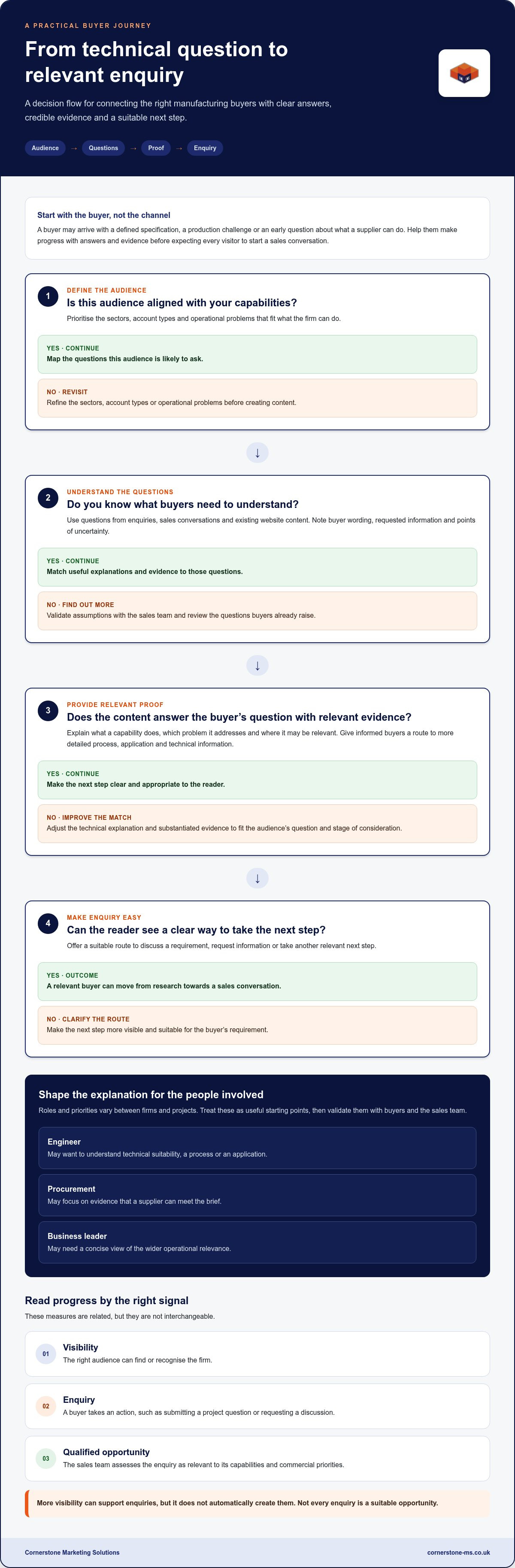
Lead generation attracts, identifies and progresses potential customers towards a relevant sales conversation by responding to buyer needs and making the next step clear. That definition separates three related measures. Visibility means the right audience can find or recognise a firm. An enquiry is an action, such as submitting a project question or requesting a discussion. A qualified opportunity is an enquiry that the sales team assesses as relevant to its capabilities and commercial priorities. More visibility can support enquiries, but it doesn’t automatically create them. Nor is every enquiry a suitable opportunity.
What makes advanced manufacturing lead generation distinctive?
Technical products and processes often need more context than a short promotional message can provide. Buyers may need to understand an application, production capability, material or process before judging whether a supplier is worth approaching. A clear explanation connects technical detail to the buyer’s practical question: will this capability fit the requirement?
Questions vary by project and by person. An engineer may focus on technical suitability, while procurement may look for evidence that a supplier can meet the brief. A business leader may want to understand the wider operational value. Useful marketing gives each reader a route to relevant detail instead of assuming a single message or buying cycle works for every firm.
Why location matters to Teesside manufacturers
Stockton-on-Tees, Middlesbrough and the wider Tees Valley provide the setting for a diverse manufacturing community. Teesside University’s advanced-manufacturing context adds to the region’s technical and educational landscape. For a general view of how research and business activity can come together in a UK manufacturing park, the Advanced Manufacturing Park (AMP) offers useful background. It is a separate example, not a Teesside endorsement.
Local context can help nearby buyers understand a firm’s location, capabilities and connections. It can also shape content around the industries and operational needs a business serves. But local relevance shouldn’t become a boundary. A Teesside manufacturer may also be developing relationships across the UK or internationally, so its digital presence should explain its offer clearly to buyers wherever they are based.
Judge lead generation by relevance, not visibility alone. When marketing helps the right buyers understand a firm’s capabilities and gives them a straightforward way to start a conversation, it creates a clearer link between technical expertise and commercial opportunity.
How manufacturing buyers move from technical questions to enquiries
A prospective buyer may arrive with a defined specification, a production challenge or only an early question about what a supplier can do. Useful marketing meets them at that point and helps them make progress without pushing every visitor straight into a sales conversation. The journey should connect the right audience to clear answers, credible evidence and an easy next step.
Useful content connects a buyer’s question with relevant evidence and a clear next step. Build that journey in four stages:
- Identify the audience. Prioritise the sectors, account types and operational problems that align with the firm’s capabilities.
- Understand its questions. Gather the concerns buyers raise while researching, assessing fit and considering suppliers.
- Provide relevant proof. Match technical explanations and substantiated evidence to the questions each audience is asking.
- Make enquiry easy. Give readers a clear way to discuss a requirement, request information or take another suitable next step.
Start with target accounts, roles and buying questions
Define the types of organisations the firm is equipped to serve and the problems it can address. Then map likely roles as working hypotheses, not fixed assumptions. Engineers may want to understand a process or application; procurement colleagues may focus on supplier suitability; business leaders may need a concise view of operational relevance. Roles and priorities will vary between firms and projects.
Validate those assumptions with the sales team. Review questions from enquiries, sales conversations and existing website content. Note the words buyers use, what information they request and where uncertainty arises. These details can guide useful pages and articles, rather than relying on internal jargon or assumptions about what prospective customers already know.
Match technical proof to each stage of consideration
Early-stage content should orient the reader: explain what a capability does, which problem it addresses and where it may be relevant. More detailed pages can then cover processes, applications and specific technical information. This layered approach gives newcomers an accessible starting point while allowing informed buyers to explore further.
Make proof precise. Use project examples only when permission is in place and the details can be substantiated. Clear website copy can explain capabilities in plain language; well-chosen images can show equipment, components or processes; video can help demonstrate how work is carried out. Together, these formats make specialist information easier to absorb, including for buyers viewing a page on a mobile device.
The UK Government’s Advanced Manufacturing Plan provides broader context on the UK sector. For an individual firm, the practical task is to translate relevant capabilities into answers buyers can use, then connect those answers to an enquiry route. A mobile-friendly website design approach can bring clear technical copy and accessible next steps together.
Which lead-generation channels fit a Teesside manufacturing firm?
Choose channels by the work they need to do, not by how visible they seem. A useful mix gives buyers somewhere to find clear information, a way to keep up with the business and evidence that helps them understand its capabilities. The right balance depends on the audience, the offer and the resources available to maintain each channel.
No channel guarantees qualified enquiries. Search can help buyers discover relevant expertise over time, while social media can support relationship-building. Website content gives prospects a place to assess fit; video can make processes or facilities easier to understand. Each channel works best when it leads naturally to relevant information and a clear enquiry route.
Channel | Best suited to | Strength | Practical limitation
Website content | Explaining capabilities and applications | Gives buyers a central place to assess fit | Needs clear, current information and obvious next steps
Organic search | Reaching buyers researching a need | Can build sustained discoverability around relevant questions | Visibility takes consistent, relevant content and optimisation
Social media | Sharing updates and maintaining professional connections | Supports relationship-building and can direct audiences to useful pages | Regular activity needs a clear purpose and relevant material
Video | Showing people, processes or facilities | Makes visual and practical details easier to grasp | Production should suit the subject and support a wider content plan
Website and search: make expertise discoverable
Start with service pages that explain what the firm does, the applications it supports and the questions a buyer should consider. Search visibility is more useful when it reflects real buyer language, such as a process, material or operational challenge, rather than broad terms that attract the wrong audience. Clear answers help visitors judge relevance before making contact. A dedicated B2B SEO guide for Teesside industrial firms can cover search optimisation in more depth.
Social media and video: demonstrate capability clearly
Use social media to share useful updates, explain a technical point or direct an audience to a relevant website page. Choose channels according to where priority buyers engage, rather than posting everywhere by default; for B2B businesses focusing on professional platforms like LinkedIn to build pipeline, specialists such as Datastu Marketing LLP focus on turning targeted outreach into qualified opportunities. Video and high-definition images can present people, processes or facilities when visual context adds value. Professional 4K footage may support that storytelling, while concise captions and links help viewers find further information.
Make the channels reinforce one another. A social post can point to a capability page; that page can answer a question raised by a video; search can help another buyer find the same explanation later. Review whether each channel attracts relevant visitors, encourages meaningful actions and helps sales conversations progress. Use that evidence to decide where to focus next.
How to build a measurable lead-generation plan for a Teesside manufacturer
A useful plan connects marketing activity to the conversations the business wants its sales team to have. Measurement should show whether the right people are finding relevant information, taking meaningful action and being assessed as potential opportunities. Start with a shared definition of success, then review the whole journey rather than relying on a single channel metric.
- Set an objective. Decide what the plan needs to support, such as enquiries about a particular capability, a priority application or a defined group of target accounts. Keep the objective specific enough to guide content and channel choices.
- Define the audience. Identify the types of organisations and operational needs that fit the firm’s offer. Note likely roles involved in evaluation, then validate those assumptions with sales colleagues.
- Map useful content. Assign each planned page or asset a buyer question, intended audience and clear next action. This keeps technical content tied to a real research need.
- Select channels. Choose where the audience is most likely to discover or engage with that information. A website, organic search and social activity should have connected roles, not separate targets.
- Review outcomes. Assess relevant visits, enquiry actions and the sales team’s view of enquiry suitability. Use what you learn to refine the next round of activity.
Set objectives and agree what counts as a qualified enquiry
Before reporting begins, agree what makes an enquiry relevant to the business. Consider whether the requirement fits its technical capabilities, intended markets and commercial priorities. Then decide how marketing and sales will record the source, assess fit and note follow-up. This shared process helps distinguish an enquiry that needs a response from one that represents a potential opportunity.
Use the company’s own available information as a baseline. That might include existing website activity, enquiry records or sales feedback. Avoid generic performance targets without context. Marketing indicators, such as visits to a capability page, show activity and interest; commercial outcomes, such as sales-qualified opportunities, show progress towards business goals. They’re connected, but they aren’t interchangeable.
Connect channels, content and measurement
Review website, search and social activity together. If a post directs people to a technical page, consider whether that page answers the question and makes a relevant action clear. For local visibility, connect location information with the firm’s actual markets and service offer. A local SEO guide can provide further context without making geography the limit of wider business development.
Keep the review practical. Look for patterns in which pages attract relevant visits, which actions people take and how sales assesses the resulting enquiries. Record what changed and why, so the team can make considered adjustments rather than reacting to isolated fluctuations.
To shape a connected plan across websites, search and social content, explore Cornerstone’s digital marketing support.
How Cornerstone can support manufacturing firms’ digital lead generation
Technical expertise is easier to evaluate when the website, social content and visual material tell a consistent story. Cornerstone Marketing Solutions is a digital marketing agency based in Stockton-on-Tees, serving businesses in Teesside and the wider North East. Its services help manufacturing firms present their capabilities clearly online, with each part of the digital presence supporting the next step in a buyer’s research.
Connect website design and content around the buyer
A well-structured website gives prospective customers a clear route through what a firm does, the problems it addresses and how to make an enquiry. Cornerstone designs and builds high-quality, mobile-friendly websites. Clear page headings, concise explanations and relevant calls to action can make it easier for a visitor to find the information that matters to their role.
Social content can extend that experience. Cornerstone’s Social Media service uses in-house talent to create content that shares useful updates, introduces a capability or directs interested audiences to a relevant website page. The connection matters: a post about a process should lead to information that explains it, rather than leaving a potential buyer to search for details. Firms exploring their website foundations can also consult Cornerstone’s Web Design North East guide.
For lead generation for advanced manufacturing firms teesside, the aim is not to dress technical work in generic promotional language. It’s to make the substance of the offer easier to understand. Cornerstone’s Graphic Design service covers branding, while its Video Content service creates professional 4K video footage and high-definition images. These can help present people, processes or facilities where visual context is useful.
Turn the framework into a tailored local project
Before starting, identify three things: the audience the firm wants to reach, the offer it wants buyers to understand and the current marketing challenge. For example, the priority may be explaining a specialist capability, improving the route from a service page to an enquiry, or creating a more consistent presence across the website and social channels. A defined starting point helps keep the project aligned with business priorities.
Cornerstone’s digital marketing services include web design, social media, graphic design and video content. The right combination depends on the firm’s needs. A website project may benefit from clear technical copy and supporting visuals; a social content plan may need a consistent set of updates that direct people to relevant pages. Cornerstone can bring these elements together without assuming every manufacturer needs the same approach.
As a local partner in Stockton-on-Tees, Cornerstone works with businesses across Teesside and the wider North East. Discuss a tailored digital marketing project with Cornerstone, starting with your audience, key offer and current challenge. Get Noticed Online.
Make your next marketing step a focused one
Your next move doesn’t need to be a complete marketing overhaul. Choose one priority offer and one buyer question that regularly needs a clear answer. Then decide what a useful next step looks like for that buyer, and how your team will recognise progress. This gives you a practical starting point for lead generation for advanced manufacturing firms teesside, grounded in your expertise and commercial priorities.
From there, build deliberately. Strengthen the page that explains the offer, create content that addresses the question, and review whether relevant buyers are taking action. Keep what supports useful conversations, refine what causes friction, and let sales feedback guide the next improvement. A steady, evidence-led approach helps your digital presence develop alongside the business, without relying on disconnected activity or unsupported promises.
Cornerstone can help shape a digital marketing project around your audience, offer and current challenge. Discuss your digital marketing project with Cornerstone and take a confident next step towards a clearer online presence.
Frequently Asked Questions
What is lead generation for an advanced manufacturing firm?
It’s the structured process of attracting potential business customers, assessing whether their needs match your capabilities and helping them take a relevant next step. An initial enquiry, such as a question about a component or process, isn’t automatically a sales-qualified opportunity. The team still needs to assess fit, timing and the nature of the requirement. The process should reflect your market, offer and sales approach rather than assume a fixed enquiry volume.
How can a manufacturing company generate B2B leads online?
Start with a website that explains the offer in terms buyers can understand, then add useful content around the questions they raise during research. Search visibility can help prospective customers find those answers, while appropriate social posts can bring relevant pages to their attention. A search for “lead generation for advanced manufacturing firms teesside” should lead to clear, credible information and a meaningful action. Agree how sales will handle incoming enquiries so interested prospects aren’t left without a next step.
Which digital marketing channels work best for manufacturers?
The best mix depends on your buyers, offer, current visibility and ability to produce useful material. A capability page may be central to explaining a complex service; search can help people find it, while social content can keep updates visible to existing networks. Video can help show a process or facility when seeing it adds context. Choose channels with distinct jobs, then review whether each reaches the intended audience and supports a useful next action.
How do you measure lead-generation success in manufacturing?
First agree what makes an enquiry relevant to your business. Then track suitable website visits, enquiry actions and how the sales team assesses each contact. Keep these indicators separate from qualified opportunities and commercial outcomes, such as progression into a sales process. Use your own starting data and a consistent recording method, rather than comparing performance with unsupported industry benchmarks. Measurement helps you identify where to improve; it can’t guarantee future results.
How long does manufacturing lead generation take to work?
There’s no universal timetable. Results depend on factors such as current visibility, the audience, the offer, available content and chosen channels. Search visibility and trust-building content often need consistent attention, while other activity may prompt earlier engagement without producing a qualified opportunity. Set review points that match your objectives and keep tracking the same measures. This helps distinguish gradual progress from short-term fluctuations and informs sensible adjustments to the plan.
Can a Teesside manufacturing firm reach customers beyond the North East?
Yes. Digital content and search can help a firm explain its offer to relevant buyers across the UK and, where appropriate, international markets. Teesside location can remain useful context for local customers, suppliers or partnerships without defining the full market. Set the intended geography for each offer, then make delivery or service coverage clear on relevant pages. This helps visitors understand whether the firm’s capabilities suit their requirements, wherever they are based.
Does a manufacturer need a new website to generate more enquiries?
Not necessarily. Review the current site against what buyers need: a clear explanation of the offer, useful answers to common questions, mobile-friendly pages and an obvious way to make contact. If the site already supports those needs, focused updates may be more appropriate than a full redesign. If important information is difficult to find or the enquiry route is unclear, improvements can address those issues. Base the decision on the audience and business objectives.