


A new brand can look polished on screen and still feel like someone else’s idea to the people expected to use it. If you’re wondering how to get my team excited about our new branding, the answer isn’t a bigger launch or a more dramatic reveal. It’s helping employees understand why the change matters and giving them a meaningful role in bringing it to life.
It’s natural to want the whole team to embrace a new identity quickly. But a one-way announcement rarely creates lasting buy-in, and uncertainty about what to say or use can lead to an inconsistent rollout. Clear context, honest conversations and practical guidance give people firmer ground to stand on. Leaders set the tone by showing how the brand’s values shape real decisions, not just launch materials.
This article explains how to connect the rebrand to your organisation’s purpose, make space for questions and contributions, and help staff use the new identity confidently in everyday communications. With shared understanding and useful tools, your team can move from simply being told about the change to taking ownership of it.
Key Takeaways
- Connect the rebrand to your organisation’s purpose, and explain whether it changes the visual identity, positioning or customer promise.
- Use a clear rollout sequence to prepare the message, brief leaders, involve teams, share materials and follow up with guidance relevant to each role.
- Gather employee input on how the new brand works in practice while keeping core strategy and design decisions clear.
- To learn how to get my team excited about our new branding, make it easy for staff to find approved assets, templates and messaging for everyday use.
- Coordinate visual and written materials across touchpoints. Cornerstone’s Graphic Design service supports branding across items such as stationery and large-scale vinyl printing.
Why your team needs to understand the reason behind new branding
Employees can’t represent a new identity confidently if they see only a new logo and a request to start using it. Internal brand engagement means helping people understand what the brand stands for, relate it to their work and represent it in everyday interactions. Explaining the reason for the change gives employees context. It shows whether the organisation is responding to a new direction, addressing customer needs or expressing an existing purpose more clearly.
Not every rebrand changes the same things. A visual refresh may update colours, typography or imagery while the organisation’s purpose and customer promise stay the same. A broader change may also shift positioning, audience or the experience the organisation intends to provide. Explain which applies in your case. A useful starting point is understanding branding as more than a logo: it shapes how an organisation is recognised and understood.
Give employees this context before asking them to update presentations, speak to customers or use new materials. Without it, the change can feel arbitrary, and staff may be left guessing which parts of the old identity still apply. A shared understanding of the brand’s purpose gives employees a common reference for what they say and do. It doesn’t require everyone to use identical words; it helps them communicate a consistent idea.
How to explain why the brand is changing
Start with the organisation’s actual reasons, not a generic claim that it is time for a change. Connect the decision to a specific goal, customer need or strategic direction, then explain what it means for employees. Be clear about what is changing and what remains consistent, such as the organisation’s commitment to a particular standard of service.
Use direct language and leave room for practical questions. Staff may want to know when to start using new materials, how the change affects existing documents or what to say if customers ask about it. Acknowledge those questions rather than presenting the launch as a finished decision with no impact on daily work. If a detail is still being worked through, explain what employees can rely on now and how you’ll share updates.
What employees need to understand beyond the new logo
Explain the brand’s purpose, intended audience and core message in plain English. Then show how the agreed direction informs its tone and visual choices. For example, if the brand aims to feel clear and dependable, show how that could shape a customer email, a service update or the imagery in a presentation. These examples make abstract language useful without turning brand guidance into a script.
Make the connection to different responsibilities. A customer-facing colleague might explain a service in familiar, direct language; an operational team might use the same core message in an update for colleagues; a manager might reinforce it when making decisions. The expression can vary by situation, but the central promise should remain recognisable. That shared understanding is the foundation for using the identity with confidence.
How to share the new branding so every team sees its relevance
A single launch message can introduce the new identity, but it can’t answer every team’s practical questions. Plan the rollout so employees hear a consistent story, see how it applies to their work and have a reliable place to refer back to. A live or in-person reveal can make the change easier to discuss. Accessible written materials help staff who can’t attend or need to revisit the details.
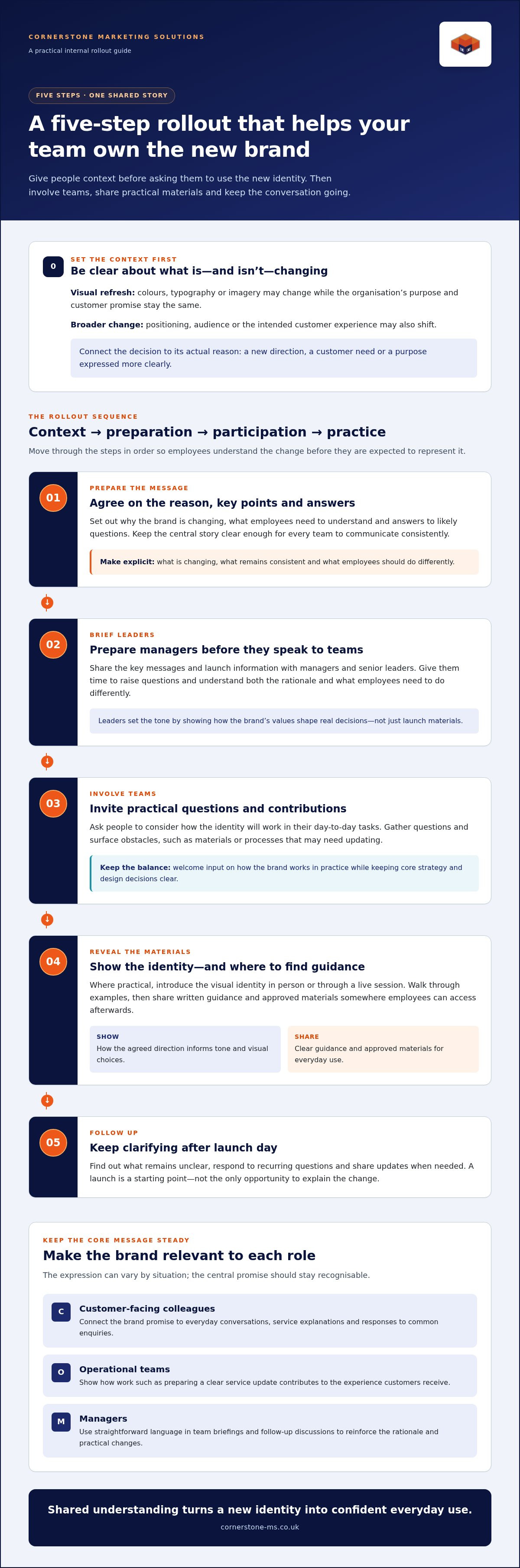
Prepare the message, brief leaders, involve teams, reveal the materials and follow up. This sequence gives employees context before asking them to put the new brand into practice.
- Prepare the message. Agree on the reason for the change, the key points everyone needs to understand and answers to likely questions. Keep the central story clear enough for each team to communicate consistently.
- Brief leaders. Give managers and senior leaders the key messages and launch information, and time to raise questions before they speak to their teams. They should understand both the rationale and what employees need to do differently.
- Involve teams. Invite people to consider how the identity will work in their day-to-day tasks. Ask for practical questions and flag obstacles, such as materials or processes that may need updating.
- Reveal the materials. Where practical, introduce the visual identity in person or through a live session. Walk through examples, then share written guidance and approved materials in a place employees can access afterwards.
- Follow up. Find out what remains unclear, respond to recurring questions and share updates when needed. A launch is a starting point, not the only opportunity to explain the change.
How to tailor the brand story to different roles
Keep the brand’s core message steady, then show how each team brings it to life. Customer-facing staff can explore how the brand promise should shape everyday conversations and responses to common enquiries. Operational teams can connect their work, such as preparing a clear service update, to the experience customers receive. Managers need straightforward language for team briefings and follow-up discussions. These role-specific examples make the story relevant without creating competing versions of it.
How leaders can make the launch feel credible
Leaders should explain the rationale in their own words while keeping the agreed messages aligned. A memorised script can sound distant; a clear explanation that reflects genuine understanding is more convincing. Their actions matter too. If the new identity is built around openness, for instance, leaders should make room for honest questions and respond plainly rather than dismissing concerns. Invite discussion during the launch and provide a route for people to raise questions afterwards. This turns communication into a conversation, not just an announcement.
For teams preparing the visual materials that support a launch, branding and design support can help carry the identity across relevant touchpoints.
How to involve employees without turning the rebrand into a popularity contest
Set that boundary early. Explain which elements are settled, such as the positioning or approved visual identity, and where staff can influence how the change is put into practice. That might include identifying unclear guidance, suggesting realistic examples or flagging materials teams need to do their jobs. When people know what’s open for input, participation feels useful rather than like a design contest with an undisclosed outcome.
Make it easy to contribute in different ways. Some employees will speak up in a group discussion; others may prefer a short feedback form or a chance to share a specific scenario with their manager. Ask teams to review a draft customer response, test whether the key message makes sense in a routine update or point out where old materials could cause confusion. Keep the questions focused on practical use.
Which parts of the new branding should employees help shape?
Employees can help test how brand principles translate into customer conversations, internal updates and everyday decisions. Their experience may reveal that a phrase is unclear, a template is hard to use or an existing workflow makes the rollout difficult. Keep strategic positioning and final identity choices with the accountable decision-makers, while using staff insight to improve how the agreed brand works in real situations.
To keep the process clear, tell employees how feedback will be handled. Explain that comments will be grouped by theme, reviewed by the relevant decision-makers and used to refine guidance where appropriate. Close the loop by sharing what changed and why. If a suggestion won’t be adopted, explain the reason respectfully. Silence can make participation feel tokenistic; a clear response shows that input was considered, even when it doesn’t change the decision.
How to respond when employees are sceptical
Scepticism often points to a practical concern. An employee may be worried about extra workload, how customers will react or what the change means for their role. Listen first, then respond with the rationale and relevant information. Clarify what can still be adjusted, such as examples or rollout support, and what has already been decided. Don’t treat disagreement as disloyalty.
Useful participation can help answer the question of how to get my team excited about our new branding without handing over every decision. When people can see where their experience matters, understand the limits of their influence and hear what happened to their feedback, they’re better placed to use the new identity with confidence.
How to turn a branding launch into confident day-to-day use
A successful launch needs to leave employees with more than a presentation. They need approved materials they can find, clear guidance for using them and a straightforward way to get help when a new situation comes up. Build these practical supports into the rollout so staff can apply the identity as part of their normal work, rather than treating it as a one-off campaign.
Accessible guidance shows employees what to use, while regular reinforcement helps them apply the brand consistently in everyday work.
Use this checklist to make the essentials clear:
- Provide current logos, visual references and approved templates, and identify where staff can access them.
- Share the core messages and a concise summary of the brand’s tone of voice, with examples of language that fits.
- Explain how to handle common situations, such as answering a customer question or writing an internal update.
- Make it clear which materials are approved and how employees can raise a question about using them.
What to include in an employee-friendly brand toolkit
Keep the toolkit easy to navigate. A staff member preparing a presentation should be able to find the correct template without searching through old emails or guessing which logo is current. Pair each guideline with an example: show a phrase that sounds clear and helpful alongside one that doesn’t match the agreed tone. Short, role-relevant notes can then show how the same principles apply in customer emails, service updates or team communications.
Avoid asking employees to memorise a long document. Give each role the information it needs for regular tasks, while keeping the complete reference available for less common questions. The goal is useful guidance at the point of use, not a test of who remembers the brand manual.
How to maintain momentum after launch day
Keep the brand present in normal team routines. Managers can use a regular meeting or internal update to answer recurring questions, highlight an example of the identity being applied naturally and clarify guidance that has caused confusion. Recognition should focus on behaviour, such as communicating clearly or applying an agreed principle, rather than simply praising people for using new colours or graphics.
Ask employees which resources are easy to use and where they still encounter friction. If staff keep asking where to find a template, improve how it’s organised; if a phrase causes uncertainty, add a practical example. Review the guidance as implementation needs emerge, and make updates visible so people know which version to use. This ongoing support helps turn the answer to “how to get my team excited about our new branding” into a dependable routine, not just launch-day enthusiasm.
For support putting a new identity into use across materials from stationery to large-scale vinyl printing, explore Cornerstone’s Graphic Design service.
How Cornerstone can help bring a new brand to life across touchpoints
Employees are more likely to use a new identity confidently when it appears consistently in the materials they work with every day. A clear visual system and aligned written content make approved brand assets easier to recognise, whether someone is preparing stationery, sharing a social media post or updating a web page. Once your team understands the purpose behind the change, coordinated materials can help turn that shared understanding into practical use.
Cornerstone Marketing Solutions provides Graphic Design, including branding services across items such as stationery and large-scale vinyl printing. These materials can express your agreed identity across relevant touchpoints, giving staff a clearer reference when choosing and using branded items in their own work.
How branding and design support everyday adoption
Stationery, vehicle graphics, and other physical materials make the identity tangible in routine tasks. For teams that operate on the road, seeing the rebrand brought to life by vehicle branding specialists such as Yeahgor Commercial Wraps & Decals makes the new look immediate and builds real pride. A consistent look across approved documents and everyday assets helps employees recognise which materials reflect the new brand and use them with greater confidence.
For organisations working through the thinking behind a rebrand, Cornerstone’s North East branding strategy guide offers related context. The useful starting point is a clear direction: once the organisation knows what the identity needs to communicate, its design materials can express that direction consistently in practical settings.
How to carry the identity into digital content
The same identity needs to carry through digital channels. Social media content can use the agreed visual style and tone, helping employees recognise how the brand should appear in posts as well as other communications. A mobile-friendly website provides another important place to express the identity, giving staff and customers a consistent experience across screens.
Photography and video can also bring the brand’s message to life. Cornerstone creates professional 4K video footage and high-definition images, which can support relevant content across digital touchpoints. Used alongside consistent design and social media content, these assets can help employees see how the identity works beyond a logo, and give them examples to refer to when creating or sharing communications.
Building enthusiasm is not about asking staff to adopt a set of visuals without context. It’s about helping them understand the brand, giving them clear materials to work with and making the identity recognisable across the places they encounter it. If you’re considering how to get my team excited about our new branding, coordinated design and content can support the practical work of putting that identity into use. Explore Cornerstone’s branding and design support as a next step.
Make your new brand part of how your team works
Brand enthusiasm grows through use. Give employees room to make the identity their own in appropriate ways, while keeping its purpose and principles as a shared reference. As your team applies the brand, notice what feels clear, where people need more guidance and which examples could help others. That steady learning can keep the change relevant well beyond its launch.
If you’re still considering how to get my team excited about our new branding, focus on making the next step practical: connect the identity to the materials and communications employees use every day. Cornerstone Marketing Solutions is a digital marketing agency based in Stockton-on-Tees, serving businesses in the North East with Graphic Design, social media management, web design and video content.
Explore Cornerstone’s Graphic Design and branding support to discuss how coordinated creative materials can help your team put its new identity into practice. With a clear purpose and useful tools, your people can help the brand take root in everyday work.
Frequently Asked Questions
How do you introduce a new brand to employees?
Introduce the brand with a clear explanation of what it means for employees’ work, not just a display of the new visuals. A short briefing can explain the change, then invite questions about practical details such as customer enquiries, document updates or team communications. Share a written reference afterwards so staff can revisit the key points. Managers can use it to keep follow-up conversations aligned across departments.
How can I get employees to buy into a rebrand?
Build buy-in by showing employees how the rebrand relates to the organisation’s direction and giving them meaningful ways to shape its implementation. If you’re asking how to get my team excited about our new branding, focus on practical ownership: ask staff to test a sample customer message or identify where new materials are needed. Explain what their feedback influenced, and be clear about decisions that remain with leadership.
What should an internal rebrand launch include?
An internal launch should give employees the information and access they need to act on the change. Alongside the rationale and identity overview, clarify when new materials take effect, who owns updates and how staff can find the current versions. Prepare answers to likely customer questions, too. For example, give front-line colleagues a concise response for someone who notices a changed email signature or website design and asks what’s new.
How do you handle employees who are resistant to a rebrand?
Start by asking what’s behind the resistance, then address the concern rather than labelling the employee as negative. A colleague worried about workload may need clarity on which materials they must update; someone concerned about customer reaction may benefit from a clear explanation of the change. If you don’t yet have an answer, say so and follow up. Distinguish concerns that can improve implementation from decisions that are already settled.
How can a small business involve its team in rebranding?
A small business can involve its team through focused conversations rather than a formal committee. Ask staff to review a draft service description, identify customer questions they hear often or point out where the identity needs to appear in daily work. In a North East business, for instance, employees who speak directly with local customers may spot wording that feels less clear than the language people use in real conversations.
How do you measure whether employees have adopted a new brand?
Look for evidence in everyday behaviour, not just attendance at the launch. Check whether teams are using current templates, applying the agreed tone in customer communications and describing the brand’s central message consistently. You can also ask short, specific questions in team check-ins, such as whether staff know where to find approved materials. Review these signals over time and use gaps to decide what guidance or support to improve.
How long does it take for a team to get used to new branding?
There isn’t a fixed timeline for every team. Familiarity depends on how often employees use the new materials, how much the identity changes and whether guidance is easy to access. A team that regularly creates customer communications may build confidence through frequent use, while others may need more reminders. Rather than setting an arbitrary deadline, look for steady, accurate use and check whether staff can explain the brand in their own words.