


Clear evidence is more persuasive than louder promotion. If you’re searching for “marketing for life sciences companies newcastle”, you’re likely looking for ways to explain complex work clearly and reach the people who need to understand it. That takes more than simplifying the science. It means communicating accurately, showing what the work does and does not demonstrate, and giving each audience a relevant next step.
Marketing can be difficult to prioritise. Too much technical detail can obscure the value; broad claims can weaken credibility; and scattered activity can consume time without supporting business goals. A considered approach starts with the evidence and the audience, then selects channels that fit the objective and the team’s capacity.
This guide explains how to shape clear, credible messages, choose activity around your objectives and build a consistent presence in Newcastle and the wider North East. It also shows how web design, SEO, social media, email, video and paid advertising can support that work as coordinated options. The aim is practical: make your expertise easier to understand without overstating what it proves.
Key Takeaways
- Shape life sciences messaging around the audience, purpose and evidence. Keep the core proposition clear before adding technical detail.
- Marketing for life sciences companies Newcastle is strongest when channel choices reflect audience needs and business objectives, rather than trends alone.
- Build a practical plan by setting objectives, assigning publishing responsibilities and reviewing measures that connect to business goals.
- Use social media, SEO, websites, email and video as complementary options, with each channel serving a clear role.
- A tailored approach can bring marketing activity into a more consistent presence across Newcastle and the wider North East.
Why life sciences marketing in Newcastle needs more than visibility
Life sciences organisations communicate with people who have different knowledge, responsibilities and priorities. A researcher may want to understand a method; a clinician may need to know how a product fits a practical setting; an investor may be looking for a clear account of its potential and development stage. Marketing needs to make the work understandable without blurring what the evidence supports.
Life sciences marketing is the planned communication of an organisation’s research, products or services to build awareness, improve understanding and support business objectives. For anyone searching “marketing for life sciences companies newcastle”, visibility alone is not enough to explain value or help an audience decide what to do next. Sector visibility gets an organisation noticed; useful marketing gives each audience a clear, evidence-led reason to pay attention.
Which life sciences organisations need a distinct marketing approach?
Different organisations need different explanations. A biotech company may need to describe the purpose and potential of its research, while a medtech firm may focus on how a device addresses a practical need. Diagnostics organisations may explain what a test is designed to identify; pharmaceutical businesses may communicate research or manufacturing capabilities. A university spin-out may need to introduce both its scientific foundation and its emerging commercial proposition. For a grounding in the field, see Biotechnology.
These examples are not interchangeable. The audience, available evidence and business stage all affect what can be said credibly. Early research may call for a careful explanation of the problem being investigated, while an established service may need to make its role and relevance clear. Start with the organisation’s actual work, then give each audience the context it needs.
What makes Newcastle relevant to life sciences communication?
Newcastle offers a recognisable setting for explaining innovation and research. Newcastle Helix is a 24-acre innovation district, with facilities including The Biosphere and the National Innovation Centres for Ageing and Data. Newcastle University is another prominent local institution. Mentioning these places can provide useful context, but it should not imply a partnership or endorsement where none exists.
Local relevance can also support a wider regional story. Life sciences work may matter to audiences across Newcastle and the North East, not only those based in the city centre. Explain where your organisation operates, what it contributes and who it serves to connect local identity with regional reach. The aim is not to claim a place in every part of the ecosystem, but to describe the organisation’s own role accurately and consistently.
How Newcastle life sciences companies can explain complex work clearly
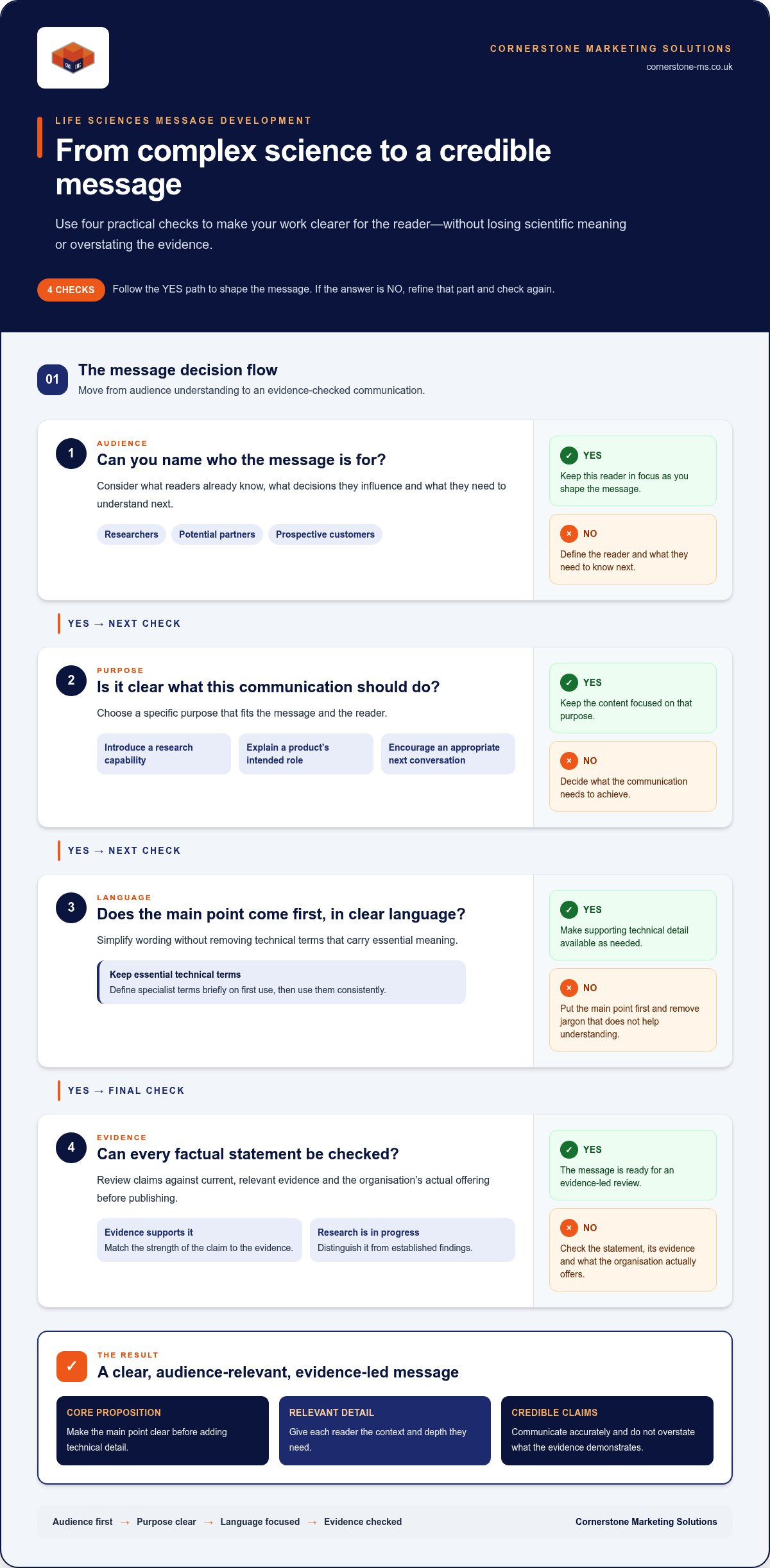
Clear communication does not mean removing the science. It means helping each reader understand the point that matters to them, then making supporting detail available at the right time. A practical message-development process helps keep communications accurate and focused, whether you’re explaining research, a product or a specialist service.
- Identify the audience. Consider what readers already know, what decisions they influence and what they need to understand next. Researchers, potential partners and prospective customers may ask different questions about the same work.
- Clarify the purpose. Decide what the communication should do, such as introduce a research capability, explain a product’s intended role or encourage an appropriate next conversation.
- Simplify the language. Put the main point first. Replace unnecessary jargon with familiar words, while keeping technical terms that carry essential meaning.
- Review the evidence. Check each factual statement against current, relevant evidence and the organisation’s actual offering before publishing.
This sequence is useful for marketing for life sciences companies Newcastle because it creates a consistent foundation without forcing every organisation into the same message. The Invest Newcastle overview of Health and Life Sciences in Newcastle can help teams understand local sector context, but each organisation still needs to explain its own work and relevance.
How do you make technical messages accessible without oversimplifying?
Start with the reader’s question. A researcher might need a precise account of a method, while a potential partner may first need to understand the problem the work addresses. Give each audience a clear core proposition, then provide technical detail as readers need it. This keeps an introduction focused while making the depth behind it available.
Retain the scientific meaning; remove jargon that does not help the reader understand it. Define specialist terms briefly on first use, then use them consistently. A simple analogy or hypothetical example can clarify an unfamiliar process, but label it as an illustration. Do not present it as proof of clinical performance or commercial results.
How should life sciences teams review claims and evidence?
Match the strength of every claim to the evidence behind it. Distinguish established findings from research in progress, and describe products or services in line with what the organisation actually offers. Before publishing technical or product-related content, assign a subject-matter expert to review the wording, supporting material and context.
For regulated claims, check current UK rules and relevant sector guidance before publication. Requirements can depend on the product, claim and communication, so avoid relying on old copy or broad assumptions. Keep a clear record of the evidence and review decisions behind important statements. This makes later updates more consistent.
For teams aligning messages across web, social and email, North East marketing support can bring content planning and communication channels together around defined business goals.
Choosing marketing channels for a life sciences company in Newcastle
Choose channels by the job they need to do, not because they are popular. Consider who you need to reach, what you want them to understand or do, what content you can reliably produce and how you will assess progress. For marketing for life sciences companies Newcastle, this keeps resources focused on channels with a defined purpose.
LinkedIn can support professional communication, such as sharing research updates, introducing expertise or reaching industry audiences. But it is not a complete strategy by itself. A prospective customer may need a detailed website page, while an existing contact may find a focused email more useful. Match the channel to the audience and the next step you want to support.
| Channel | Useful for | Content and measurement considerations |
|---|---|---|
| Social media | Maintaining a consistent presence and sharing timely updates with relevant communities. | Plan accurate, audience-appropriate posts; review reach and engagement alongside the objective. |
| SEO | Helping people find useful information when they search for relevant topics. | Develop clear, well-structured content; monitor relevant search visibility and visits. |
| Website | Providing a dependable destination for fuller explanations and next steps. | Organise information around visitor needs; assess engagement with key pages and enquiries. |
| Sharing relevant updates with people who have opted to receive them. | Use focused messages; consider opens and clicks in relation to the communication goal. | |
| Video | Showing processes, people or ideas where a visual explanation helps. | Keep the format suitable for the subject; review viewing behaviour and onward actions. |
When can social media support life sciences marketing?
Planned social posts can keep an organisation’s work visible between major announcements and provide a consistent route for sharing useful updates. Choose platforms and formats based on audience habits and communication aims, rather than posting everywhere by default. Comments and shares indicate interaction with content; they do not prove sales, clinical impact or research outcomes. A social media management guide for Teesside offers further context for planning consistent activity.
How do websites, SEO, email and video work together?
Use the website as the central destination for detailed explanations, supporting information and clear next steps. SEO helps relevant audiences discover that information through search. Email can bring useful updates directly to opted-in contacts, while video can make a process or concept easier to follow when visuals add clarity. Connect the channels where it makes sense: a post or email can direct readers to a fuller website resource.
Review performance against each channel’s purpose. Reach and clicks help show whether content is being seen; meaningful progress depends on the objective, such as relevant enquiries or engagement with a key resource. Cornerstone Marketing Solutions can coordinate social media management, SEO, web design, email marketing and videography into a tailored approach informed by data and business priorities.
Building a measurable Newcastle life sciences marketing plan
A workable marketing plan connects business priorities to specific audiences, content and measures. For marketing for life sciences companies Newcastle, this helps teams use their time carefully and understand whether communication is reaching the people it is intended to serve. Start with a defined objective, such as improving awareness of a research capability or generating relevant enquiries about a service.
Turn that objective into a practical plan:
- Set the objective. State what the organisation wants to achieve and by when. Make it specific enough to guide decisions, rather than relying on a broad aim such as “grow our presence”.
- Define the audience. Identify the people the communication should reach and what they need to know or do.
- Choose priorities. Select the channels and content that fit the audience, objective and available resources. If organic search supports the goal, a North East local SEO strategy can help frame discoverability around relevant searches.
- Assign responsibilities. Name who prepares content, reviews technical details, approves claims and publishes each item.
- Review and refine. Compare results with the starting point, capture what the team learns and adjust the next period’s priorities.
Which marketing measures should teams define first?
Choose measures that reflect the objective instead of collecting every available metric. Visibility measures, such as reach or search impressions, indicate exposure. Interaction measures, such as comments or clicks, show responses to content. Website behaviour can show whether visitors explore key information, while qualified enquiries may indicate progress towards a defined business goal.
These measures are not interchangeable. A rise in social engagement does not, by itself, demonstrate sales or research impact. Establish a baseline before judging change, noting the period, channel and relevant activity so comparisons are meaningful. Agree a review rhythm that fits your publishing cycle. A regular monthly review, for example, can help teams spot patterns and adjust plans without treating every short-term fluctuation as a trend.
How can a Newcastle team keep marketing consistent?
Consistency depends on clear ownership and a realistic publishing plan. Set out who supplies source material, who checks technical accuracy, who approves the final content and who schedules it. Build topics around genuine research, product or organisational milestones, while leaving room to respond when priorities change. This creates a dependable process without requiring a constant stream of new announcements.
Regional relevance should come from the organisation’s real location, work and audiences. Explain why Newcastle or the wider North East matters to your activity, but do not imply local partnerships or endorsements that do not exist. Keep an evidence trail for published claims and revisit content when the underlying information changes.
For a tailored plan that connects objectives, content and measurement, explore Cornerstone’s marketing support for businesses across the North East.
Working with a North East marketing partner for life sciences growth
Coordinating marketing activity can be challenging when specialist teams are focused on research, product development or service delivery. A North East partner can organise communications around business objectives, audience needs and available resources, bringing selected channels together rather than treating each as a separate task. For organisations considering marketing for life sciences companies Newcastle, the priority is a practical approach that communicates clearly and supports defined goals without overstating results.
Cornerstone Marketing Solutions is based in Stockton-on-Tees and serves businesses across the Tees Valley and wider North East, including Newcastle. Its marketing services include social media management, web design, SEO, email marketing, videography, photography, branding and graphic design. The right mix depends on what the organisation needs to communicate. A business seeking clearer online explanations might prioritise its website; another may need a consistent social presence or visual content to support its communications.
What does a tailored marketing partnership look like?
A tailored partnership begins with objectives, not a preset collection of channels. The team can identify activities that fit the organisation’s audience, content capacity and business priorities. Creative work, such as video or graphic design, can help present information in an accessible format, while data-informed decisions can guide review and refinement. Each organisation retains responsibility for the accuracy and approval of its specialist claims.
Coordination helps create continuity. A website page can provide fuller information, while social posts direct relevant audiences to that resource. SEO can support discoverability, and email can share updates with appropriate contacts. These channels are options, not requirements for every organisation. Review their purpose and contribution against the goals they were selected to support, without assuming guaranteed results or sector-specific outcomes.
What should the first planning conversation establish?
Begin by clarifying who the organisation needs to reach, what those audiences need to understand and which business outcomes matter. Review current communications, including the website and existing content, to identify what is useful and where explanations could be clearer. Then establish what subject-matter expertise is available internally, who will review technical content and what time or resources the team can commit.
Agreeing these foundations makes planning more focused. It helps define suitable topics, channels, publishing responsibilities and a sensible way to review progress. The plan should reflect genuine organisational milestones and regional context, while avoiding unverified claims about local partnerships or endorsements. Cornerstone’s Stockton-on-Tees base provides a North East perspective, with services supporting businesses across the region.
To discuss how coordinated marketing could support your objectives, Discuss a tailored North East marketing approach.
Make your next marketing step clear and achievable
Growth rarely begins by doing everything at once. It starts with one defined communication priority, a clear owner and a practical way to assess progress. For marketing for life sciences companies newcastle, that could mean making key information easier to find, clarifying a central message or building a more consistent publishing routine. Choose a starting point your team can sustain, then review what changes.
Make space to learn. Pay attention to the questions audiences ask, where they need more explanation and which content helps them take a relevant next step. Use those observations to refine your approach while keeping scientific meaning and evidence at its core. Steady, considered improvements can give your marketing a stronger foundation over time.
Cornerstone Marketing Solutions can help shape a tailored approach using social media management, web design, SEO and content services. Discuss a tailored marketing approach for your life sciences company and take a considered next step towards clearer communication and sustainable progress.
Frequently Asked Questions
Does a life sciences company in Newcastle need a specialist marketing strategy?
It needs a strategy suited to its science, audiences and business objectives, but not necessarily a large programme or every marketing channel. For marketing for life sciences companies Newcastle, begin with a specific communication challenge, such as helping potential partners understand a capability or making a service easier to find. Use regional context where it adds meaning, while keeping the message relevant to audiences outside Newcastle.
How can life sciences companies explain complex science to non-specialists?
Start with the question the reader is trying to answer, then explain the central idea in plain language. For example, use a short introductory summary before a detailed technical page, so readers can choose how much information they need. Define essential specialist terms and use them consistently. Have a subject-matter expert review the final wording, and distinguish illustrative examples from evidence of clinical or commercial outcomes.
Is LinkedIn the best social media platform for a Newcastle life sciences company?
Not automatically. LinkedIn may suit professional updates, recruitment or conversations with industry audiences, but another platform may better fit a different audience or content format. Consider where the intended readers are active and what they need from each communication. A team could trial a small number of relevant posts, then review the quality of responses and whether readers take useful next steps, rather than judging success by activity alone.
How much marketing content should a life sciences company publish?
Publish at a pace the team can sustain while maintaining accuracy and usefulness. A monthly research update may suit one organisation, while another may have fewer shareable milestones and focus on evergreen website information. Map topics to available subject expertise and approval capacity before setting a schedule. If reviews cause delays, reduce the planned cadence or prepare content earlier rather than publishing material before it is ready.
What should a life sciences marketing plan measure?
Choose measures that fit each activity’s purpose. If a page aims to help people find a service, monitor relevant search visibility and visits to that page. If the goal is commercial, agree what makes an enquiry qualified and record how it arrived. Compare results with a baseline and review them consistently. A single rise in clicks or engagement should not be treated as proof of business growth or scientific impact.
Can a marketing agency help a Newcastle life sciences company with social media and SEO?
Yes. Social media management can support planned updates and audience communication, while SEO can help people discover useful website content through relevant searches. The best role for each depends on the organisation’s goals and capacity to supply and review content. Cornerstone Marketing Solutions provides these services alongside web design and content services for businesses across the North East, using a tailored approach rather than a fixed channel plan.