


What if the strongest case for marketing spend isn’t a promise of instant sales, but a plan you and your partner can test together? If you’re working out how to justify marketing spend to my business partner, start with what you both want the business to achieve, then show how the proposed investment will support that goal.
Your caution is reasonable. Marketing activity doesn’t always lead directly or immediately to a sale, and clicks or impressions alone don’t explain its wider value. A clear case recognises that uncertainty and makes the risks, priorities and measures visible to both partners.
Build your proposal around shared business goals, evidence you already have, realistic alternatives and an agreed review plan. Choose indicators that connect marketing activity to business progress, set a time to assess results and decide what you’ll adjust if performance falls short. That turns the conversation from a request to spend on faith into a measured plan for investing, learning and deciding together.
Key Takeaways
- Begin with the business outcome you both want, so the discussion centres on shared priorities rather than the size of the budget.
- To show how to justify marketing spend to my business partner, build a concise case around existing evidence, clear measures and an agreed review date.
- Compare the proposal fairly with maintaining current activity, doing the work internally or reallocating effort.
- Present assumptions and trade-offs openly, then invite questions before seeking agreement.
- Turn approval into accountable delivery with clear ownership, consistent activity and performance reporting.
Start with the Business Goal, Not the Marketing Budget
You and your business partner may want the same thing: a stronger, more resilient business. You may assess the risk of spending differently. One partner might see marketing as necessary to reach new customers; the other may be weighing cash flow, timing or whether current activity is working. Start with that difference, not with a request for a particular budget.
Define the decision in business terms. Are you trying to generate more qualified enquiries, encourage repeat purchases or build visibility with a particular market? Explain how the proposed activity is intended to address that need. Keep the components distinct: the investment requested, the activity it funds, the audience it targets, the timeframe and the evidence you’ll review. This makes it easier to discuss the plan itself, rather than treating the budget as a yes-or-no test of confidence in marketing.
A marketing business case is a goal-linked investment proposal with measurable criteria for reviewing progress and deciding what happens next.
Agree what the business needs marketing to achieve
Choose a priority you both recognise, then connect it to a customer or commercial challenge. For example, if suitable prospects aren’t finding your business, activity aimed at a defined audience could support a goal of increasing qualified enquiries. Be precise about what “qualified” means for your business, such as an enquiry that matches your service and target customer.
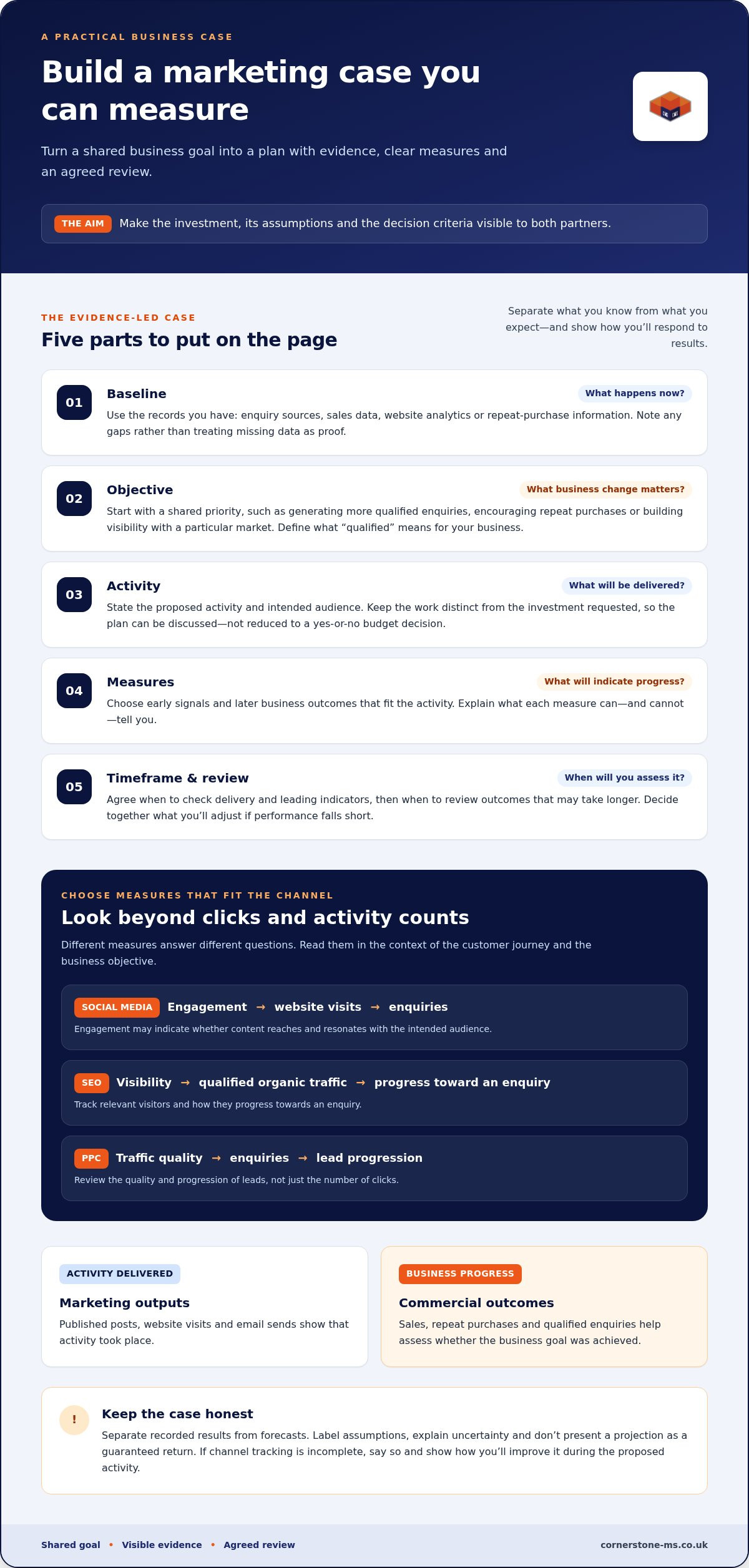
Separate the outcome from the work produced. Sales, repeat purchases and qualified enquiries are business outcomes. Published posts, website visits and email sends are marketing outputs. Outputs show that activity took place, but don’t prove by themselves that the business goal was achieved. Agree which outputs may indicate progress and which business measures will inform the decision.
Understand your partner’s main concern
Ask directly what makes the proposal difficult to support. Is the concern affordability, timing, uncertainty about results or another priority competing for resources? Listen before defending the plan. A concern about cash flow or risk is part of responsible decision-making, not necessarily opposition to growth.
Then agree what evidence would make the investment responsible for both of you. That might include a current baseline, a defined audience, a review date and a clear way to record relevant enquiries or sales. If there are gaps in the data, state them and label estimates as assumptions. This gives you a more honest starting point than presenting forecasts as certain returns.
If you discuss financial impact, explain what you can and can’t attribute to marketing. Return on Marketing Investment (ROMI) provides a framework for considering marketing’s contribution, but a single measure may not capture every influence on a customer’s decision. The practical question of how to justify marketing spend to my business partner is best answered with a shared goal, transparent assumptions and review criteria you both accept.
Build an Evidence-Led Case for Marketing Investment
A useful case turns the business goal into a plan that can be reviewed, not a forecast presented as a promise. Set out the current baseline, objective, proposed activity, measures, timeframe and review date. If you’re considering how to justify marketing spend to my business partner, this structure shows what you know, what you expect and how you’ll respond to the evidence.
Use existing records where possible, such as enquiry sources, sales data, website analytics or repeat-purchase information. Then identify gaps. If your records don’t show which channels generated enquiries, say so and explain how you’ll improve tracking during the proposed activity. Keep assumptions separate from confirmed historical results.
- Baseline: What happens now, based on the data available?
- Objective: What change would support the business goal?
- Activity: What will be delivered, and for which audience?
- Measures: What early signals and later outcomes will you assess?
- Timeframe and review: When will you check delivery and decide what to change?
Choose measures that connect activity with business outcomes
Choose measures that fit the channel and objective. For social media, relevant engagement may indicate whether content is reaching and resonating with the intended audience; website visits and enquiries add further context. For SEO, track visibility and qualified organic traffic alongside how relevant visitors progress towards an enquiry. For PPC, review traffic quality, enquiries and lead progression, not just clicks. Each measure answers a different question, so interpret it as part of the customer journey.
Measurable marketing activity shows what was delivered; attributable business impact shows how confidently that activity can be linked to a commercial result. For a fuller discussion of balancing evidence and business impact, see Harvard Business Review’s Building a Business Case for Marketing.
State assumptions and set realistic review points
Distinguish a forecast from a result already recorded. If you expect a campaign to increase enquiries, show the evidence behind that estimate and label assumptions, such as expected audience response or conversion rates. Don’t present a projection as a guaranteed return. A transparent case helps both partners judge the proposal on its actual evidence and uncertainty.
Agree an early review for delivery and leading indicators, then later reviews for outcomes that may take longer to emerge. Early checks can confirm whether planned activity ran and whether the intended audience engaged. Later checks can assess qualified enquiries, sales or repeat business. Set dates that suit the activity and sales cycle rather than judging every channel on the same timetable.
Attribution has limits. A customer may discover a business through search, return via social media and enquire after a conversation. Record what you can, note where the journey is unclear, and avoid assigning the full result to one touchpoint without evidence. Consistent reporting can make these distinctions easier to discuss. Data-informed marketing support can help turn an agreed plan into structured activity and reporting.
Compare the Proposed Spend with Realistic Alternatives
A proposal is easier to assess when it sits alongside other credible choices. Compare it with keeping current activity as it is, managing the work internally or reallocating existing time and budget. This helps you and your partner discuss trade-offs rather than treating the proposal as the only route to progress. Use the same criteria for each option: fit with the business goal, resources required, ability to measure progress, delivery capacity and uncertainty.
For example, if the shared aim is to improve the quality of enquiries, compare what each route would involve and how you would judge whether it is working. Doing nothing may preserve resources for now, but could leave the customer challenge unaddressed. That doesn’t mean inaction guarantees lost revenue. It means delay also has a cost to consider, such as postponing learning or leaving an operational gap in place.
Assess channels against the same decision criteria
Compare channels only when they support the agreed objective. Social media may suit an audience that needs regular engagement and useful content; SEO can support visibility in relevant searches, while PPC can put targeted activity in front of searchers. Web design may be more relevant if the site makes it difficult for visitors to understand an offer or enquire. No channel is universally superior, and each needs a suitable measure and review period.
Consider the work as well as the channel. Who will plan, create, publish and monitor activity? What existing capacity will it use? For social media, consistent planning, content, community management and reporting all form part of delivery. This social media management guide for Teesside businesses explains the practical commitment involved in that type of channel activity.
- Business fit: Does the option address the specific customer or commercial challenge?
- Resources: What staff time, skills and budget will it require?
- Measurement: What evidence can you collect, and what will it show?
- Capacity: Can the work be delivered consistently alongside existing responsibilities?
- Uncertainty: What remains unknown, and how will you learn more?
Consider a staged investment instead of an all-or-nothing decision
If neither partner is ready to commit to a broad programme, define a first phase with a clear scope. Agree the initial activity, who owns each task, which early indicators to monitor and when you’ll review them. Set decision conditions in advance: continue if delivery is consistent and evidence supports the objective, adjust if the activity or audience needs refining, or pause if agreed criteria aren’t being met.
Staging limits the commitment without making the plan directionless. It also gives you a fair basis for comparing the proposal with alternatives: each route has defined responsibilities, measures and review points. That structure makes how to justify marketing spend to my business partner a practical conversation about which option best fits your shared goal and capacity, rather than a debate over whether marketing is worthwhile in general.
Present the Proposal and Address Your Partner’s Concerns
A clear proposal makes the discussion easier to follow and gives both partners something specific to assess. Keep the main case to one page, with supporting detail available if questions arise. Include the business goal, intended audience, proposed activity, evidence behind the recommendation, assumptions and review date. If organic visibility is part of the plan, explain how it supports the goal and what progress you’ll monitor. For a North East business, local SEO can be relevant when customers use local searches to find providers.
State your recommendation and its trade-offs plainly. Explain why you favour this option, what it requires from the business and what it won’t address. Then pause. Invite your partner to question the reasoning before you ask for agreement. The aim isn’t to win a debate; it’s to reach a decision you can both explain and review.
Respond to common questions about cost, timing, and proof
If affordability is the concern, show the agreed scope and how the spend will be monitored. If timing is the issue, distinguish early delivery signals from outcomes that may take longer to emerge. If your partner wants proof, separate recorded results from estimates and agree what the proposed activity can realistically test. This is a practical way to address how to justify marketing spend to my business partner without overstating what the evidence can show.
Answer questions directly, and note any you can’t resolve in the meeting. For instance, if you don’t yet know which enquiries came from a particular channel, acknowledge the gap and propose a way to capture that information. Where organic visibility is the focus, agree what evidence will help you assess progress alongside the time needed for meaningful results. Avoid treating an early change in one measure as proof of a commercial outcome.
Turn the discussion into a shared decision
Once you’ve discussed the proposal, write down what you’ve agreed. A short record reduces the chance of different expectations later. Capture:
- Goal and scope: The intended outcome, audience and approved activity.
- Ownership: Who will deliver the work, provide input and review progress?
- Decision: Who can approve changes within the agreed scope?
- Review: When will you meet, and what evidence will inform continuation, adjustment or a pause?
Keep a brief list of unresolved questions, each with an owner and a practical next step. That might mean reviewing existing records, clarifying delivery responsibilities or agreeing how enquiries will be recorded. Turn uncertainties into actions that can be revisited at the next review, rather than leaving them as general concerns.
With a shared decision recorded, the next step is consistent delivery and clear reporting. Explore marketing support for your agreed plan to see how the work can be put into practice.
Turn an Agreed Marketing Case into Consistent Delivery
Approval is the start of the work, not the end of the decision. To protect the value of the agreed investment, assign ownership for delivery, set a reporting rhythm and make clear who can approve changes. Without those arrangements, activity can become inconsistent and partners may have different ideas about what progress should look like.
Write down the practical handover before work begins: what will be delivered, who is responsible for each part, what information the business needs to provide and when progress will be reviewed. Specialist support can help translate the agreed direction into planned activity and consistent reporting, while your team retains visibility of priorities and decisions. This turns the business case into a working plan rather than leaving it as a budget approval.
Match support to the work your business needs
Choose support according to the agreed objective, not simply because a particular channel is familiar. If regular audience engagement is a priority, social media management can bring together strategic planning, content creation and posting, community management and performance reporting. If the goal is to improve search visibility, SEO may be a closer fit. Web design, videography or PPC may also support specific objectives when the customer challenge and intended measures justify them.
Before activity starts, agree how responsibilities will be shared. Decide who supplies business information, approves content, manages customer enquiries and reviews reports. Set a reporting cadence that suits the work, and identify which changes need both partners’ agreement. Clear ownership helps activity remain coordinated and prevents routine delivery decisions from becoming points of confusion.
Make the first review part of the plan
Use the first review to compare what was delivered and what happened with the baseline and objectives you agreed. Check whether the activity reached its intended audience, whether early indicators are moving in a useful direction and whether any business outcomes can be observed. A report should explain what the evidence supports, what remains uncertain and what needs attention, rather than presenting activity counts as proof of commercial impact.
Then make a decision together. Continue if delivery is on track and the evidence remains relevant to the goal; refine the activity if the audience, message or execution needs adjusting; or redirect the investment if the original approach no longer fits the business need. Record the reasoning so the next review builds on what you’ve learned. This gives both partners a fair process for assessing the decision without expecting every marketing effect to appear immediately.
If you’re considering how to justify marketing spend to my business partner, remember that accountable delivery is part of the case: it shows how an agreed investment will be put into practice and reviewed, without promising a particular result. Cornerstone Marketing Solutions works with businesses in Stockton-on-Tees, Tees Valley and the wider North East, combining data-informed marketing with creative brand work. Discuss a tailored marketing approach with Cornerstone to explore how your business goal can guide planning, delivery and reporting.
Take the Next Step with a Shared Plan
A partner conversation can do more than approve or decline a budget. It can establish a better way to make future investment decisions: set a clear objective, agree what evidence matters and decide together how to respond when results emerge. That makes how to justify marketing spend to my business partner a question you can revisit with real learning, rather than a case you have to defend once and hope will hold.
Once you’ve agreed the direction, focus on making the next step manageable. Define the work, assign ownership and keep the review connected to the business goal. If priorities change, the plan can change with them. A measured approach gives both partners a sound basis for moving forward without assuming a particular outcome.
Cornerstone Marketing Solutions is part of the award-winning Cornerstone Group and supports businesses across the North East with social media management, web design, videography and other digital marketing services. Discuss your marketing priorities with Cornerstone Marketing Solutions and put your agreed plan into motion.
Frequently Asked Questions
How do I explain marketing ROI to my business partner?
If you’re asking how to justify marketing spend to my business partner, explain ROI in terms of contribution, not just turnover. Estimate the gross profit associated with campaign-linked sales, then compare it with the marketing investment. Be clear about how you assigned credit and whether other channels influenced those sales. If tracking is incomplete, label the figure as an estimate and agree what records would make a future calculation more dependable.
What should a marketing budget proposal include?
Include the decision your partner needs to make, what the proposed work covers and what it leaves out. Show the expected use of internal staff time as well as direct spending, since both affect capacity. Add the data sources behind your assumptions and identify who will approve changes. A brief appendix with baseline data or a campaign outline can help your partner check the reasoning without crowding the main proposal.
How can I justify marketing spend when results take time?
Set expectations around the customer’s buying journey. If a prospect typically needs time to compare options or obtain approval before buying, an early review may be too soon to judge sales impact. Check whether the planned work is reaching the intended audience and generating meaningful next steps, then assess commercial outcomes as the decision cycle progresses. Explain in advance which signals would prompt a change, rather than treating a short-term dip as a final verdict.
Which marketing metrics should I show my business partner?
Choose a small set that reflects the decision, and make each metric easy to interpret. For lead generation, you might show qualified enquiries, their source and how many progress to a conversation or sale. For online campaigns, use tagged links and consistent source recording to distinguish visits by channel. Include a quality check, such as whether enquiries match your target customer, so a rise in volume doesn’t obscure a fall in relevance.
Should a small business hire a marketing agency or manage marketing in-house?
Choose based on the skills, time and oversight your business can reliably provide. In-house work can suit a team member with the right expertise and capacity; external support may help when specialist skills or consistent delivery are difficult to maintain internally. A blended approach is also possible, with your team setting priorities and sharing customer insight while an agency handles agreed execution. North East businesses should consider which option best serves their audience and working arrangements.
How often should business partners review marketing performance?
Set a rhythm that matches the work: a short monthly check can cover delivery, emerging issues and data quality, while a less frequent strategic discussion can assess progress against commercial objectives. Treat this as a starting point, not a fixed rule. Review sooner if spending, activity or business conditions change materially. Keep each meeting focused by agreeing beforehand which decisions need to be made and who should bring the relevant information.
Can social media marketing generate measurable business results?
Yes, social media can be measured when you connect activity to meaningful customer actions. For example, use tagged links to track visits from a post, then record whether those visitors enquire or purchase. Also consider assisted influence: someone may first discover your business on social media but convert later through another channel. Engagement figures provide context, but don’t by themselves show that activity generated revenue.