


A technically accurate battery story can still leave a buyer unsure what to do next. For electrification businesses, a strong content strategy for electrification and battery tech firms must do more than explain specifications. It should connect verified product evidence to the practical questions each decision-maker needs answered.
That can be difficult because engineers, procurement teams and commercial leaders assess different risks, while B2B buying journeys often involve repeated research and evaluation. Content that focuses only on how a technology works may not explain how it addresses operational needs, supports a business case or earns a place on a shortlist.
This article sets out how to build a credible, measurable strategy that makes complex technologies easier to understand without oversimplifying them. You’ll learn how to map audience needs to useful evidence, clarify messages for technical and commercial readers, choose appropriate channels and measure content’s contribution to qualified enquiries. The result is a practical plan your team can deliver consistently, with each piece of content serving a clear purpose across the buying journey.
Key Takeaways
- Build a content strategy for electrification and battery tech firms around business priorities, audience questions, clear messaging and measurable goals.
- Use a repeatable review process to explain technical evidence in plain language while preserving its meaning and credibility.
- Choose formats and channels according to who needs the information and where they are in the buying process.
- Plan content quarterly, linking each activity to relevant indicators and commercial outcomes across the longer sales journey.
- When selecting a partner, check how they’ll learn your product, work with technical reviewers and report on delivery and performance.
Why electrification and battery tech firms need a deliberate content strategy
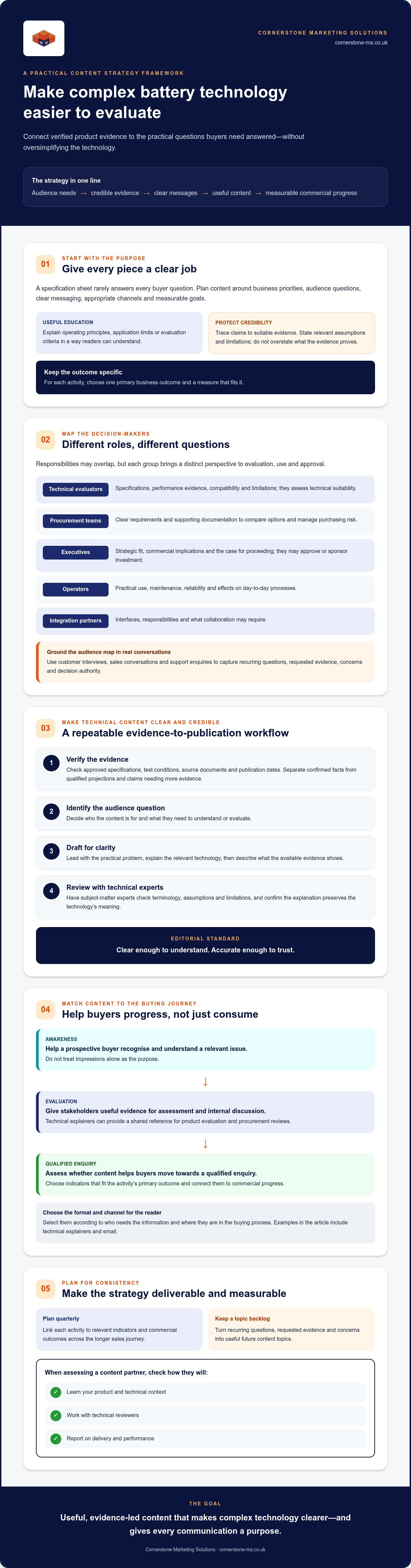
For complex products, a specification sheet rarely answers every question a buyer needs to resolve. Technical evaluators need confidence in performance and compatibility; procurement teams assess evidence and risk; executives consider commercial priorities. A deliberate content strategy connects those needs to business goals, messaging, channels and measurement, so each communication has a clear purpose.
Content strategy is the evidence-led planning of useful information that helps the right buyers understand a technology, assess its relevance and take an informed next step. This builds on the foundational idea of Content strategy, which connects content decisions with user needs and experience. For electrification and battery technology, that means making technical detail clearer without changing its meaning or overstating what the evidence proves.
Education is not the same as promotion. A useful explainer makes a system’s operating principles, application limits or evaluation criteria easier to understand. Product promotion presents an offer. Both have a role, but unsupported performance or sustainability claims can undermine trust. Make claims traceable to suitable evidence, and state relevant assumptions and limitations.
Which audiences influence electrification and battery technology purchases?
Start by mapping the people involved in evaluation, use and approval. Their responsibilities may overlap, but their questions and decision authority differ:
- Technical evaluators ask about specifications, performance evidence, compatibility and limitations. They assess technical suitability.
- Procurement teams need clear requirements and supporting documentation to compare options and manage purchasing risk.
- Executives consider strategic fit, commercial implications and the case for proceeding. They may approve or sponsor investment.
- Operators focus on practical use, maintenance, reliability and the effect on day-to-day processes.
- Potential integration partners need to understand interfaces, responsibilities and what collaboration may require.
Test this audience map against customer interviews, sales conversations and support enquiries. Record recurring questions, requested evidence, concerns and who has authority at each stage. These notes help distinguish real decision barriers from internal assumptions, and can form a useful topic backlog for future content.
What should content achieve across a complex buying journey?
Awareness content should help a prospective buyer recognise and understand a relevant issue, not simply generate impressions. As evaluation advances, technical explainers can give stakeholders a shared reference for internal discussions and procurement reviews. Clear, consistent answers also help commercial teams continue the conversation without asking each reader to start from scratch.
Give every content activity one primary business outcome. A technical explainer might support informed product evaluation; an email might bring an interested contact back to relevant evidence. Choose a measure that fits that outcome, then assess whether the content helps buyers move towards a qualified enquiry. This keeps the content strategy for electrification and battery tech firms accountable to audience needs as well as commercial progress.
How to turn complex battery technology into clear, credible content
Technical content works best when it gives readers a clear path from evidence to relevance. A repeatable editorial workflow helps writers clarify the explanation without simplifying the underlying technology. It also gives subject-matter experts a defined role before publication.
- Verify the evidence. Check approved specifications, test conditions, source documents and publication dates. Separate confirmed facts from qualified projections and claims that need more evidence.
- Identify the audience question. Decide who the content is for and what they need to understand or evaluate.
- Draft for clarity. Lead with the practical problem, explain the relevant technology, then describe what the available evidence shows.
- Review with technical experts. Ask reviewers to check terminology, assumptions and limitations, and confirm that the explanation preserves the original meaning.
- Adapt for the channel. Keep the verified message consistent while adjusting its depth and format for a website, email or social post.
For example, if a specification is measured under stated test conditions, retain that context. Don’t turn a measured result into a promise about performance in every application. Explain what the figure can help a buyer assess and what it doesn’t establish. Approved diagrams, demonstrations and interviews with subject-matter experts can make mechanisms easier to follow, provided they represent the technology accurately.
How should firms handle sustainability and performance claims?
Keep a record for every public claim, including its source, scope, comparison basis, relevant date and assumptions. A performance statement should identify the conditions it applies to. An environmental statement should make clear what is being measured and against which baseline. Avoid broad terms such as “sustainable” unless their meaning and supporting evidence are specific.
Every performance or environmental claim needs a clear source and scope. Have qualified reviewers assess claims against applicable guidance, and verify current requirements before publication. Harvard Business School’s material on the challenges facing B2B marketers offers wider context for why clear, evidence-led communication matters in business-to-business markets.
This is a practical foundation for a content strategy for electrification and battery tech firms: explain the buyer’s problem, state what the evidence supports, and make uncertainty visible rather than filling gaps with confident language. Teams coordinating website, video and social content can also explore digital marketing support from Cornerstone Marketing Solutions.
How to choose channels and formats for electrification content
Choose channels by the job they need to do, not by a desire to publish everywhere. A technical website explainer can provide a detailed reference; a LinkedIn post can bring a key insight to a professional audience; video can show a process that is difficult to picture. Email, webinars and sales enablement materials each support different conversations. The right mix depends on audience behaviour, access to technical expertise, production capacity and sales priorities.
Which formats help technical buyers evaluate a solution?
Match the format to the question. Use explainers and approved diagrams to clarify mechanisms, specifications and system context. Demonstrations or subject-matter interviews can make a process easier to understand. FAQs and comparison guides can address recurring evaluation questions. Keep the evidence consistent across formats, and give each asset a useful next step rather than asking every reader to make an immediate enquiry.
| Audience | Buying stage | Format | Distribution channel | Success measure |
|---|---|---|---|---|
| Technical evaluators | Research and evaluation | Detailed explainer, diagram or FAQ | Website, supported by LinkedIn | Relevant page engagement or return visits |
| Procurement teams | Shortlisting and review | Comparison guide or evidence summary | Website and sales follow-up | Use in qualified discussions or review activity |
| Operators | Practical assessment | Demonstration video or process interview | Website, email or webinar | Relevant questions and follow-up requests |
| Executives | Awareness and internal consideration | Concise business-focused article or presentation | LinkedIn, email or sales enablement | Engaged target accounts or progression to discussion |
How can one strong content asset support multiple channels?
Start with an expert interview about a recurring customer question. With the interviewee’s approval, turn its verified points into a website article, short LinkedIn posts, an email summary and material sales teams can share in follow-up. Keep the central evidence intact while adjusting detail, context and next step for each audience. Link social and email activity to a useful website resource, not simply to a general homepage.
Not every firm needs every channel or a high-volume schedule. For a practical content strategy for electrification and battery tech firms, prioritise formats your team can produce accurately and maintain. Check whether each channel reaches the intended audience and supports a defined sales need. If a format repeatedly uses capacity without helping buyers progress, refine it or redirect that effort to a more useful resource.
How to build a measurable content plan for long B2B sales cycles
A useful quarterly plan starts with commercial priorities, not a list of topics. Agree which audiences and buying-stage barriers matter most, then select content that can help address them. Give each activity one primary goal, such as improving discovery among technical evaluators, supporting procurement review or prompting a qualified conversation.
For each goal, pair an early indicator with a business outcome. A technical explainer might be assessed through relevant search visibility and engaged visits, then through its use in sales discussions or sales-qualified conversations. These signals show different things. They don’t prove that content alone created an enquiry, especially when buyers interact with several channels and people over time.
Activity measures show what was published and seen; evidence of commercial contribution shows whether content helped the right buyers take a meaningful next step. Views and likes can help diagnose distribution, but they’re not a substitute for qualified enquiries, useful resource engagement or sales-team feedback. Agree with sales what counts as a qualified conversation and how to record content’s role before interpreting changes in lead quality.
Which content metrics matter beyond views and likes?
Match measures to the buying journey. At discovery, review relevant reach, search visibility and engaged visits from intended audiences. During evaluation, look at resource use, return visits and whether buyers refer to material in sales-qualified conversations. Keep definitions consistent across reporting periods, and ask sales which assets helped answer objections or prepare stakeholders for a discussion.
How should teams plan content with technical experts?
Set a workable process before filling the calendar. Assign each asset an owner, a subject-matter reviewer, approval stages and a realistic publishing date. Build a backlog from customer questions, product updates and sales objections, then prioritise topics against commercial goals and the capacity of the people who must review them.
A quarterly cycle can follow four steps:
- Set priorities: agree the audience, buying-stage need and business outcome for the quarter.
- Choose content: select topics and formats that address those needs, with a named owner and reviewer.
- Publish and monitor: track agreed indicators, resource engagement and feedback from sales.
- Review and improve: retain what supports buyer progress, revise weak or unclear assets, and update material when evidence, products or audience needs change.
This keeps the content strategy for electrification and battery tech firms grounded in delivery as well as measurement. For support coordinating SEO, email marketing and social media management, contact Cornerstone Marketing Solutions.
How to select a content strategy partner for an electrification business
A suitable partner should make the work clearer, not add assumptions about your technology. Ask how they’ll learn the product, who will verify technical content and how the plan will connect audience needs with delivery and measurement. Sector experience can be useful, but it shouldn’t replace a transparent process for understanding your product and checking every claim.
What should a strong content strategy proposal include?
Look for a proposal that explains how the partner will move from discovery to delivery. It should show how they’ll research audiences, shape messages, choose channels and assess results. Check that it identifies what your technical team must review, how approvals work and what assumptions underpin the proposed activity. The plan should fit the actual availability of internal experts, rather than depend on an unrealistic flow of reviews and content.
- Discovery: How will the partner learn the product, audiences, buyer questions and commercial priorities?
- Technical review: Who checks specifications, claims and context, and when does approval happen?
- Channel planning: Why are the proposed channels suitable for your audiences and buying journey?
- Delivery: Are responsibilities, capacity and timelines clear for both teams?
- Reporting: What will be measured, how are key terms defined, and how will findings inform improvements?
Then compare delivery models. An in-house team may offer close product knowledge but have limited production capacity. A specialist agency may bring relevant sector familiarity, which you should validate against its work and process. An integrated agency can coordinate several marketing disciplines, but check that technical review and governance remain robust. Choose based on your internal capacity, approval requirements and need for joined-up delivery.
How can Cornerstone support content delivery and distribution?
Cornerstone Marketing Solutions is based in Stockton-on-Tees and serves businesses across the Tees Valley and wider North East. Its services include social media management, web design, videography and SEO. Depending on your audience and plan, these services can support social distribution, visual explanations, useful website destinations and search visibility. Consider Cornerstone as a potential delivery partner, not as a claimed battery-sector specialist.
Strong messaging also needs a consistent position, a suitable website destination and a relevant distribution plan. Related planning topics include social media management in Teesside, a North East branding strategy and North East web design.
Use your evaluation framework to discuss your needs with potential partners. Ask how their approach to the content strategy for electrification and battery tech firms will fit your technical approval process, available expertise and commercial goals before deciding on the right model.
Turn clear technical content into confident buyer decisions
A strong content strategy for electrification and battery tech firms connects verified evidence to the questions buyers need answered. Start with audience needs, explain technical detail without overstating it, then choose channels that match each stage of the buying journey. Set a clear outcome for every activity and review meaningful signals with your sales team, so content supports informed evaluation as well as visibility.
Building that approach takes consistent planning and delivery. Cornerstone Marketing Solutions is based in Stockton-on-Tees and serves businesses across the wider North East. Its services include social media management, web design, videography and SEO, which can support a coordinated content plan. Discuss your priorities and delivery needs with the team through a practical content strategy discussion.
With clear evidence, responsible messaging and a plan your team can sustain, complex technology can become easier for the right buyers to understand and assess. Start with one useful answer, then build from there.
Frequently Asked Questions
What should a content strategy for an electrification company include?
It should connect commercial priorities with audience needs, messages, channels, delivery and measurement. Identify the questions technical evaluators, procurement teams, executives and operators need answered, then map suitable content to each buying stage. Set a clear purpose and success measure for every activity, such as supporting technical evaluation or generating qualified enquiries. Include an evidence review process so product, performance and environmental claims are checked before publication.
How can battery technology companies explain complex products clearly?
Start with a practical problem the audience recognises, then explain how the relevant technology relates to it. Translate specifications into implications for use while retaining test conditions, limitations and context. Diagrams, demonstrations and interviews with subject-matter experts can clarify how a mechanism works. Ask technical reviewers to check terminology and assumptions, and distinguish confirmed results from projections. Clear explanations help buyers understand the evidence without turning it into an unsupported promise.
Which content channels work best for electrification and battery tech firms?
The best channels are those that reach the intended audience and suit the information they need. Website explainers can provide a detailed reference; LinkedIn can share concise insights; video can demonstrate a process; email can deliver relevant follow-up. Webinars may support deeper discussion, while sales materials help teams answer evaluation questions. Choose a manageable mix based on audience behaviour, available expertise and capacity, rather than trying to publish everywhere.
How can a company measure whether its technical content is working?
Set measures that reflect the content’s purpose and the buyer’s stage. For discovery, review relevant search visibility and engaged visits. For evaluation, track resource use, return visits and sales-qualified conversations. Ask sales whether prospects used the material to understand a product or prepare for internal review. Agree definitions with sales in advance, and treat views or likes as activity signals, not proof that content contributed to commercial progress.
How often should an electrification business publish content?
Publish at a pace your team can sustain while maintaining technical accuracy and useful review. There’s no single schedule that suits every business. Plan around commercial priorities, product updates and recurring customer questions, then assign owners and reviewers before setting dates. A quarterly review can help teams assess performance, refresh outdated information and adjust the schedule. Consistent, reliable content is more useful than frequent publishing that exceeds production or approval capacity.
Should an electrification firm hire a specialist agency or manage content in-house?
Choose the model that fits your expertise, capacity and approval requirements. In-house teams often have close product knowledge, while an agency can add marketing delivery capacity; a specialist’s sector experience should be checked rather than assumed. A North East business could also consider an integrated partner for services such as SEO, web design, videography and social media management. Cornerstone Marketing Solutions is based in Stockton-on-Tees and serves the wider North East, without claiming battery-sector specialism.